

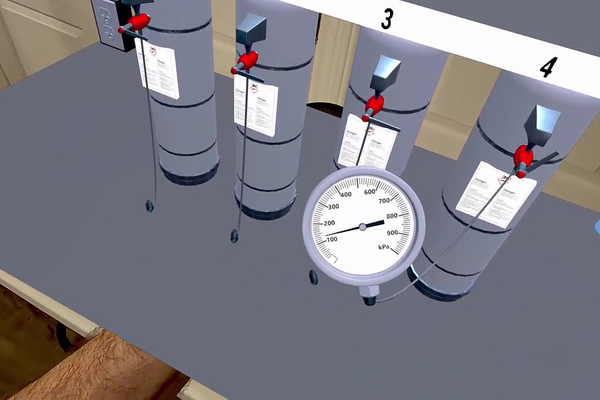
Pressure is force spread over an area, and for a gas it is the aggregate effect of countless molecules striking the walls of their container. It is one of the few properties of a gas that can be read directly off an instrument, which is why almost every practical dealing with gases begins by measuring it: a diver checking a cylinder before entering the water, a technician charging a refrigeration circuit, a nurse working from a medical oxygen regulator, a mechanic setting tyre pressures. The instrument that does the reading in almost all of these cases is the Bourdon dial gauge, patented by Eugène Bourdon in 1849 and still the standard after a hundred and seventy years.
Inside such a gauge is a flattened metal tube bent into an arc and sealed at one end. Raising the pressure inside it makes its oval cross-section rounder, and a tube whose cross-section rounds out has to become straighter, so the sealed end swings outward through a small distance. A linkage and a rack-and-pinion multiply that movement into the sweep of a needle across a dial. Nothing is measured electrically and nothing needs a power supply; the deflection of a piece of metal is doing the work. Because the outside of the tube is exposed to the room, the gauge responds to the difference between the pressure inside and atmospheric pressure outside — it reads gauge pressure, and it reads zero when it is open to the air.
In this laboratory you will measure the pressure held in four sealed gas cylinders. For each one in turn you will connect the gauge to the cylinder hose, open the cylinder valve with a touch, let the needle settle, read the dial in kilopascals, close the valve and detach the hose before moving to the next. The technique is short and the discipline is the point: connect before opening, read only once the needle has stopped, and close the valve before disconnecting anything. The readings then become the raw material for everything that follows in the gas laboratories — the pressure-volume relationship in laboratories 054 and 055, and the effect of temperature in 056.
Educational Goals
Understanding what pressure is
- Define pressure as force per unit area, P = F / A, and give the pascal as one newton per square metre.
- Explain gas pressure in terms of molecular collisions with the container wall, and say what happens to the pressure when gas is added at constant volume and temperature.
Operating a Bourdon dial gauge
- Connect a gauge to a cylinder, open the valve, allow the needle to settle, and close the valve before disconnecting.
- Describe in outline how a Bourdon tube converts pressure into needle movement, and why the gauge needs no power supply.
Reading an analogue scale
- Read a dial by identifying the value of one minor division before reading the needle, rather than estimating from the labelled numbers alone.
- Take the reading square to the face to avoid parallax, and quote it to a precision the scale supports.
Gauge pressure and absolute pressure
- Explain why a gauge open to the room reads zero when the air around it is at about 101 kPa.
- Convert between gauge and absolute pressure, and state which of the two belongs in the ideal gas equation.
Working with pressure units
- Convert a reading in kilopascals into bar, atmospheres, pounds per square inch and millimetres of mercury.
- Recognise which unit is conventional in which setting, and why a single value can carry five different numbers.
Handling compressed gas safely
- Wear eye protection, a laboratory coat and gloves whenever a pressurised cylinder is opened.
- Keep cylinders secured and upright, never open a valve on a disconnected hose, and treat a pressurised vessel as stored energy rather than as a container.
Protocol
To measure the pressure of a gas, we can use a manometer.
- Connect the manometer to the hose of cylinder 1.
- Open the valve of the cylinder (touch with finger tip).
- Check the manometer needle to determine the pressure of the contained gas.
- Close the valve of the cylinder.
- Detach the hose from the manometer.
- Repeat the procedures for the other 3 cylinders.
Anticipated Outcomes
The measurements. Four cylinders are tested and each holds a different pressure, so the needle comes to rest in a different place each time. The simulation’s results table records the pressures of the first two cylinders; the values below are taken from it.
| Cylinder | Gauge pressure (kPa) | Absolute pressure (kPa) | bar | atm | psi | mmHg |
|---|---|---|---|---|---|---|
| 1 | 280 | 381 | 2.80 | 2.76 | 40.6 | 2100 |
| 2 | 345 | 446 | 3.45 | 3.40 | 50.0 | 2588 |
| 3 | not recorded | — | — | — | — | — |
| 4 | not recorded | — | — | — | — | — |
| Room air | 0 | 101.3 | 1.013 | 1.000 | 14.7 | 760 |
Gauge pressure is not the pressure of the gas. This is the single idea a student is most likely to leave the laboratory without. The Bourdon tube has room air on the outside and cylinder gas on the inside, and it deflects according to the difference. When the gauge is lying on the bench, the air inside it and the air around it are both at about 101 kPa, the difference is zero, and the needle sits on zero — even though the tube is full of air at 101 kPa. The reading is therefore
Pgauge = Pabsolute − Patmospheric, so Pabsolute = 280 + 101.3 = 381.3 kPa for cylinder 1
Every gas-law calculation — PV = nRT, Boyle’s law in laboratory 054, the temperature relationship in 056 — requires absolute pressure. A student who feeds a gauge reading into PV = nRT will be 101 kPa low every time, and at these pressures that is an error of a quarter.
What the reading says about the gas inside. The ideal gas equation PV = nRT can be rearranged so that the volume of the cylinder, which is not given, drops out:
n / V = P / (R T) = 381 300 Pa / (8.314 J·mol−1·K−1 × 293 K) = 157 mol/m3 = 0.157 mol/L
at 20 °C for cylinder 1, against 0.0416 mol/L for the room air outside it. Cylinder 1 therefore holds 3.8 times as many molecules per litre as the room, and cylinder 2 at 446 kPa absolute holds 0.183 mol/L, or 4.4 times. Multiplying by the molar mass of air, 29.0 g/mol, turns those into densities of 4.6 and 5.3 g/L against 1.21 g/L for the room. The pressure ratio, the number-density ratio and the density ratio are all the same ratio, which is the practical content of Avogadro’s principle: at fixed temperature and volume, pressure counts molecules.
Where the pressure comes from. Kinetic theory gives P = (1/3) × (N/V) × m × ⟨v2⟩ — one third of the number density, times the mass of a molecule, times its mean square speed. Nothing in that expression refers to the wall, the shape of the container or the identity of the gas beyond its molecular mass, which is why a gauge can be calibrated once and used on any gas. Raising the pressure in a cylinder means putting more molecules into the same space, so that more of them arrive at each square centimetre of wall each second; it does not mean the individual collisions become harder, which depends on temperature alone.
Why the valve is closed before the hose is detached. Two reasons, one of technique and one of safety. Opening the cylinder valve lets gas expand out of the cylinder into the hose and the Bourdon tube, which have a volume of their own, so the pressure that settles is very slightly below the pressure the cylinder held while sealed; if that dead volume is one per cent of the cylinder volume, the reading is about one per cent low. Closing the valve first also means the hose is depressurised before it is disconnected, so nothing whips and nothing is discharged into the room. On a real bench a hose released under pressure is the most common accident in this operation.
Summary of Assignment by Grade Range
Grade 9–10
Focus. Operating the instrument correctly and reading the dial. Pressure is introduced as force spread over an area and as the push a gas exerts on its container.
- Carry out the sequence in order — connect, open, read, close, detach — and explain why each step comes where it does.
- Work out the value of one minor division on the dial before reading the needle, and record each pressure in kPa with its cylinder number.
- Rank the four cylinders from lowest to highest pressure and state which holds the most gas.
- Convert one reading into bar using 1 bar = 100 kPa.
- Vocabulary to be used correctly by the end: pressure, pascal, kilopascal, manometer, gauge, valve, compressed gas.
Grade 11
Focus. Units, gauge versus absolute pressure, and the link between a reading and the quantity of gas.
- Convert each reading into bar, atmospheres, psi and mmHg, and reproduce the conversion table above.
- Explain why a gauge open to the room reads zero, and convert each reading to absolute pressure.
- Use n/V = P/(RT) to find the number of moles per litre in each cylinder at 20 °C, and compare with room air.
- Explain, in terms of molecular collisions, why one cylinder reads higher than another when both are the same size and at the same temperature.
Grade 12 / College Level
Focus. Instrumentation, error analysis and the kinetic-theory foundation.
- Derive P = (1/3)(N/V)m⟨v2⟩ from the momentum transferred in wall collisions, and show that it reduces to PV = nRT with the identification of temperature with mean kinetic energy.
- Compare the Bourdon gauge with a mercury manometer, a piezoresistive transducer and a capacitance diaphragm gauge on range, accuracy, response time and cost, and say which is used where.
- Assess how far the ideal gas equation can be trusted at these pressures by estimating the compressibility factor Z for air at 4 bar and 20 °C, and state at what pressure the correction would begin to matter.
- Design a procedure that would establish whether the gauge itself is reading correctly, given access to a second gauge and a known atmospheric pressure.
Laboratory essentials
Instruments
- Dial manometer, Bourdon type, graduated 0 to 1000 kPa
- Compressed gas cylinders numbered 1 to 4, each with a valve and a connecting hose
- Safety glasses, laboratory coat and gloves
- Recovery bin
Products
- Compressed air, four cylinders at different pressures (cylinder 1 at 280 kPa and cylinder 2 at 345 kPa gauge)