

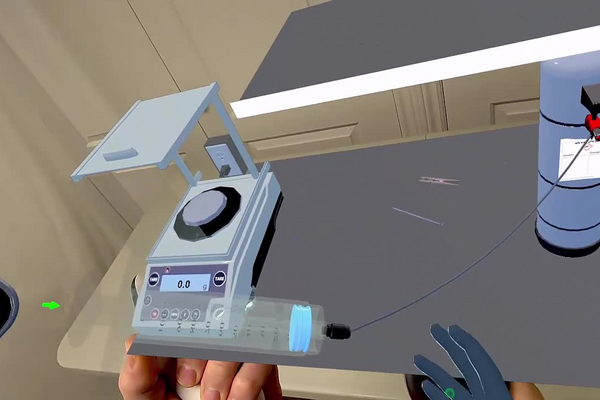
Gases have density, just as solids and liquids do — but so little of it that measuring it takes ingenuity. The answer matters more than it might seem: propane leaking from a tank does not drift away but pools invisibly at floor level, precisely because it is denser than air; helium lifts a balloon because it is lighter; and a gas’s density is often the quickest clue to its identity, since at a given temperature and pressure it is fixed by the mass of the gas’s molecules.
The difficulty is practical: 100 mL of a typical gas weighs a fifth of a gram, far too little to place on a balance by itself. The classical solution is weighing by difference. Weigh a sealed container empty — genuinely empty, evacuated — then weigh it again filled with the gas; the difference is the mass of the gas alone, and dividing by the volume gives the density. Because both weighings are made with the syringe at the same setting, everything else about the apparatus cancels out of the subtraction.
In this laboratory you will measure the density of an unknown gas: first weighing a syringe assembly holding a 100 mL vacuum, then refilling it with 100 mL of the gas from its cylinder and weighing again. From the 0.18 g difference you will compute the density — and from the density, reason your way to what the gas is.
Educational Goals
Familiarization with the laboratory environment
- Identify the equipment of the gas-density laboratory: the electronic scale, the graduated syringe, the gas cylinder with its valve, and the small hardware — nail, wooden clamp and connector — that seals the system.
Manipulating a gas quantitatively
- Create a vacuum by drawing the sealed syringe out to 100 mL, and lock the piston with the nail so the volume holds while weighing.
- Aspirate a measured 100 mL of gas from the cylinder and seal the connection with the wooden clamp.
Precision weighing and the difference method
- Weigh the complete assembly identically in both states, so that the subtraction isolates the mass of the gas alone.
- Appreciate why every component — even a 0.5 g nail — must be present in both weighings for the method to work.
Computing and interpreting a gas density
- Calculate density as mass over volume and express it in appropriate units (g/mL or g/L).
- Compare the result with the density of air and predict whether the gas rises or sinks.
From density to identity
- Use the ideal gas law to convert a measured density into a molar mass, and judge which gases are consistent with the result.
Protocol
In this lab, you will use the syringe. Here is how to proceed:
- Using the controllers: Grab the syringe with either controller. To select the direction in which you want to move the piston, press the X – Y buttons (left controller) or A – B buttons (right controller) to switch between pushing and pulling actions. Then, simply click the trigger button to move the piston in the chosen direction (refer to the video tutorial if necessary).
- One-handed mode: Grab the syringe. To select the direction in which you want to move the piston, press the Back button to switch between pushing and pulling actions. Then, simply click the touchpad button to move the piston in the chosen direction.
- With your hands: Grab the syringe with one hand and, with the other hand, press the arrow pointing in the direction you want to move the piston. While keeping your hand closed on the syringe, you will then only need to open and pinch your index finger and thumb to move the piston in the chosen direction (refer to the video tutorial if necessary).
- Ensure that the syringe’s piston is fully pushed in order to empty the syringe of all its air.
- Install the connector linked to the canister on the end of the syringe.
- Close the connection between the syringe and the connector with the wooden clamp.
- Pull on the plunger all the way in order to create a vacuum in the syringe, until reaching a volume of 100 mL.
- Block the piston with the nail.
- Read the volume measurement.
- Weigh the whole syringe-connector-nail-plier set.
- Remove the nail, the wooden clamp, and the plastic connector.
- Push the plunger of the syringe so as to return to zero volume.
- Install the connector attached to the canister on the end of the syringe.
- Open the valve of the unknown gas cylinder (touch with finger tip).
- Aspire an unknown volume of gas equivalent to that measured in step 4 (100 mL) and close the connection with the wooden clamp as close as possible to the end of the syringe.
- Insert the nail into the piston hole.
- Weigh the whole set, syringe, connector, clamp, nail.
Anticipated Outcomes
Expected results. The unknown gas is propane.
| Measurement | Expected value |
|---|---|
| Syringe (drawn to 100 mL) | 45 g |
| Nail | 0.5 g |
| Wooden clamp | 0.45 g |
| Connector | 0.5 g |
| First weighing — assembly with 100 mL vacuum | 46.45 g |
| Second weighing — assembly with 100 mL of unknown gas | 46.63 g |
| Mass of the gas (difference) | 0.18 g |
| Density of the gas | 0.00183 g/mL, i.e. 1.83 g/L |
Why the weighing is done by difference. A balance reading to 0.01 g cannot usefully weigh 0.18 g of anything directly — least of all a gas, which must be confined in something far heavier than itself. Weighing the same sealed assembly twice, once holding vacuum and once holding gas, removes the container from the problem entirely: 46.63 g − 46.45 g = 0.18 g of gas. The protocol’s insistence that the nail, clamp and connector be present both times is not fussiness; any item missing from one weighing would corrupt the subtraction by far more than the mass being measured.
Why the vacuum matters. The syringe is weighed drawn out to 100 mL in both states, so the assembly presents the same external volume to the surrounding air each time. This quietly cancels a subtle error: air exerts a buoyant force on everything weighed, and had the two weighings been made at different piston positions, the difference in buoyancy alone (about 0.12 g on 100 mL) would have rivalled the mass of the gas itself.
From density to identity. The density follows directly: ρ = m/V = 0.18 g ÷ 100 mL = 0.00183 g/mL, or 1.83 g/L. At room temperature and atmospheric pressure the ideal gas law converts this to a molar mass: M = ρRT/P = (1.83 g/L × 0.0821 L·atm/mol·K × 293 K) ÷ 1 atm ≈ 44 g/mol. Propane, C3H8, has a molar mass of 44.1 g/mol — consistent with the measurement. The result also explains the gas’s notorious safety behaviour: at 1.83 g/L it is half again as dense as air (about 1.2 g/L), so leaked propane sinks and accumulates near the floor, which is why propane detectors are mounted low.
Summary of Assignment by Grade Range
Grade 9–10
- Focus: gases have measurable mass and density, and careful technique makes small quantities measurable.
- Activities: carry out both weighings following the protocol; compute the mass of the gas by difference and its density from the 100 mL volume; compare the density with air and state whether the gas would rise or sink in a room; explain why the nail and clamp must be weighed both times.
Grade 11
- Focus: the difference method, and density as a route to molar mass.
- Activities: explain why the gas cannot be weighed directly and how the difference method removes the container; convert the density to a molar mass using the ideal gas law, showing the substitution; identify which common gases are consistent with 44 g/mol.
Grade 12 / College Level
- Focus: experimental design, buoyancy and the limits of a single measurement.
- Activities: explain why both weighings are made at the same piston position and calculate the buoyancy error that would otherwise arise; derive M = ρRT/P from the ideal gas law; design the follow-up test that would distinguish propane from carbon dioxide; discuss how temperature and pressure would have to be recorded for the density to be quotable as a standard value.
Laboratory essentials
Instruments
- Electronic scale
- Gas tank with unknown gas
- Nail
- Syringe
- Wood clamp
- Plastic connector (canister to syringe)
Products
- Unknown gas