

A stool examination is one of the cheapest and most informative tests in gastroenterology, because what leaves the body undigested says exactly where digestion or absorption has failed. Fat in the faeces points to a pancreas that is not delivering enough lipase or to a damaged intestinal lining; undigested protein points the same way; and sugars that should have been broken down and absorbed in the small intestine turn up in the stool when an enzyme such as lactase is missing. None of these findings requires sophisticated equipment to detect. Each class of nutrient has a colour test that has been in use for well over a century: Fehling’s solution turns a brick-red precipitate in the presence of a reducing sugar, iodine turns blue-black with starch, Sudan IV stains lipid droplets red, and copper in alkaline solution turns violet with peptide bonds. In this laboratory you will run all four tests on two samples side by side — sample N from a person whose digestion is normal, and sample P from a patient — and use the difference between the two columns of results to say which nutrient classes the patient is failing to digest. Three of the tests are done in the wells of a microplate; the Fehling’s test needs heat, so it is done in test tubes clamped in a water bath on a hot plate.
Educational Goals
Familiarization with the laboratory environment
- Identify the microplate, the test tube rack, the droppers, the pipette, the hot plate with its magnetic stirrer, the digital thermometer and the recovery bin, and state the role of each.
- Work with two samples at once without cross-contaminating them, and clean the glass rod between every stirring.
Handling of biological material
- Treat a stool sample as potentially infectious: gloves throughout, no transfer by mouth, excess reagent into the recovery bin rather than the sink.
- Explain why a well plate that has held biological material is disposed of rather than washed and reused.
Sample handling and layout of an assay
- Measure 10 mL of each sample into its labelled test tube, and place drops of each into the three wells that carry its label.
- Set up a plate so that every well can be identified afterwards, and record the layout before adding any reagent.
Operation of a heated water bath
- Fill and set up a stirred water bath, bring it to its set point, and clamp a test tube so that its contents — not the bath — reach the temperature the reaction needs.
- Verify the temperature inside the tube with the digital thermometer rather than trusting the hot plate’s setting, and explain the difference between the two readings.
Use of the four qualitative nutrient tests
- State, before adding anything, what each reagent detects and what colour counts as a positive result.
- Add the Biuret reagents in the right order — sodium hydroxide first, then copper sulfate — and explain why the alkali has to be there before the copper.
Reading, recording and interpreting results
- Record the colour of all eight results as observed, and only then decide positive or negative against the stated criteria.
- Draw a conclusion about the patient from the pattern across the four tests, and say what the pattern does not establish.
Protocol
Preparation of stool samples
- Using the pipette measure 10 mL of normal stool sample.
- Pour the 10 mL sample into test tube N.
- Using a dropper, place 5 to 10 drops of the normal stool sample into each of the 3 wells identified as follows:
- Well N (Lugol)
- Well N (Sudan IV)
- Well N (Biuret)
- Repeat steps 1 to 3 for the patient stool sample (P) by filling in the test tube and the 3 corresponding wells.
Identification of simple carbohydrates
- Fill 400 mL of tap water into a 500 mL beaker.
- Insert the magnetic stir bar into the beaker.
- Place the beaker on the hot plate and set to 75°C. Wait until the temperature is reached.
- Turn on the magnetic stirrer (left button).
- Using the pipette, add 10 mL of Fehling A to test tube N.
- Using the pipette, add 10 mL of Fehling B to test tube N.
- Mix the contents of test tube N with a circular motion.
- Place a universal clamp on the left stand, above the 500 mL beaker prepared in step 1.
- Secure test tube N to the universal clamp above the center of the beaker.
- Using the digital thermometer, verify that a temperature above 70°C is reached in the test tube.
- Take test tube N and put it back in its original place on the test tube rack.
- Mix the contents of the test tube by shaking it for a few seconds with the glass rod.
- Using the pipette, add 10 mL of Fehling A to test tube P.
- Using the pipette, add 10 mL of Fehling B to test tube P.
- Mix the contents of test tube P with a circular motion.
- Secure test tube P to the universal clamp above the center of the beaker.
- Using the digital thermometer, verify that a temperature above 70°C is reached in the test tube.
- Take test tube P and put it back in its original place on the test tube rack.
- Mix the contents of the test tube by shaking it for a few seconds with the glass rod.
- Lower the temperature of the hot plate to 15°C.
- Turn off the magnetic stirrer.
The observations of the control reaction are found in the results table.
Identification of complex carbohydrates
- Using the dropper, add 5 to 10 drops of Lugol into each of the 2 wells identified as follows:
- Well N (Lugol)
- Well P (Lugol)
- Empty the excess from the dropper into the recovery bin.
- Mix the contents using the glass rod. Warning: make sure to clean the glass rod well after each mixing to avoid mixing the substances!
Identification of lipids
- Using the dropper, add 5 to 10 drops of Sudan IV into each of the 2 wells identified as follows:
- Well N (Sudan IV)
- Well P (Sudan IV)
- Empty the excess from the dropper into the recovery bin.
- Mix the contents using the glass rod.
Identification of proteins
- Using the dropper, place 1 drop of sodium hydroxide (NaOH) into each of the 2 wells identified as follows:
- Well N (Biuret)
- Well P (Biuret)
- Empty the excess from the dropper into the recovery bin.
- Use the pipette to draw 1 full pipette (10 mL) of copper sulfate (CuSO4).
- Using the pipette, dispense 1 mL of copper sulfate (CuSO4) into wells N and P (Biuret).
- Empty the excess from the pipette into the recovery bin.
- Mix the contents using the glass rod.
The observations are found in the results table.
- A positive result for the presence of simple carbohydrates will result in a brick-red precipitate (Cu2O) in the test tube (Fehling reaction).
- A positive result for the presence of complex carbohydrates will result in a purple coloration (iodine – starch complex) in the well (Lugol test).
- A positive result for the presence of lipids will result in a red coloration (Sudan IV – lipid complex) in the well (Sudan IV test).
- A positive result for the presence of proteins will result in a purple coloration (Biuret complex) in the well (Biuret test).
Anticipated Outcomes
Each of the four tests answers one question, and each has a positive colour that has to be known before the reagent goes in. The first table sets out what is being looked for and what counts as a result.
| Test | Reagent | What it detects | Positive result | Negative result |
|---|---|---|---|---|
| Simple carbohydrates | Fehling’s A + B, heated above 70 °C | Reducing sugars: glucose, fructose, maltose, lactose | A brick-red precipitate of Cu2O in the tube | The deep blue of the copper reagent is unchanged and nothing settles out |
| Complex carbohydrates | Lugol’s iodine 2 % | Starch, and to a lesser extent glycogen and dextrins | A blue-black to deep purple coloration in the well | Only the yellow-brown to red-brown of the reagent itself |
| Lipids | Sudan IV | Neutral fats and fatty acids present as droplets | Distinct red to red-orange stained droplets | A faint, evenly dispersed pink with no stained droplets |
| Proteins | Biuret: NaOH then CuSO4 | Peptide bonds, so proteins and peptides of three residues or more | A violet to mauve coloration in the well | The pale blue of the copper solution, or no change at all |
The second table gives the eight results with the call each one supports.
| Test | Sample N (normal) — observed | Call | Sample P (patient) — observed | Call |
|---|---|---|---|---|
| Fehling’s, simple carbohydrates | No precipitate forms after heating; the results table records only that the Fehling reaction was detected | Negative | A precipitate is observed in the tube after heating | Positive |
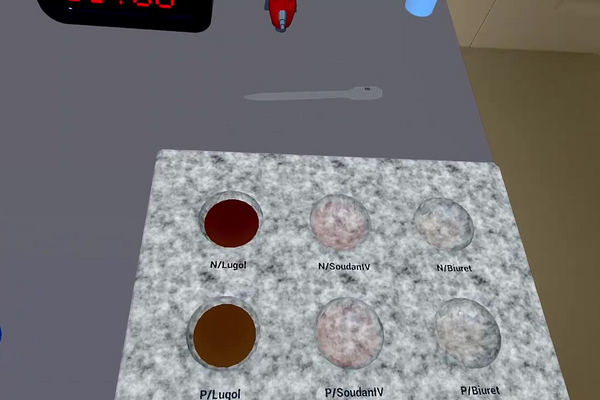
| Lugol, complex carbohydrates | Deep red-brown, the colour of concentrated iodine solution | Negative — not blue-black | Amber to mid-brown, lighter than well N | Negative — not blue-black |
| Sudan IV, lipids | Pale mottled pink throughout the well, no discrete stained droplets | Negative | Pale mottled pink, very close to well N and with no discrete stained droplets | Negative |
| Biuret, proteins | Almost colourless, a very pale off-white pink | Negative | A mauve well, with a clear pale-blue precipitate, unmistakably different from N | Positive |
The conclusion the results support. Sample N gives four negatives: nothing detectable has escaped digestion, which is the expected finding for a healthy gut. Sample P gives two clear positives, reducing sugars and protein, on the same tests that were negative for N and with the same reagents from the same bottles, so the difference is a property of the sample and not of the method. Undigested protein and unabsorbed sugar arriving in the stool together point to a general failure of digestion in the small intestine rather than to the absence of one specific enzyme — a pancreatic insufficiency, in which several digestive enzymes are missing at once, or damage to the intestinal lining that shortens the time and surface available for absorption. What the result does not do is name the disease; it says which processes have failed, and a clinician would follow it with tests that measure rather than detect.
Why the positive well shows both a colour and a precipitate. The two signals in well P are two different compounds of the same copper. The mauve tint of the liquid is the biuret complex itself: in the alkaline solution created by the sodium hydroxide, Cu2+ is chelated by the nitrogen atoms of adjacent peptide bonds, and this copper–peptide complex is soluble, so it colours the whole well evenly rather than settling. The precipitate is copper(II) hydroxide, formed wherever a Cu2+ ion meets hydroxide ions before it meets a peptide bond: Cu2+ + 2 OH− → Cu(OH)2(s), a pale-blue solid. Copper(II) hydroxide is among the least soluble of the common hydroxides, so once the peptide bonds present have taken their share of the copper, the excess leaves the solution as this solid. The two observations are therefore one story told twice: the protein claims part of the copper as a soluble mauve complex, and the hydroxide claims the remainder as a solid.
Why Fehling’s solution needs heat, and what the red precipitate is. Fehling’s reagent is copper(II) held in solution by tartrate in strong alkali, which is why it is supplied as two bottles and mixed only at the moment of use. A reducing sugar carries a free aldehyde group, and in hot alkaline solution that group is oxidised to a carboxylate while the copper(II) is reduced to copper(I), which is insoluble and drops out as brick-red copper(I) oxide: RCHO + 2 Cu2+ + 5 OH− → RCOO− + Cu2O(s) + 3 H2O. The reaction is far too slow to see at room temperature, which is the whole reason for the water bath: the hot plate is set to 75 °C and the protocol asks for more than 70 °C inside the tube, because that is where the reaction happens. Note what the test does and does not cover. Glucose, fructose, maltose and lactose all reduce the reagent; sucrose does not, because both of its anomeric carbons are locked into the glycosidic bond, so a stool loaded with sucrose would give a negative. The test says that a reducing sugar is present, never which one.
Why iodine goes blue-black with starch. Lugol’s solution contains iodine dissolved in potassium iodide as the triiodide ion, I3−. Amylose, the unbranched fraction of starch, coils into a helix whose interior is just wide enough to hold a chain of triiodide ions, and the resulting charge-transfer complex absorbs across the visible spectrum to give the familiar blue-black. The colour is therefore a report on the shape of the polysaccharide, not merely on its presence: amylopectin and glycogen, which are heavily branched and cannot form long helices, give red-brown instead, and dextrins — partly broken-down starch — give something in between. This is why a red-brown well has to be read carefully. It is what the reagent looks like on its own, so it is scored as negative, but a student should know that partly digested starch can also read red-brown and that the test loses sensitivity exactly where the biology becomes interesting.
Why Sudan IV and Biuret work at all. Sudan IV is a lysochrome: a dye that undergoes no chemical reaction whatever, but is many times more soluble in fat than in water, so it partitions into any lipid droplet present and stains it red-orange while the surrounding water stays almost colourless. A positive result is therefore discrete red droplets, not a uniform colour change, and reading it is a matter of looking for structure rather than for hue. The Biuret reaction is the opposite kind of test: it is a genuine coordination reaction, in which Cu2+ in strongly alkaline solution is chelated by the nitrogen atoms of at least two adjacent peptide bonds to give a violet complex with an absorbance maximum near 540 nm. Two consequences follow. Free amino acids and dipeptides do not react, so the test reports peptide bonds rather than nitrogen; and because the intensity of the violet is proportional to the concentration of peptide bonds, this is the one test of the four that turns directly into a quantitative assay with a spectrophotometer and a standard curve. The order of addition matters: the alkali has to be present before the copper, or the copper precipitates as hydroxide instead of forming the complex.
Summary of Assignment by Grade Range
Grade 9–10
- Focus: the four nutrient classes, the reagent that reveals each one, and the discipline of recording a colour before interpreting it.
- Activities: lay out and label the plate; run the four tests on both samples; write down the observed colour of all eight results in a table like Table 2 before deciding anything; score each result positive or negative against the criteria in the protocol; state in one sentence what sample P is failing to digest, and name the safety precautions that apply to handling a stool sample.
Grade 11
- Focus: the chemistry behind each colour, and the conditions each reaction requires.
- Activities: write the Fehling’s equation and identify what is oxidised and what is reduced; explain why the tube must exceed 70 °C and why the reading inside the tube differs from the hot plate’s set point; explain why sucrose gives a negative Fehling’s result while lactose gives a positive; account for the blue-black colour in terms of the amylose helix and triiodide; explain why Sudan IV needs no reaction to work; and justify the order in which the two Biuret reagents are added.
Grade 12 / College Level
- Focus: the step from a qualitative screen to a diagnostic measurement, and the interpretation of a pattern of results.
- Activities: describe how the Biuret reaction is turned into a quantitative protein assay, including the standard curve, the wavelength used and the reason absorbance is proportional to peptide bond concentration; propose the positive and negative controls this protocol lacks and state what each would rule out; explain why Fehling’s and Biuret positives arriving together point to a general digestive failure rather than a single missing enzyme, and list the further tests that would distinguish pancreatic insufficiency from mucosal damage; evaluate the sensitivity and specificity of each of the four tests as a screen; and explain why a negative result cannot exclude a condition.
Laboratory essentials
Instruments
- Test tubes, 50 mL (2, labelled N and P)
- Test tube rack
- Droppers, 1 mL (8)
- Pipette
- Beaker (500 mL, filled with 400 mL of tap water)
- Microplate (well plate, 6 wells used)
- Hot plate, set to 75 °C
- Magnetic stirrer and magnetic stir bar
- Digital thermometer
- Glass rods
- Stand and universal clamp
- Paper towel
- Recovery bin
Products
- Normal stool sample (N)
- Patient stool sample (P)
- Fehling’s reagent, solutions A and B (10 mL of each per tube)
- Lugol’s iodine solution 2 %
- Sudan IV solution
- Biuret reagent — sodium hydroxide, NaOH 2.5 M
- Biuret reagent — copper sulfate, CuSO4 0.0094 M
- Tap water (400 mL for the bath)