

Dilution is how one carefully prepared concentrated solution is turned into the many working strengths that a laboratory, a hospital pharmacy or a bottling plant actually needs. A single stock solution is made up and verified once, and every weaker solution is then obtained from it by measuring out a known volume and bringing that volume up to a known final volume. Disinfectants, intravenous drug doses, buffers, photographic developers and the syrups behind soft drinks are all made this way, because measuring a volume accurately is quicker and far more reproducible than weighing out a small mass of solute afresh every time.
The science behind it is a conservation statement: adding solvent changes the volume of a solution and therefore its concentration, but it does not change the amount of solute already in it. If a volume V1 of a solution at concentration C1 is diluted to a final volume V2, the amount of solute is the same before and after, so C1V1 = C2V2. The ratio V2/V1 is called the dilution factor, and the concentration falls by exactly that factor. When the solute is coloured, that fall is visible: a more dilute solution absorbs less light and looks paler, which is what makes a set of known dilutions usable as a comparison scale for a sample whose concentration has never been measured.
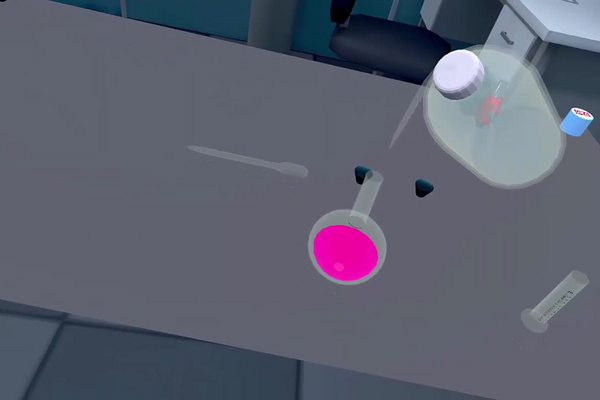
In this laboratory you are given a solution concentrated at 5 % V/V and a second solution whose concentration is unknown, and your task is to find out how strong the unknown one is. Using a 10 mL graduated cylinder and two 100 mL volumetric flasks you will prepare two reference solutions from the stock — solution A at 0.5 % V/V from a 10 mL aliquot, and solution B at 0.1 % V/V from a 2 mL aliquot — then compare the unknown against both and decide which of the two it matches.
Educational Goals
Understanding what a dilution does
- Explain that adding solvent to a solution changes its volume and its concentration but not the amount of solute already present.
- Use the vocabulary of solutions correctly: solute, solvent, stock solution, aliquot, dilution factor, and percentage by volume (% V/V).
Quantitative use of the dilution relation
- Calculate the volume of stock solution needed to reach a target concentration in a given final volume, using C1V1 = C2V2.
- Express the same solution three ways — as a dilution factor, as a percentage by volume and as a molar concentration — and convert between them.
Correct use of volumetric glassware
- Measure an aliquot in a graduated cylinder, reading the bottom of the meniscus at eye level.
- Explain why a solution is brought up to the mark of a volumetric flask rather than made by adding a measured volume of solvent to the aliquot.
- Rinse the graduated cylinder between the two preparations and state what carry-over would do to the second result.
Concentration, colour and comparison against a reference
- Predict the order of colour intensity of the stock and of the two prepared solutions from their concentrations alone.
- Use a set of solutions of known concentration as a comparison scale to bracket the concentration of an unmeasured sample.
- Explain why a colour comparison only works over a limited range of concentrations.
Protocol
Preparation of solution A
We want to identify the concentration of the unknown solution.
We are therefore going to prepare 2 solutions of different concentrations and compare them to the unknown solution.
- Measure 10 mL of the concentrated 5% V/V solution with the 10 mL graduated cylinder.
- Pour the solution into a 100 mL volumetric flask.
- Add distilled water to the volumetric flask until it reaches exactly 100 mL. If necessary, use the dropper.
- Put the stopper on the volumetric flask.
- Mix gently.
- Compare the prepared solution with the unknown solution.
- Rinse the graduated cylinder.
Preparation of solution B
- Measure 2 mL of the concentrated 5% V/V solution with the 10 mL graduated cylinder.
- Pour the solution into the other 100 mL volumetric flask.
- Add distilled water into the volumetric flask until reaching exactly 100 mL. If necessary, use the dropper.
- Put the stopper on the volumetric flask.
- Mix gently.
- Compare the prepared solution with the unknown solution.
Determine the concentration of the unknown solution following the comparison with solution A and B.
Anticipated Outcomes
Both dilutions are fixed entirely by the ratio of the aliquot to the final volume, so the two concentrations are known before any liquid is poured. The concentration of the unknown solution is then read off by comparison: it matches solution A, and is therefore 0.5 % V/V.
| Solution | Concentration (% V/V) | Stock volume V1 (mL) | Final volume V2 (mL) | Dilution factor | Concentrate in 100 mL (mL) | Estimated concentration (mol/L) |
|---|---|---|---|---|---|---|
| Concentrated stock | 5.00 | — | — | 1 | 5.00 | 0.344 |
| Solution A | 0.500 | 10.0 | 100.0 | 10 | 0.500 | 0.0344 |
| Solution B | 0.100 | 2.0 | 100.0 | 50 | 0.100 | 0.00688 |
Where the two aliquot volumes come from. The amount of solute in an aliquot is n = C × V. Diluting does not add or remove solute, so that product is the same before and after: C1V1 = C2V2, and therefore V1 = C2V2 / C1. For solution A, V1 = (0.500 % × 100.0 mL) / 5.00 % = 10.0 mL. For solution B, V1 = (0.100 % × 100.0 mL) / 5.00 % = 2.00 mL. The concentration units cancel, which is why the relation may be used with percentages, with g/L or with mol/L, provided the same unit appears on both sides.
What the percentages mean in millilitres. A concentration of 5 % V/V means 5 mL of concentrate in every 100 mL of finished solution. The 10 mL aliquot therefore carries 0.500 mL of concentrate, and the 2 mL aliquot carries 0.100 mL. Once either aliquot is made up to 100 mL, those volumes of concentrate sit in 100 mL of solution, giving 0.500 % and 0.100 % V/V respectively — the same answers as the dilution relation, arrived at by counting the solute instead of scaling the concentration. Students should be asked to do it both ways at least once, because the second route makes it obvious that nothing is created or destroyed by adding water.
Converting to molar concentration, and what that conversion assumes. Two pieces of information are needed that the laboratory itself does not supply: that 5 mL of the concentrate weighs 6.2 g, giving a density of 6.2 g / 5 mL = 1.24 g/mL, and that the dissolved matter may be treated as a hexose sugar of molar mass M = 180.16 g/mol. On those assumptions, solution A contains 0.500 mL × 1.24 g/mL = 0.620 g of concentrate, that is n = 0.620 g / 180.16 g/mol = 3.44 × 10⁻³ mol, in 0.1000 L, so c = 3.44 × 10⁻³ mol / 0.1000 L = 0.0344 mol/L. Solution B contains one fifth as much, 0.124 g or 6.88 × 10⁻⁴ mol, so c = 0.00688 mol/L, and the undiluted stock works out at 0.344 mol/L. These three figures stand in the ratio 50 : 5 : 1, as they must. They should be presented as an order-of-magnitude estimate rather than a result: a concentrate is mostly water, so treating the whole of its mass as sugar makes every molarity here an upper bound.
| Vessel | Concentration (% V/V) | Concentration relative to solution B | Expected appearance |
|---|---|---|---|
| Concentrated stock | 5.00 | 50 × | Deepest colour of the set; over the path length of a flask, close to opaque |
| Solution A | 0.500 | 5 × | Clearly paler than the stock |
| Solution B | 0.100 | 1 × | Palest of the set, about five times lighter than solution A |
| Unknown solution | 0.500 (the result) | 5 × | Indistinguishable from solution A |
Why colour tracks concentration, and only over a limited range. Absorbance obeys the Beer–Lambert law, A = εbc, where ε is the molar absorptivity of the coloured species, b the path length the light travels through the liquid and c the concentration. The light that reaches the eye is I = I0 × 10−A, so absorbance is proportional to concentration but the appearance is not: a tenfold rise in concentration raises A tenfold and cuts the transmitted light by a factor of 109 if A goes from 1 to 10. The eye works best where A lies roughly between 0.1 and 1, and that window spans only about one order of magnitude in concentration. Path length matters as much as concentration: the bulb of a 100 mL volumetric flask is about 6 cm across, six times the 1 cm cuvette of a spectrophotometer, so the workable concentration window here sits about six times lower than a laboratory instrument would suggest. This is why the 5 % stock looks flatly opaque rather than merely dark, and why the useful discrimination in this laboratory is between the two dilute solutions rather than between either of them and the stock.
Summary of Assignment by Grade Range
Grade 9–10
Focus: careful measurement, observation and vocabulary. Students carry out both dilutions and rank the vessels by colour without doing any algebra.
Activities:
- Name each piece of glassware and say what it is for, and explain why the flask has a single mark while the cylinder has a scale.
- Measure the 10 mL and the 2 mL aliquots, reading the bottom of the meniscus at eye level, and bring both flasks up to the mark with the dropper for the last drops.
- Record the appearance of the stock, of solutions A and B and of the unknown in a four-row table, and put them in order from deepest to palest.
- Explain in their own words, using the words solute and solvent, why the solutions become paler.
- State which reference solution the unknown resembles and therefore roughly how concentrated it is.
Grade 11
Focus: quantitative treatment. Students predict both aliquot volumes before touching the glassware and move between the three ways of expressing a concentration.
Activities:
- Use C1V1 = C2V2 to calculate both aliquot volumes before starting, showing the substitution in full.
- Convert each concentration from % V/V to the volume of concentrate contained in 100 mL, and then, using the stated density of 1.24 g/mL and molar mass of 180.16 g/mol, to mol/L.
- State the dilution factor of each solution and confirm that it equals V2/V1 and that the three concentrations stand in the ratio 50 : 5 : 1.
- Complete a results table and identify the unknown solution, quoting the reference it matches.
- Calculate the concentration that would result if 100 mL of water were added to the 10 mL aliquot instead of the aliquot being made up to 100 mL, and say by how much the solution would be wrong.
Grade 12 / College Level
Focus: error analysis, the optics behind the comparison, and criticism of the method itself.
Activities:
- Show numerically that measuring 2 mL in a 10 mL cylinder is five times less precise than measuring 10 mL in it, then design a two-stage route to 0.1 % V/V that avoids the problem.
- Apply A = εbc and I = I0 × 10−A to explain why a colour comparison has a usable range of only about one order of magnitude in concentration, and estimate how that range shifts when the path length is the 6 cm bulb of a volumetric flask rather than a 1 cm cuvette.
- Criticise the molar concentrations given on this page: list every assumption they rest on, and say which of those assumptions a student could test and how.
- Propose an instrumental method that would measure the unknown rather than bracket it and state what standards it would require.
Laboratory essentials
Instruments
- Graduated cylinder (10 mL)
- 2 × Volumetric flask (100 mL, with stopper)
- Dropper
Products
- Concentrated solution, 5 % V/V (stock)
- Unknown solution
- Distilled water (wash bottle)