

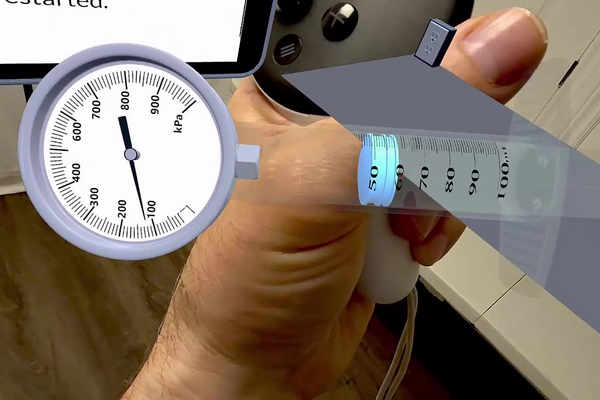
A gas has no fixed size. Squeeze it and it occupies less room; release it and it expands again. Engineers depend on that behaviour every time they design a bicycle pump, the compression stroke of an engine, a scuba regulator, a pneumatic brake or a syringe, and it is how breathing works: the chest cavity enlarges, the pressure inside the lungs falls below the pressure of the room, and air flows in. The quantitative statement behind all of it is Boyle’s law — at constant temperature, a fixed quantity of gas satisfies P × V = constant, so pressure and volume are inversely proportional.
The microscopic reason is that pressure is nothing more than the accumulated force of molecules striking the walls of their container. Compressing a gas does not make its molecules faster; that would require heating them. It packs the same number of molecules into a smaller space, so more of them reach the wall each second and the force per unit area rises in exact proportion to the crowding. Halve the volume and the pressure doubles; double the volume and it halves.
In this laboratory you will seal exactly 50 mL of room air inside a graduated syringe, connect it to a dial manometer through an airtight fitting, and then change the volume in small steps — first drawing the plunger out towards 100 mL, then pushing it in towards 20 mL — reading the pressure at every step. Plotting pressure against volume gives a hyperbola; plotting it against the reciprocal of the volume straightens that hyperbola into a line through the origin whose slope is the constant P1V1. Returning the plunger to 50 mL at the end of each leg and checking that the starting pressure comes back is the leak test that decides whether the run can be trusted at all.
Educational Goals
Familiarization with the laboratory environment
- Identify the graduated syringe, the dial manometer and the airtight fitting, and state what each contributes to a sealed-gas measurement.
- Explain why the assembly must be airtight before a single reading is worth recording.
Handling a sealed gas system
- Set the plunger to an exact starting volume before the system is closed, and explain why that sealing volume fixes the constant for the whole run.
- Move the plunger in controlled steps, using the controller, one-handed or hand-tracking method, without breaking the seal.
Measurement and data recording
- Read an analogue dial to the nearest graduation, and estimate to half a division.
- Record volume and pressure as matched pairs across the full 20–100 mL range rather than at a few scattered points.
Quantitative treatment of Boyle’s law
- Compute the product P × V at every point and test whether it stays constant.
- Convert volume to 1/V and plot pressure against it, recognising a straight line through the origin as the signature of an inverse proportionality.
- Predict the pressure at a volume that was not measured from P1V1 = P2V2, then check the prediction against a reading.
Experimental control and validity
- Carry out the return-to-50 mL check and interpret a mismatch as a leak rather than as a failure of the law.
- Explain why the gas must be allowed to come back to room temperature before each reading, and what a hurried run does to the data.
Protocol
In this lab, you will use the syringe. Here is how to proceed:
- Using the controllers: Grab the syringe with either controller. To select the direction in which you want to move the piston, press the X – Y buttons (left controller) or A – B buttons (right controller) to switch between pushing and pulling actions. Then, simply click the trigger button to move the piston in the chosen direction (refer to the video tutorial if necessary).
- One-handed mode: Grab the syringe. To select the direction in which you want to move the piston, press the Back button to switch between pushing and pulling actions. Then, simply click the touchpad button to move the piston in the chosen direction.
- With your hands: Grab the syringe with one hand and, with the other hand, press the arrow pointing in the direction you want to move the piston. While keeping your hand closed on the syringe, you will then only need to open and pinch your index finger and thumb to move the piston in the chosen direction (refer to the video tutorial if necessary).
Measure the pressure of a gas
- Pull the syringe plunger so that it contains exactly 50 mL of air.
- Connect the syringe to the dial pressure gauge using the appropriate fittings. The assembly must be perfectly airtight and must be able to withstand significant pressure.
- Pull on the piston to increase the volume by 10 mL. Read the pressure measurement.
- Repeat step 3 several times (at 5 mL intervals) until reaching a volume of 100 mL.
- Hold the syringe interaction button to counteract the pressure difference for a few seconds and then allow the volume to decrease in the syringe.
- Wait for the syringe to return to a volume of 50 mL and ensure that the pressure matches the one measured in step 3. If this is not the case, the experiment must be restarted.
- Push on the piston to reduce the volume by 5 mL. Read the pressure measurement and record the measurements in the results table.
- Repeat step 7 several times (at 5 mL intervals) until reaching a volume of 20 mL.
- Hold the syringe interaction button to counteract the pressure difference for a few seconds and then allow the volume to rise back into the syringe.
- Wait for the syringe to return to a volume of 50 mL and ensure that the pressure matches the one measured in step 3. If this is not the case, the experiment must be restarted.
Anticipated Outcomes
Expected results. The syringe holds a fixed quantity of air at room temperature. Moving the plunger changes the volume; the gauge reports the pressure of the trapped gas. The seventeen volumes below are the ones the protocol calls for, listed from the largest to the smallest.
| Volume V (mL) | 1 / V (mL−1) | Pressure P (kPa) | P × V (kPa·mL) |
|---|---|---|---|
| 100 | 0.01000 | 51 | 5100 |
| 95 | 0.01053 | 53 | 5035 |
| 90 | 0.01111 | 56 | 5040 |
| 85 | 0.01176 | 60 | 5100 |
| 80 | 0.01250 | 63 | 5040 |
| 75 | 0.01333 | 68 | 5100 |
| 70 | 0.01429 | 73 | 5110 |
| 65 | 0.01538 | 78 | 5070 |
| 60 | 0.01667 | 85 | 5100 |
| 55 | 0.01818 | 92 | 5060 |
| 50 | 0.02000 | 102 | 5100 |
| 45 | 0.02222 | 113 | 5085 |
| 40 | 0.02500 | 127 | 5080 |
| 35 | 0.02857 | 145 | 5075 |
| 30 | 0.03333 | 169 | 5070 |
| 25 | 0.04000 | 203 | 5075 |
| 20 | 0.05000 | 254 | 5080 |
The single result to take away. The seventeen products in the last column average 5.08 × 10³ kPa·mL, and every one of them falls between 5035 and 5110 — a spread of ±0.7 % about the mean. Meanwhile the volume changes by a factor of five and the pressure by the same factor in the opposite direction. A quantity that stays put to within one percent while its two ingredients each move by 500 % is not staying put by accident. This is Boyle’s law:
P × V = constant (at fixed temperature and fixed amount of gas)
or, comparing any two states of the same sample, P1V1 = P2V2. Taking the first and last rows as a check: 51 × 100 = 5100, and 254 × 20 = 5080. The two agree to 0.4 %, over the widest separation the apparatus allows.
The two graphs, and why the second one matters. Plotting pressure against volume gives a curve that falls steeply at small volumes and flattens toward large ones — a hyperbola. It is the right shape, but a curve is weak evidence: many decreasing functions look like that by eye, and none of them can be distinguished from the others without a great deal of care.
Plotting pressure against the reciprocal of volume converts the claim into a straight line. If P = constant / V, then P plotted against 1/V is a straight line of slope equal to that constant, passing through the origin. Both conditions matter, and each carries its own meaning:
- The slope is the constant itself. Read off these data it is about 5.08 × 10³ kPa·mL — the same number as the average of the fourth column, obtained independently.
- The intercept should be zero. An infinite volume would mean zero pressure. A line that misses the origin points to the apparatus — see the note on dead volume below — not to a failure of the law.
A straight line is far easier to judge than a curve, and this is the general lesson: when a relationship is suspected, find the variable that makes it linear and plot that instead. Physics is full of examples — period against the square root of length for a pendulum, current against voltage for a resistor.
Why the product stays constant. Pressure is the accumulated effect of gas molecules striking the walls: each impact delivers a small impulse, and pressure is the total impulse per second per unit area. Halve the volume and the same number of molecules is confined to half the space, so each one meets a wall twice as often. Nothing about the individual collisions changes — the molecules are no faster, because the temperature has not changed, and their average speed is fixed by temperature alone. Only the rate of collisions changes, and it changes in exact proportion to the crowding. Twice the number density, twice the pressure.
This also shows why the law needs its two conditions. Constant temperature, because warming the gas would make the molecules faster and each impact harder, raising pressure without any change in volume. Constant amount of gas, because a leak removes molecules and lowers the collision rate. A syringe that leaks slowly produces a product that drifts downward through the run rather than scattering randomly about a mean — which is how a leak is told apart from ordinary reading error.
Out and back: the run is reversible. The protocol does not sweep the volume once. It moves out from 50 mL to 100 mL, returns to 50, compresses to 20 mL, then returns to 50 again. Every volume is therefore visited at least twice, and at each one the pressure reads the same on the way out as on the way back — 85 kPa at 60 mL in both directions, 127 kPa at 40 mL in both directions, 102 kPa at 50 mL on all four visits.
That repeatability is worth pointing out to students, because it is doing real work. It shows the gas returns to precisely its former state, so nothing was lost and nothing was permanently changed: the seal held, and any heat generated by compression had time to leave. A trace that did not retrace itself — higher pressures during compression than during expansion at the same volume — would indicate either a leak or a gas that had not returned to room temperature. Neither happens here, which is what licenses treating the whole run as a single isothermal data set rather than as two separate experiments.
How much gas is in the syringe. The constant is not merely a number that happens to stay put; it is nRT. From the ideal gas law PV = nRT, and 5.08 × 10³ kPa·mL is 5.08 J, so at 20 °C:
n = PV / RT = 5.08 / (8.314 × 293) = 2.1 × 10⁻³ mol
about 2.1 millimoles, or roughly 60 mg of air — some 1.3 × 10²¹ molecules. A student who reaches this number has done something more than confirm a proportionality: they have counted the molecules in a syringe from two dial readings, which is a fair demonstration of what a physical law is for.
Gauge pressure and absolute pressure. The instrument in this laboratory reports absolute pressure — pressure measured from a true vacuum — and Boyle’s law requires nothing less. The reading of 102 kPa at 50 mL is the confirmation: the plunger sits at rest, so the trapped gas is at atmospheric pressure, and 102 kPa is atmospheric pressure. A gauge that read from atmosphere instead would have shown 0 kPa there, and its readings would satisfy no simple law at all. If a student ever works with a gauge instrument, atmospheric pressure must be added to every reading before the product is formed.
Why the readings must not be rushed. Compressing a gas does work on it and warms it; letting it expand cools it. Push the plunger quickly from 50 mL to 20 mL and the gas is momentarily well above room temperature, so the pressure reads high; the value then decays over several seconds as heat passes through the syringe wall. The law assumes a constant temperature, so each reading must be taken after the gas has settled. Rushing the compression strokes and not the expansion strokes is what produces an apparent difference between the two directions where none exists.
Dead volume, and how to detect it. The gas in the apparatus is not only the gas in front of the graduations: a little sits in the connector and the gauge itself. If that dead volume is V0, the true volume is V + V0 and the constant becomes P(V + V0). Using the scale reading alone then makes the product drift upward as the volume is reduced, since a fixed extra volume matters far more at 20 mL than at 100 mL. The reciprocal plot exposes it cleanly: dead volume moves the straight line off the origin. These data show no such drift — the products at 20 and 100 mL agree to within the scatter — so any dead volume is small compared with the smallest volume used.
Summary of Assignment by Grade Range
Grade 9–10
Focus. Observation and vocabulary. Students learn that a gas can be compressed, that a sealed system is required for the measurement to mean anything, and that pressure and volume move in opposite directions.
- Seal 50 mL of air, take readings at 100, 80, 60, 40 and 20 mL, and describe in words what happens to the pressure.
- Sketch pressure against volume by hand and name the curve as a falling one that never reaches zero.
- Answer the qualitative question: what would the reading be at 25 mL — more or less than at 40 mL, and roughly how much more?
- Use the return-to-50 mL check and say what a mismatch would mean.
Grade 11
Focus. Quantitative treatment. Students take the full series, compute the product P × V and test the constancy claim numerically rather than by eye.
- Record all fifteen measured volumes, tabulate V, 1/V, P and P × V, and comment on the spread of the last column.
- Plot P against 1/V, draw the best straight line, and take its slope; compare the slope with P1V1 = 101.3 kPa × 50 mL.
- Use P1V1 = P2V2 to predict the pressure at a volume not measured, then measure it.
- Explain why the gauge must be read in absolute pressure, and show what the plot looks like if it is not.
Grade 12 / College Level
Focus. Derivation, error analysis and independent interpretation. Students are expected to connect the macroscopic law to the ideal gas law and to kinetic theory, and to quantify what limits the experiment.
- Derive P ∝ 1/V from PV = nRT and from P = (1/3)(N/V)m⟨v2⟩, and state which assumptions each derivation makes.
- Compute n for the sealed sample and convert it to a mass of air and a molecule count.
- Treat the dead volume quantitatively: fit 1/P against V, extract the intercept, and state the value of Vd it implies.
- Compare the isothermal and adiabatic predictions for a compression from 50 mL to 25 mL and explain, in terms of energy, why the adiabatic pressure is the higher of the two.
Laboratory essentials
Instruments
- Graduated syringe, 100 mL, graduated in 1 mL
- Dial manometer, 0–1000 kPa, reading in kPa
- Airtight fitting joining the syringe to the manometer
Products
- Air — 50 mL of room air, sealed in the syringe at atmospheric pressure