

A swinging pendulum is the clearest demonstration in physics that energy can change form without changing amount. It is also, historically, one of the most consequential: the constancy of a pendulum’s swing gave the world its first accurate clocks, held that role for nearly three centuries, and is still used to measure local gravity precisely enough to map the density of rock beneath a survey site. The same principle governs a child on a swing, a wrecking ball, a skateboard in a half-pipe and the suspended damper that steadies a tall building in the wind.
The mechanical energy of an object is the sum of its gravitational potential energy, Ep = m g h, and its kinetic energy, Ek = ½ m v2. When no friction acts, that sum is conserved: whatever one form loses, the other gains, instant for instant. A pendulum makes the exchange visible because it separates the two forms in space. At the ends of the swing the mass is momentarily at rest at its highest point, so the energy is entirely potential; at the bottom of the arc the mass is at its lowest point and moving fastest, so the energy is entirely kinetic. Every position in between holds a mixture whose total is always the same.
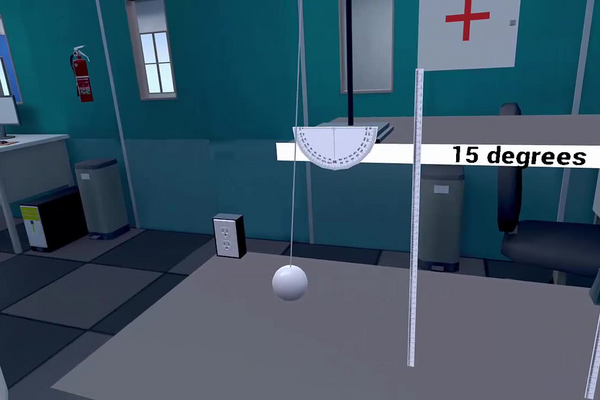
In this laboratory you will suspend a 50 g mass from a rigid rod on a universal support, draw it aside to 15° from the vertical, and measure the height it has been raised above its rest position. Releasing it, you will time five complete oscillations. You will then repeat the whole procedure at 30°. From the two heights you will calculate the potential energy stored at the start of each swing, and from the conservation of mechanical energy you will deduce the speed the mass reaches at the bottom of its arc — a speed the apparatus never measures directly, but which the energy accounting gives without any need to.
Educational Goals
Familiarization with the laboratory environment
- Assemble a pendulum on a universal support, setting the clamp height so the mass swings clear of the table by a known distance.
- Identify the rest position of the mass as the reference level from which every height in the experiment is measured.
Careful measurement of length, angle and time
- Set a release angle relative to the vertical and read a height above the table with a ruler, recording both to the precision the instrument allows.
- Time five complete oscillations rather than one, and explain why timing several and dividing gives a better period than timing one.
Calculating gravitational potential energy
- Convert masses to kilograms and heights to metres before substituting, and calculate Ep = m g h with the working shown.
- Explain why only the change in height matters, and why the choice of reference level does not affect the result.
Applying the conservation of mechanical energy
- State that Ep + Ek is constant in the absence of friction, and identify the two points in the swing where one term is zero.
- Deduce the maximum speed from ½ m v2 = m g h, and show that the mass cancels from the result.
Relating the release angle to the energy
- Relate the height risen to the release angle through h = L (1 − cos θ), and use it to find the length of the pendulum from the measured heights.
- Explain why doubling the release angle almost quadruples the stored energy but only doubles the maximum speed.
Checking the model
- Predict the period from T = 2π√(L/g), compare it with the measured time for five oscillations, and state what the comparison establishes.
- Explain what a real pendulum would do over many swings that this one does not, and where the energy would go.
Protocol
- Hang a clamp on the universal support; as high as possible.
- Hang a protractor on the foot of the universal support.
- Suspend a rigid movable rod from the clamp. Allow a distance of at least 20 cm between the pendulum mass and the table.
- Hang a 50g lead mass on the rigid rod.
- Using the red arrows located on each side of the upper part of the rigid rod; place the pendulum at an angle of 15° relative to the vertical.
- Measure the initial height of the pendulum mass relative to the table using the 50 cm rulers (take the measurement from the top part of the mass).
- Using the stopwatch, measure the time required for the pendulum to complete 5 full oscillations (back and forth).
- Activate the Start button on the stopwatch, which will release the pendulum.
- When 5 oscillations (back and forth) have been completed, stop the stopwatch.
- The final height when the pendulum reaches the other end of its trajectory will be identical to the initial height (already measured in step 6).
-> The results, oscillation time and height measurements, will be recorded in the results table.
- Reset the stopwatch.
- Repeat steps 5 to 10 by placing the pendulum at an angle of 30° relative to the vertical.
- Verify the data collected in the results table.
Anticipated Outcomes
The measurements. The mass is 50 g = 0.050 kg and g is taken as 9.8 N/kg. The rest position of the mass sits 20.0 cm above the table, and that is the reference level for every height below.
| Release angle θ | Height of the mass at release | Rest height | Rise h | Rise in metres |
|---|---|---|---|---|
| 15° | 22.6 cm | 20.0 cm | 2.6 cm | 0.026 m |
| 30° | 30.0 cm | 20.0 cm | 10.0 cm | 0.100 m |
Potential energy at the moment of release. With the mass momentarily at rest, all of its mechanical energy is potential:
Ep = m g h
At 15°: Ep = 0.050 kg × 9.8 N/kg × 0.026 m = 0.013 J.
At 30°: Ep = 0.050 kg × 9.8 N/kg × 0.100 m = 0.049 J.
Maximum speed at the bottom of the swing. At the lowest point the mass has returned to its rest height, so its potential energy relative to that level is zero and the whole of the mechanical energy has become kinetic. Setting the two equal,
½ m v2 = m g h → v = √(2 g h)
The mass appears on both sides and cancels, which is the single most instructive line on this page: the speed at the bottom does not depend on the mass at all. A 50 g bob and a 500 g bob released from the same height arrive at the bottom travelling at exactly the same speed, because the heavier one stores ten times the energy but also needs ten times as much to reach any given speed. Substituting,
At 15°: v = √(2 × 9.8 × 0.026) = √0.5096 = 0.71 m/s.
At 30°: v = √(2 × 9.8 × 0.100) = √1.96 = 1.4 m/s.
The same answers follow from v = √(2Ek/m) using the energies above, as they must; the second route is quicker and shows the mass-independence directly.
| Angle | h | Ep = Ek,max | v = √(2gh) | 1 − cos θ | Implied length L = h / (1 − cos θ) |
|---|---|---|---|---|---|
| 15° | 0.026 m | 0.013 J | 0.71 m/s | 0.0341 | 0.76 m |
| 30° | 0.100 m | 0.049 J | 1.4 m/s | 0.1340 | 0.75 m |
Why doubling the angle does not double the energy. The geometry of the swing gives the rise as h = L (1 − cos θ). Because 1 − cos θ ≈ θ2/2 for small angles measured in radians, the height — and therefore the energy — grows with the square of the release angle, while the speed, being the square root of the energy, grows in direct proportion to it. The data bear this out exactly: the energy rises from 0.013 J to 0.049 J, a factor of 3.8 where θ2 predicts 4.0, and the speed rises from 0.71 to 1.4 m/s, a factor of 1.97 where the prediction is 2.0. A student who expects twice the angle to give twice the energy will be wrong by a factor of two, and the reason is worth spelling out rather than merely correcting.
What the timing measurement is for. The protocol has you time five complete oscillations at each angle, and this is the part of the experiment the calculation above never touches. Its purpose is to test a separate and far less obvious claim: that the period of a pendulum does not depend on how far it is swung. For small amplitudes,
T = 2π √(L / g)
which contains neither the mass nor the amplitude. With the length of 0.75 m implied by the height measurements, T = 2π √(0.75 / 9.8) = 2π × 0.277 = 1.74 s, so five oscillations should take about 8.7 s — and, crucially, about the same 8.7 s at both release angles even though the 30° swing carries nearly four times the energy and travels at twice the speed. The amplitude does have a small effect, given to first order by T ≈ T0 (1 + θ2/16), which adds 0.4 % at 15° and 1.7 % at 30°; five oscillations should therefore take roughly 8.73 s and 8.84 s, a difference of about a tenth of a second.
A system whose energy can be quadrupled without changing its period is the definition of a harmonic oscillator, and that property — not accuracy of manufacture — is what made the pendulum clock possible: a clock whose escapement lets the swing decay a little keeps the same time regardless.
Summary of Assignment by Grade Range
Grade 9–10
Focus: observing the exchange between the two forms of energy and measuring the quantities that describe it.
- Assemble the pendulum, set the release angle to 15° and measure the height of the mass above the table at release and at rest; calculate the rise.
- Describe in words where in the swing the mass is highest, where it is fastest, and where it is momentarily not moving at all.
- Calculate the potential energy at release from Ep = m g h, converting grams to kilograms and centimetres to metres before substituting.
- Time five oscillations and divide by five to obtain the period; repeat at 30° and state whether the period changed.
Grade 11
Focus: using conservation of mechanical energy to obtain a quantity the apparatus never measures.
- State the conservation of mechanical energy and identify the point in the swing where Ep = 0 and the point where Ek = 0.
- Calculate the maximum speed at both angles from ½ m v2 = m g h, showing the full substitution once.
- Show algebraically that the mass cancels, and predict what would happen to the speed and to the energy if the 50 g mass were replaced by a 100 g mass.
- Use h = L (1 − cos θ) to calculate the length of the pendulum from each height reading, and comment on whether the two agree.
- Calculate the ratio of the energies and of the speeds between the two angles, and explain why one ratio is about four and the other about two.
- Predict the period from T = 2π√(L/g) and compare it with the measured time for five oscillations.
Grade 12 / College Level
Focus: derivation and the pendulum model.
- Derive v = √(2gh) from the conservation of mechanical energy and h = L (1 − cos θ), and obtain the maximum speed as a function of the release angle alone for a given length.
- Derive T = 2π√(L/g) from the small-angle approximation to the equation of motion, stating explicitly where sin θ ≈ θ is used and how large the resulting error is at 30°.
- Apply the first-order amplitude correction T ≈ T0(1 + θ2/16) and determine whether the predicted difference between the two angles is detectable with the timing method used.
- Discuss how the rod’s own mass and moment of inertia modify the period, and write the physical-pendulum expression T = 2π√(I / m g d) that replaces the simple formula.
- Estimate the energy a real pendulum would lose to air resistance and pivot friction over five oscillations, and describe how the amplitude decay could be measured and used to quantify it.
Laboratory essentials
Instruments
- Universal support
- Clamp
- Rigid movable rod (pendulum arm)
- Lead mass (50 g)
- Angle protractor
- Rulers (50 cm) × 2
- Stopwatch / timer
Products
- None — this laboratory uses no chemical reagents.