

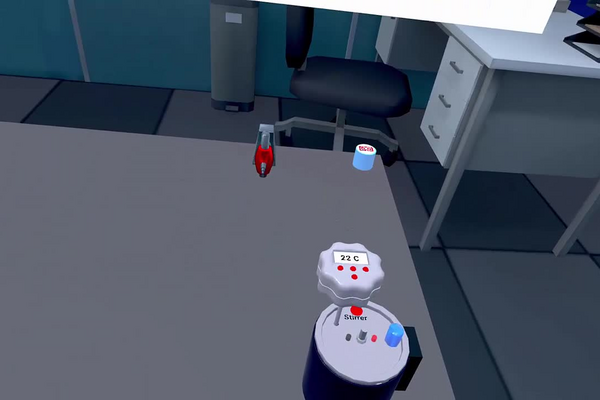
Calorimetry is how the energy content of anything gets measured — the calorie figure on a food label, the heating value of a fuel, the waste heat a battery gives off while charging, the heat released as concrete cures in a dam wall. The method never changes: run the process inside an insulated vessel whose heat capacity is known, and measure the temperature change of what is inside. Here the process is the reaction of magnesium metal with hydrochloric acid, Mg(s) + 2 HCl(aq) → MgCl2(aq) + H2(g), which is one of the most strongly exothermic reactions available at school scale.
Energy stored in the metallic bonding of magnesium and in the hydrated protons of the acid is released as the reaction proceeds, and because a calorimeter loses very little heat to the room, almost all of it shows up as a rise in the temperature of the liquid. Measuring the size of that rise gives the enthalpy of the reaction. Because the temperature is logged continuously rather than read once at the end, the same experiment answers a second question at the same time: how fast the reaction runs, read from how steeply the temperature climbs and when it levels off. The two answers are linked, because the heat the reaction releases warms the mixture and a warmer mixture reacts faster. In this laboratory you will measure 100 mL of hydrochloric acid into the calorimeter and record its temperature, weigh about 0.2 g of magnesium powder and add it, close the lid, start the stirrer and the stopwatch, and follow the temperature on the tablet’s graph until it stops rising.
Educational Goals
Familiarization with the calorimetry bench
- Locate the calorimeter, its lid with the built-in stirrer, the digital thermometer, the balance, the graduated cylinder and the tablet, and understand what each contributes to a single measurement.
- Recognise that a calorimeter is not simply a container: its value lies in limiting the heat exchanged with the room during the few minutes the reaction takes.
Use of the balance and of a weighing boat
- Tare a weighing boat and weigh out a small mass of powder to the resolution the balance offers, without losing any of it in the transfer.
- Explain why the mass of magnesium must be known before the reaction starts, and cannot be recovered afterwards.
Operation of the calorimeter
- Assemble the calorimeter in the correct order — liquid first, temperature recorded, solid added, lid closed, thermometer inserted, stirrer started — and say why each step comes where it does.
- Explain the purpose of the stirrer: without it the thermometer reads the liquid next to the metal rather than the average temperature of the contents.
Following a reaction in real time
- Read a temperature-against-time curve and identify the initial temperature, the steepest part of the rise and the plateau that marks the end of the reaction.
- Use the stopwatch and the graph together to state how long the reaction took, rather than relying on a single reading at the end.
Enthalpy calculation
- Apply q = mcΔT to convert a temperature rise into a quantity of heat, with the substitution written out.
- Convert that heat into a molar enthalpy of reaction by dividing by the amount of the limiting reagent, and identify which reagent that is.
Reaction rate
- Convert the temperature curve into an extent of reaction and use it to describe how the rate changes from the start of the reaction to the end.
- Name the factors that set the rate here — surface area of the powder, concentration of the acid, temperature — and predict the effect of changing each.
Critical evaluation of the measurement
- Compare the result with a published value.
- Identify the heat that the calculation ignores — the calorimeter itself, the escaping hydrogen, losses to the room — and state which way each shifts the answer.
Protocol
- Measure 100 mL of hydrochloric acid (HCl) 0.2 M using the graduated cylinder.
- Pour the contents of the graduated cylinder into the calorimeter.
- Immerse the tip of the digital thermometer in the liquid to take its temperature.
- The initial temperature of the liquid in the calorimeter will appear in the results table.
- Weigh approximately 0.2g of magnesium (Mg) powder.
- Pour the contents of the weighing boat into the calorimeter.
- Put the lid on the calorimeter.
- Insert the digital thermometer into the lid of the calorimeter.
- Start the stopwatch.
- Activate the green button of the agitator on the lid of the calorimeter.
- The graph of temperature as a function of time is on the tablet (graph tab).
- Note the final temperature when the reaction ends (between 3 and 4 minutes).
- Stop the stopwatch.
- The results are found in the results tab on the tablet.
- Stop the agitator by pressing the red button.
- Remove the thermometer from the calorimeter lid.
- Remove the lid of the calorimeter.
- Empty the contents of the calorimeter into the recovery bin.
- Rinse the calorimeter with distilled water and empty its contents into the recovery bin.
- Rinse the graduated cylinder with distilled water and empty its contents into the recovery tank.
Note : the reaction is accelerated 10 times faster, to more easily observe the complete reaction.
Anticipated Outcomes
The magnesium disappears within a few minutes, a steady stream of hydrogen bubbles rises through the acid, and the temperature climbs and then levels off. These are the readings the laboratory produces:
| Quantity | Reading | Where it is read |
|---|---|---|
| Mass of magnesium powder | 0.20 g | Electronic balance |
| Volume of HCl 0.2 mol/L | 100 mL | Graduated cylinder |
| Initial temperature | 22 °C | Calorimeter thermometer |
| Final temperature | 29 °C | Calorimeter thermometer |
| Temperature rise, ΔT | 7 °C | By difference |
| Time to the plateau | about 3 min | Stopwatch and graph tab |
The reaction. Magnesium is oxidised and the hydrated protons of the acid are reduced: Mg(s) + 2 HCl(aq) → MgCl2(aq) + H2(g), or as a net ionic equation Mg(s) + 2 H3O+(aq) → Mg2+(aq) + H2(g) + 2 H2O(l). The chloride ion takes no part; it is there to balance the charge. Two moles of acid are consumed for every mole of metal, which is what decides the limiting reagent.
Working the energy balance through. Each line below can be checked by a student with a calculator, which is the point of setting it out this way:
| Step | Expression and substitution | Result |
|---|---|---|
| Amount of magnesium | n = m/M = 0.2076 / 24.305 | 8.54 × 10⁻³ mol |
| Amount of acid | n = CV = 0.200 × 0.100 | 2.00 × 10⁻² mol |
| Acid needed for that magnesium | 2 × 8.54 × 10−3 | 1.71 × 10⁻² mol — magnesium is limiting, the acid is in 17 % excess |
| Heat taken up by the solution | q = mcΔT = 100 × 4.18 × 7 | 2.93 × 10³ J = 2.9 kJ |
| Molar enthalpy from this run | ΔH = −q/n = −2930 / 8.54 × 10⁻³ | −343 kJ/mol |
| Standard value, from ΔHf(Mg2+, aq) | 0 − (−466.85) | −466.9 kJ/mol |
| Hydrogen produced | V = nRT/P = (8.54 × 10−3 × 8.314 × 295) / 101 300 | 2.1 × 10⁻⁴ m3 = 210 mL |
The measured enthalpy sits below the textbook value, and the gap is worth discussing. The seven-degree rise corresponds to −343 kJ/mol, while the standard value calculated from the enthalpy of formation of the aqueous magnesium ion is −466.9 kJ/mol, which would give a rise of about 9.5 °C. Some of that gap is honest physics — a real calorimeter absorbs heat itself, and the escaping hydrogen carries a little away. Part of it is simply resolution: with a display that shows whole degrees, ΔT = 7 could be anything from 6.5 to 7.5, which is already ±7 % on the answer, or −343 ± 25 kJ/mol.
Why the reaction releases so much energy. The size of the enthalpy is worth unpacking, because it is not obvious. Building the products costs a great deal before it pays anything back: subliming the metal takes 148 kJ/mol, the first two ionisation energies of magnesium take a further 738 + 1451 = 2189 kJ/mol, and stripping the water from the two hydrated protons takes about 2 × 1091 = 2182 kJ/mol. Against that, hydrating the small, doubly charged Mg2+ ion releases about −1921 kJ/mol, discharging the two protons releases 2 × 1312 = 2624 kJ/mol, and forming the H–H bond releases a further 436 kJ/mol. The sum, 148 + 2189 + 2182 − 1921 − 2624 − 436, comes to −462 kJ/mol, within about 1 % of the tabulated −466.9. The single largest term on the release side is the hydration of Mg2+, and that is the general reason a small doubly charged metal ion in water is such an energetic product — the same argument accounts for calcium and the rest of the alkaline earths behaving the same way.
The same curve is a rate measurement. Because the heat released is proportional to the amount of magnesium consumed, the temperature curve is a conversion curve in disguise: the extent of reaction at any moment is α = (T − T0) / (T∞ − T0), so at 25.5 °C the reaction is half over. The slope dT/dt is proportional to the rate. Averaged over the roughly three minutes the run takes, that is 7 / 180 = 0.04 °C/s, or 8.54 × 10⁻³ / 180 = 4.7 × 10⁻⁵ mol/s. The instantaneous rate is not constant: three things change during the run and they do not all pull the same way.
- The acid is being used up. Its concentration falls from 0.200 mol/L to about 0.029 mol/L by the end, a factor of seven, and the rate of attack on the metal falls roughly in proportion to it. This is the dominant slowing influence and it is what makes the curve flatten.
- The metal surface is shrinking. A powder offers an enormous area to begin with, but that area falls as the particles dissolve, and the last few grains contribute very little. This is the variable that laboratories 061 and 062 isolate deliberately.
- The mixture is getting hotter, which speeds the reaction up. With an activation energy of roughly 60 kJ/mol, the Arrhenius factor between 295 K and 302 K is exp[(60 000/8.314) × (1/295 − 1/302)] = exp(0.57) = 1.8, so on temperature grounds alone the reaction would be running nearly twice as fast at the end as at the start. This is the feedback that ties the two halves of the laboratory together: the enthalpy the reaction releases changes its own rate.
The first two effects win and the curve flattens into a plateau, but the third is why the rise is steeper in the middle than at the very beginning. A class that has already done laboratory 067 can use the same q = mcΔT machinery here, and one that goes on to 065 will use this measurement as one leg of a Hess’s-law cycle.
Summary of Assignment by Grade Range
Grade 9–10
Focus: Recognising an exothermic reaction and measuring it with a thermometer.
Activities: Record the temperature before and after and state the rise. Describe what is seen — bubbles of hydrogen, the metal disappearing, the liquid warming — and identify which of those observations shows that a chemical reaction has taken place rather than a physical change. Write the word equation and then the balanced symbol equation. Sketch the shape of the temperature-against-time graph from memory and mark on it where the reaction was fastest and where it finished. Explain in a sentence where the energy came from, given that nothing was heated.
Grade 11
Focus: Quantitative calorimetry and the limiting reagent.
Activities: Calculate the amount of magnesium and the amount of acid, show by comparison with the 1:2 stoichiometry that the magnesium is limiting, and state the percentage excess of acid. Apply q = mcΔT with the substitution written out, then divide by the amount of magnesium to obtain the molar enthalpy. Compare the result with the published −466.9 kJ/mol and calculate the percentage difference. Use the ideal gas equation to find the volume of hydrogen produced. Predict what would happen to both the temperature rise and the final result if 0.4 g of magnesium were used instead of 0.2 g — the answer is not simply “twice”, because 0.4 g needs more acid than 100 mL of 0.2 mol/L provides.
Grade 12 / College Level
Focus: Error analysis, calorimeter calibration and the rate–enthalpy link.
Activities: Design and describe the calibration that would give the calorimeter’s own heat capacity, and calculate what value of it would reconcile the measured −343 kJ/mol with the published figure. Convert the temperature curve into an extent-of-reaction curve using α = (T − T0)/(T∞ − T0) and extract an initial rate from its slope. Use the Arrhenius equation to estimate how much of the change in rate over the run is due to the temperature rise and how much to the falling acid concentration, and say which dominates. Finally, construct the Born–Haber-style cycle given above and explain which single term makes this reaction as exothermic as it is.
Laboratory essentials
Instruments
- Calorimeter with insulating lid, and the lid’s built-in stirrer (green button to start, red to stop)
- Digital thermometer, inserted through the lid (displays whole degrees Celsius)
- Electronic balance (two decimal places)
- Graduated cylinders (70 mL and 250 mL) — the larger one is used to measure the 100 mL of acid
- Spatula
- Weighing boat
- Timer or stopwatch
- Tablet, for the protocol, the temperature-against-time graph and the results table
- Beaker (1000 mL) and recovery bin, for the waste and the rinsings
- Wash bottle of distilled water
Products
- HCl 0.2 mol/L (solution), 100 mL
- Magnesium (powder), about 0.2 g
- Distilled water, for rinsing the calorimeter and the cylinder