

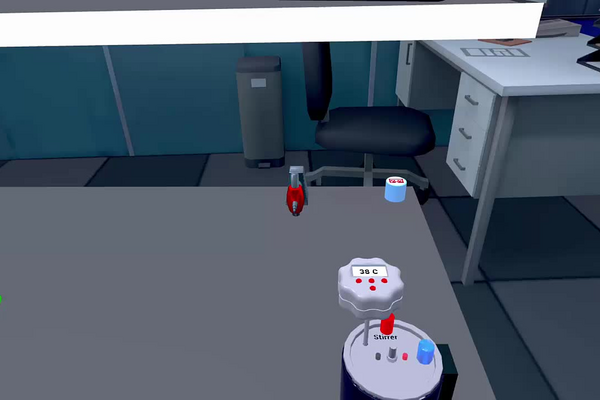
A reaction that gives out heat announces its own progress. If the vessel is insulated well enough that the heat stays where it is made, the temperature of the contents rises in step with the amount of reaction that has happened, so a thermometer becomes a clock and a yardstick at once: the height of the rise says how much reacted, the steepness of it says how fast. Chemical engineers use exactly this reading to control industrial reactors, where a runaway is detected as a temperature that climbs faster than the cooling can remove it, and calorimetry of this kind is how the energy content of a fuel or a foodstuff is certified.
Two separate things are being read off the same trace, and keeping them apart is the point of the laboratory. How far a reaction goes is fixed by the reagent that runs out first, and here that is always the magnesium: the same mass of metal releases the same quantity of heat, so the final temperature is the same whatever the acid. How fast it goes is set at the surface of the metal, where dissolved hydronium ions arrive at a rate proportional to how many of them there are in each millilitre of solution. Double the concentration and the reaction should finish in roughly half the time, while ending at the same temperature it would have reached anyway.
In this laboratory you will react about 0.4 g of magnesium powder with 100 mL of hydrochloric acid inside a stirred calorimeter, follow the temperature on the tablet’s graph, and record both the total rise and the time the reaction takes to finish. The run is then repeated with acid of twice the concentration. Because only the concentration changes between the two runs, the pair of durations is enough to measure how strongly rate depends on concentration — the order of reaction — rather than merely to observe that it does.
Educational Goals
Operation of a calorimeter
- Charge, close, stir and read a calorimeter, and say what each part of it is for.
- Explain why the lid, the stirrer and the insulation are all required before a temperature reading means anything.
Thermochemistry
- Convert a temperature rise into a quantity of heat with q = CΔT, and that quantity of heat into a molar enthalpy of reaction.
- Recognise an exothermic reaction from its trace and give the sign convention that goes with it.
Stoichiometry and the limiting reagent
- Show by calculation that the magnesium is limiting in both runs, and predict from that alone that the two temperature rises must be equal.
- Distinguish the extent of a reaction from its rate, and identify which of the two the acid concentration controls.
Chemical kinetics
- Write a rate law of the form rate = k · A · [H3O+]a and say what each symbol stands for.
- Obtain the order a from two runs that differ only in concentration, using the ratio of their durations.
Measurement and interpretation of data
- Read an end point from a temperature curve — the moment the trace becomes flat — rather than from the clock, and justify the choice.
- Compare two runs quantitatively.
Safety and waste handling
- Handle concentrated hydrochloric acid and a finely divided reactive metal with the appropriate protective equipment, and keep the hydrogen released away from any source of ignition.
- Empty and rinse the calorimeter and the cylinder into the recovery tank between the two runs, and explain why carry-over would spoil the second measurement.
Protocol
Part 1 : reaction with 1M HCl
- Measure 100 mL of hydrochloric acid (HCl) 1M using the graduated cylinder.
- Pour the contents of the graduated cylinder into the calorimeter.
- Immerse the tip of the digital thermometer in the liquid to take its temperature.
- The initial temperature of the liquid in the calorimeter will appear in the results table.
- Weigh approximately 0.4g of magnesium (Mg) powder.
- Pour the contents of the weighing boat into the calorimeter.
- Put the lid on the calorimeter.
- Insert the digital thermometer into the lid of the calorimeter.
- Start the stopwatch.
- Activate the green button of the agitator on the calorimeter lid.
- The graph of temperature as a function of time is on the tablet (graph tab).
- Note the final temperature when the reaction ends (at approximately 2 minutes).
- Stop the stopwatch.
- The results are found in the results tab on the tablet.
- Stop the agitator by pressing the red button.
- Remove the thermometer from the calorimeter lid.
- Remove the calorimeter lid.
- Empty the contents of the calorimeter into the recovery tank.
- Rinse the calorimeter with distilled water and empty its contents into the recovery tank.
- Rinse the graduated cylinder with distilled water and empty its contents into the recovery tank.
- Reset the stopwatch.
Part 2 : reaction with 2M HCl
- Repeat steps 1 to 21 above but using hydrochloric acid (HCl) 2M.
- Note the time required until the end of the reaction, determined by the stabilization of the temperature. Compare to the reaction from part 1 performed with 1M hydrochloric acid (HCl).
Note : the reaction is accelerated 10 times faster, to more easily observe the complete reaction.
Anticipated Outcomes
The reaction is the same in both runs: Mg(s) + 2 HCl(aq) → MgCl2(aq) + H2(g), a redox process in which the metal is oxidised to Mg2+ and the hydronium ion is reduced to hydrogen gas. It is strongly exothermic, which is what makes the calorimeter the right instrument.
The same temperature rise in both runs
With M(Mg) = 24.31 g/mol, a 0.41 g sample — the mass the balance displays in both recorded runs — is n = 0.41 / 24.31 = 1.69 × 10⁻² mol, and the equation requires 2 × 1.69 × 10−2 = 3.38 × 10⁻² mol of acid. The 100 mL portions supply 0.100 mol at 1 mol/L and 0.200 mol at 2 mol/L, so the acid is in excess by factors of 3.0 and 5.9 and the magnesium is limiting in both runs. The same number of moles reacts each time, so the same quantity of heat is released each time, so the two runs must end at the same temperature. This is worth predicting out loud before the second run is started, because it is the result students least expect: making the acid twice as strong does not make the reaction twice as hot.
| Run | Acid | HCl supplied in 100 mL | Mg | Limiting reagent | Acid in excess by | [HCl] at completion | Expected ΔT | Duration on the page |
|---|---|---|---|---|---|---|---|---|
| Part 1 | 1 mol/L | 0.100 mol | 0.0169 mol | Mg | 3.0 × | 0.66 mol/L | 17 °C | about 50 s |
| Part 2 | 2 mol/L | 0.200 mol | 0.0169 mol | Mg | 5.9 × | 1.66 mol/L | 17 °C | about 22 s |
From the temperature rise to the enthalpy of reaction
The heat released is q = CΔT, where C is the heat capacity of everything that warms up. Treating the 100 mL of dilute acid as water gives 100 g × 4.18 J/(g·K) = 418 J/K, to which the calorimeter itself adds a few tens of joules per kelvin. Taking the solution alone and the observed ΔT = 17 °C gives q = 418 × 17 = 7.1 kJ, and dividing by the 1.69 × 10⁻² mol of magnesium gives ΔrH = −7.1 / 0.0169 = −420 kJ/mol. The negative sign is the convention for a reaction that gives heat out.
That figure is a lower bound, because any heat capacity not counted makes the true enthalpy larger. The accepted value for this reaction is −466.9 kJ/mol, and recovering it from a 17 °C rise requires C = 0.0169 × 466 900 / 17 = 464 J/K — the 418 J/K of solution plus 46 J/K for the vessel, lid, stirrer and thermometer, which is an entirely ordinary calorimeter constant. The figure of −440 kJ/mol previously quoted on this page corresponds to C = 437 J/K, which is equally reasonable. In other words this laboratory’s temperature rise is consistent with the accepted enthalpy once the calorimeter is properly accounted for, which is not the case for every experiment in this set: see the reconciliation problem noted in laboratories 059 and 060. Determining C independently, by adding a known quantity of hot water before the run, turns this from a demonstration into a measurement.
The reaction also produces 1.69 × 10⁻² mol of hydrogen, which is about 0.41 L at room conditions and escapes past the lid. Laboratory 063 collects that gas instead of measuring the heat, and the two laboratories are therefore two ways of watching the same reaction: 063 counts the product, 064 counts the energy.
The order of reaction, from two durations
The rate of a solid dissolving in acid is rate = k · A · [H3O+]a, where A is the exposed area of metal and a is the order in hydronium ion. The same mass of the same powder is used in both runs, so A follows the same history in both and cancels. The time to consume a fixed quantity of metal is inversely proportional to the rate, so t1 / t2 = ([HCl]2 / [HCl]1)a, and taking logarithms gives a = ln(t1 / t2) / ln([HCl]2 / [HCl]1).
With the durations the page gives, t1 = 50 s and t2 = 22 s, the ratio of times is 2.27 for a concentration ratio of 2.00, so a = ln(2.27) / ln(2.00) = 0.821 / 0.693 = 1.18. That is close to first order, and slightly above it.
The excess above one is largely an artefact of using the starting concentrations, because the acid is consumed as each run proceeds and the weaker one loses proportionally more of it. Part 1 falls from 1.00 to 0.66 mol/L, a mean of 0.83; part 2 falls from 2.00 to 1.66 mol/L, a mean of 1.83. The effective concentration ratio is therefore 1.83 / 0.83 = 2.21 rather than 2.00, and a = ln(2.27) / ln(2.21) = 0.821 / 0.793 = 1.04. Corrected for depletion the reaction is first order in hydronium ion to within the precision two runs can support — the same conclusion laboratory 062 reaches for calcium carbonate, where the order came out at 1.03.
| Quantity | Part 1 (1 mol/L) | Part 2 (2 mol/L) | Ratio | Order a |
|---|---|---|---|---|
| Duration of the reaction | 50 s | 22 s | 2.27 | — |
| Concentration at the start | 1.00 mol/L | 2.00 mol/L | 2.00 | 1.18 |
| Mean concentration over the run | 0.83 mol/L | 1.83 mol/L | 2.21 | 1.04 |
What the shape of the trace shows
Both curves rise steeply at first and then flatten, and the flattening has three causes acting together. The acid is being consumed, by a third in part 1 and by a sixth in part 2. The magnesium grains are shrinking, so the area A in the rate law falls — for particles dissolving at a constant linear speed the area goes roughly as the two-thirds power of the mass remaining, so the last tenth of the metal takes far longer than the first. And the reaction is running out of reactant altogether, which is what fixes the end point.
Pulling the other way, the mixture is heating itself. A 17 °C rise is worth a factor of exp[(60 000 / 8.314)(1/293 − 1/310)] ≈ 3.9 in the rate constant for an activation energy of order 60 kJ/mol, so the reaction accelerates itself substantially as it goes. The temperature curve is consequently S-shaped rather than a simple decaying exponential: slow at the start while the surface oxide dissolves and the mixture is still cold, steepest in the middle where the metal is still plentiful and the solution already warm, then flat. The fraction of the magnesium consumed at any moment is (T − T0) / (T∞ − T0), which is the most useful way to read the graph: the half-way point of the reaction is the moment the temperature has risen by half its final amount, about 8.5 °C here.
Because the self-heating is the same size in both runs but arrives sooner in part 2, it inflates the apparent order slightly — part of the reason the uncorrected figure came out at 1.18 rather than 1.00. Separating the thermal feedback from the concentration effect properly would require running both concentrations in a thermostatted vessel, which is the natural extension for a college class.
Where this laboratory fits
This is one of a set of four experiments on the factors that govern reaction rate. Laboratories 061 and 062 hold the concentration fixed and vary the contact surface; laboratory 063 and this one hold the surface fixed and vary the concentration. Laboratory 063 follows the same magnesium and hydrochloric acid reaction by collecting its hydrogen, so the two make a natural pair to run together, and laboratories 059 and 060 use the same calorimeter for the enthalpy of this reaction and for a Hess cycle built on it.
Summary of Assignment by Grade Range
Grade 9–10
Focus: Exothermic reactions, and the difference between how hot a reaction gets and how quickly it gets there.
Activities: Run both parts and record the starting temperature, the final temperature and the time taken for each. Sketch the two temperature curves on one grid. Answer two questions from them: which acid finished sooner, and which reached the higher temperature. Use the fact that the answer to the second is “neither” to introduce the limiting reagent, and write the word equation for the reaction.
Grade 11
Focus: Quantitative thermochemistry and the concentration effect.
Activities: Balance the equation and show by calculation that the magnesium is limiting in both runs, predicting the equality of the two temperature rises before running part 2. Convert the observed rise into a quantity of heat with q = CΔT, taking the solution as 100 g of water, and then into an enthalpy per mole of magnesium. Compare with the accepted −466.9 kJ/mol and say what a shortfall implies about the calorimeter. Compare the two durations and state in words how strongly rate depends on concentration.
Grade 12 / College Level
Focus: Extraction of the order of reaction, and a full account of what limits its precision.
Activities: Derive a = ln(t1/t2) / ln([HCl]2/[HCl]1) from the rate law and evaluate it, first with the initial concentrations and then with the concentrations averaged over each run; account for the difference. Read the extent of reaction off the temperature trace as (T − T0) / (T∞ − T0) and obtain an initial rate from the first few seconds rather than from the total duration, then repeat the determination of a from those initial rates and say which of the two methods is sounder. Estimate the calorimeter constant required to reconcile the measured enthalpy with the accepted value, and design the hot-water calibration that would measure it. Discuss the effect of the 17 °C self-heating on the apparent order, and compare the result with laboratory 062, which obtains an order of 1.03 for calcium carbonate by the same argument.
Laboratory essentials
Instruments
- Calorimeter with lid, stirrer and green/red stirrer controls
- Digital thermometer
- Electronic scale
- Graduated cylinder, 100 mL
- Recovery tank
- Spatula
- Tablet (graph and results tabs)
- Timer
- Weighing boat
Products
- HCl 1 mol/L (solution)
- HCl 2 mol/L (solution)
- Magnesium (powder, approximately 0.4 g per run)
- Distilled water (rinsing)