

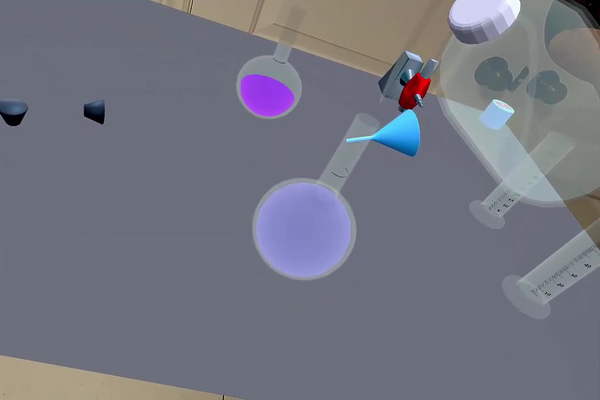
Preparing a solution of a stated concentration is the most common operation in a chemistry laboratory, and there are only two ways to do it: dissolve a weighed mass of solid and make the volume up to a mark, or take a measured volume of a solution that already exists and dilute it. Analytical laboratories, hospital pharmacies and water-treatment plants all keep concentrated stock solutions and dilute them on the day of use, because a dilution can be carried out more accurately and far more quickly than a weighing. Both routes work for the same reason: concentration is a ratio, the mass of solute divided by the volume of solution, so adding solvent changes the volume and therefore the concentration, but never the amount of solute already present.
Potassium permanganate is a useful solute for learning this because its colour reports its concentration: the deeper the violet, the more concentrated the solution. In this laboratory you will prepare one solution by each route and check both against a set of six reference tubes. First you will weigh about 4 g of potassium permanganate, transfer it through a funnel into a 100 mL volumetric flask, dissolve it in distilled water and bring the volume up to the calibration mark, which gives 40 g/L. Then you will measure 54.7 mL of that solution into a 250 mL volumetric flask, make that flask up to its own mark, and obtain 8.75 g/L. Comparing each result against the control tubes closes the loop between a calculation on paper and something you can see.
Educational Goals
- Preparation of a solution by dissolution — weigh a solid to the hundredth of a gram, transfer it into a volumetric flask without loss, dissolve it completely, and bring the solution to a known final volume rather than adding a known volume of solvent.
- Preparation of a solution by dilution — calculate the volume of a stock solution needed to reach a target concentration and volume, measure it out, and complete the dilution in volumetric glassware.
- Correct use of volumetric glassware — distinguish a volumetric flask, which is calibrated to contain one volume very precisely, from a graduated cylinder, which is calibrated to read many volumes approximately; read the bottom of the meniscus against the calibration mark at eye level; mix by inversion once the stopper is in place.
- Concentration calculations — convert between mass concentration in g/L and molar concentration in mol/L using the molar mass, and apply C1V1 = C2V2 to a dilution.
- Colorimetric verification of a result — compare a prepared solution against a graded reference series in front of a black card, and judge how far such a comparison can be trusted.
- Handling a strong oxidiser safely — wear gloves, eye protection and a laboratory coat, keep potassium permanganate away from organic material, and dispose of the solutions in the container provided rather than in the sink.
Protocol
Solutions are first obtained through the dissolution process. Then, it is possible to modify the concentration of a solution through the dilution process.
- Dissolution
We want to prepare a potassium permanganate solution at 40 g/L.
- Weigh about 4 g of potassium permanganate using the electronic balance.
To do this, use 1 scoop of the 1 mL spatula and 4 scoops of the 0.12 mL spatula.
- Using a funnel, pour the weighed powder into a 100 mL volumetric flask, the smaller of the two volumetric flasks.
- Measure 50 mL of distilled water using a graduated cylinder.
- Pour the measured water into the volumetric flask containing the potassium permanganate.
- Remove the funnel and place a stopper on the neck of the flask.
- Shake the solution, then remove the stopper.
- Bring the volume of the solution up to the calibration mark with distilled water.
- Replace the stopper and mix by inversion.
- Compare the color obtained with that of the samples provided to verify the final concentration.
The concentrations of the control solutions are as follows:
- Test tube 1 : 8.75 g/L
- Test tube 2 : 17.5 g/L
- Test tube 3 : 31.25 g/L
- Test tube 4 : 35 g/L
- Test tube 5 : 40 g/L
- Test tube 6 : 45 g/L
- Dilution
We want to prepare 250 mL of potassium permanganate solution at 8.75 g/L.
- Using a 70 mL graduated cylinder, measure 54.7 mL of the solution prepared in the first part.
- Pour the contents of the graduated cylinder into the empty 250 mL volumetric flask.
- Bring the volume of the solution up to the calibration mark with distilled water.
- Insert a stopper and mix by inversion.
- Compare the color obtained with that of the samples provided to verify the final concentration.
Note: Ensure that the solutions are in front of a black card, to clearly distinguish the color changes.
Safety: potassium permanganate is a strong oxidizer that stains skin and clothing. Wear gloves and eye protection and keep it away from organic material.
Anticipated Outcomes
Two solutions are produced, one by each route, and each is expected to match one of the six control tubes.
| Part A — by dissolution | Part B — by dilution | |
|---|---|---|
| Target concentration | 40 g/L | 8.75 g/L |
| KMnO4 in the flask | 4.00 g weighed out | 2.19 g carried over |
| Final volume of solution | 100 mL (to the mark) | 250 mL (to the mark) |
| Molar concentration | 0.253 mol/L | 0.055 mol/L |
| Volume transferred in | — | 54.7 mL of the 40 g/L solution |
| Expected colour match | control tube 5 | control tube 1 |
The two calculations, worked out
Part A, dissolution. Mass concentration is C = m / V, so 4.00 g made up to 0.1000 L of solution gives C = 4.00 / 0.1000 = 40.0 g/L. To express the same solution in molar terms, the molar mass of potassium permanganate is M = 39.10 + 54.94 + (4 × 16.00) = 158.04 g/mol, so n = m / M = 4.00 / 158.04 = 0.0253 mol and C = n / V = 0.0253 / 0.1000 = 0.253 mol/L.
Part B, dilution. Because the amount of solute does not change when solvent is added, C1V1 = C2V2. Rearranging for the volume of stock solution required, V1 = C2V2 / C1 = (8.75 g/L × 250 mL) / 40 g/L = 2187.5 / 40 = 54.7 mL. The dilution factor can be checked two ways and must agree: by concentration, 40 / 8.75 = 4.57, and by volume, 250 / 54.7 = 4.57. The mass carried across is 54.7 mL × 40 g/L = 2.19 g, and that same 2.19 g is what the 250 mL flask contains at the end: 2.19 g / 0.250 L = 8.75 g/L.
The control series
| Tube | Concentration (g/L) | Concentration (mol/L) | Volume of the 40 g/L solution needed to make 250 mL of it |
|---|---|---|---|
| 1 | 8.75 | 0.055 | 54.7 mL |
| 2 | 17.5 | 0.111 | 109.4 mL |
| 3 | 31.25 | 0.198 | 195.3 mL |
| 4 | 35 | 0.222 | 218.8 mL |
| 5 | 40 | 0.253 | 250 mL, undiluted |
| 6 | 45 | 0.285 | not obtainable by dilution |
Why the flask is filled to the mark
Concentration is defined per litre of solution, not per litre of solvent, and this laboratory is built so that the difference shows. Solid potassium permanganate has a density of about 2.70 g/cm3, so the 4.00 g weighed out occupies roughly 1.5 mL of its own; dissolving it also changes the volume of the water slightly. Adding a measured 100 mL of distilled water to the solid would therefore give something close to 101.5 mL of solution and a concentration near 39.4 g/L — about 1.5 % low, which is larger than every other error in the procedure combined. Bringing the level up to the flask’s single calibration mark removes the problem entirely, because the total volume of solution is then fixed by the glass rather than by a calculation. The same logic explains why the flask is only about half filled before the solid is dissolved: it must be possible to reach the mark afterwards, not overshoot it.
What the colour can and cannot tell you
The permanganate ion absorbs strongly around 525 nm, and the relationship between colour and concentration is the Beer–Lambert law, A = εlc, where A is absorbance, ε the molar absorption coefficient (about 2400 L mol−1 cm−1 for MnO4−), l the path length through the liquid and c the molar concentration. Substituting the most dilute tube in the series, at 0.055 mol/L viewed across a test tube of roughly 1.5 cm internal diameter: A = 2400 × 0.055 × 1.5, which is about 200. An absorbance of 200 means a transmittance of 10−200 — no light at all. On a real bench every one of the six tubes, and both prepared solutions, would look uniformly black.
A permanganate solution shows a usable violet only up to about A = 1.5, which corresponds to c = 1.5 / (2400 × 1.5) = 4 × 10⁻⁴ mol/L, or 0.07 g/L. That is roughly 130 times more dilute than tube 1 and 600 times more dilute than tube 5. The simulation renders the tubes as a legible gradient from pale lilac to deep violet, which makes the exercise work on screen, but it is not what the eye would see. A teacher running this on a real bench has two honest options: dilute the reference series and a sample of each prepared solution by the same large factor before comparing them, or measure absorbance at 525 nm with a spectrophotometer, which is how permanganate concentrations are actually determined.
There is a second limit, independent of the first. Visual colour matching can resolve a difference in concentration of perhaps 20 to 30 % at best. Tubes 4, 5 and 6 are 35, 40 and 45 g/L, spaced by only 13 and 11 %, so they cannot be distinguished by eye even at a workable dilution — and tube 5 is precisely the one the student is asked to match in Part A. Tube 1 at 8.75 g/L is a factor of two below tube 2, so the Part B comparison is sound. If the reference series is intended to be gradeable, spacing it by a factor of about 1.5 or 2 throughout would make it so; this is the same issue recorded for the reference rack in the preparation of solution by dissolution laboratory.
Summary of Assignment by Grade Range
Grade 9–10
- Focus: the vocabulary of solutions and the correct handling of volumetric glassware.
- Activities: identify the solute, the solvent and the solution; weigh the permanganate and record the mass actually obtained; carry out both preparations, reading the meniscus against the calibration mark; calculate the concentration of Part A as mass divided by volume in g/L; place both flasks against the black card and choose the matching control tube for each; explain in one sentence why the flask is filled to a mark instead of by adding a measured volume of water.
Grade 11
- Focus: molar concentration and the dilution relationship.
- Activities: convert both solutions from g/L to mol/L using M = 158.04 g/mol; derive the 54.7 mL transfer volume from C1V1 = C2V2 before starting, and verify it afterwards by two independent routes (dilution factor by concentration and by volume); calculate the mass of permanganate transferred and show that it is unchanged by the dilution; complete the control-tube table by converting all six concentrations to mol/L and working out the volume of stock each would require.
Grade 12 / College Level
- Focus: the Beer–Lambert law and quantitative colour comparison.
- Activities: use A = εlc to calculate the absorbance of tube 1 and demonstrate that the reference series is far too concentrated to show colour, then determine the dilution factor that would bring it into a readable range; decide which pairs of control tubes could be distinguished by eye and which could not; explain why the concentration must be defined per litre of solution; design a spectrophotometric calibration that would turn the colour comparison into a measurement, and explain why a permanganate solution has to be restandardised.
Laboratory essentials
Instruments
- Electronic balance (readable to 0.01 g)
- Volumetric flasks (100 mL and 250 mL) with stoppers
- Graduated cylinders (50 mL and 70 mL)
- Spatulas (0.12 & 1mL)
- Weighing boat
- Funnel
- Control solutions in test tubes (tubes 1 to 6, 8.75 to 45 g/L)
- Black comparison card
- Gloves, safety glasses and laboratory coat
Products
- Potassium permanganate KMnO4 (powder, about 4 g)
- Distilled water