

Electrical conductivity is the fastest measurement made in any water laboratory. A drinking-water plant, a dialysis unit, a hydroponic greenhouse and a boiler feedwater line all monitor it continuously, because a single number tells an operator how much dissolved ionic material a liquid is carrying, in real time and without destroying the sample. The same measurement is what a soil probe reports as salinity, what a swimming-pool controller uses to decide how much salt to add, and what a clinical laboratory uses to check that a saline bag is what its label says.
A liquid conducts an electric current only if it contains charged particles that are free to move through it. Water itself contains almost none, so pure water is a poor conductor; what matters is whether the dissolved substance releases ions into the solution. An ionic solid such as sodium chloride is already built of ions and only needs its lattice pulled apart by hydration. A polar molecule such as hydrogen chloride contains no ions at all until water takes a proton from it, and how far that proton transfer goes is set by the acid constant. A molecule such as sucrose has neither a lattice to break nor a proton to give: it dissolves beautifully and releases nothing. Dissolving and dissociating are two different processes, and conductivity is the property that tells them apart.
In this laboratory you will test twelve liquids with an electrical conductivity detector — a pair of electrodes wired in series with an indicator lamp — and record the brightness of the lamp for each one on a three-level scale. Ten of the liquids are prepared solutions of known concentration; the other two, distilled water and drinking water, you will measure out yourself. From those twelve readings you will sort the substances into strong electrolytes, weak electrolytes and non-electrolytes, and then account for each group by the kind of bonding it contains.
Educational Goals
Distinguishing electrolytes from non-electrolytes
- Classify a solution as a strong electrolyte, a weak electrolyte or a non-electrolyte from a conductivity reading alone.
- State why the classification belongs to the solution and not to the solute on its own: the same substance can be a strong or a weak electrolyte depending on how dilute it is.
Bonding as the cause of conduction
- Explain conduction in terms of what the dissolved particle actually is — an ion released from a lattice, an ion created by proton transfer, or an intact neutral molecule.
- Predict, before testing it, whether an unfamiliar substance will conduct, from its formula and its bonding.
Operating the conductivity detector
- Use the detector correctly: switch on, immerse both electrodes to the same depth, read, withdraw, rinse and wipe.
- Explain why the rinse between samples is a measurement step and not housekeeping, and estimate what a single carried-over drop would do to the next reading.
Quantitative treatment of conductivity
- Calculate the conductivity of a strong electrolyte solution from tabulated limiting molar conductivities and its concentration.
- Calculate the fraction of a weak acid that is dissociated, and use it to explain a dim lamp at the same concentration that gives a bright one for a strong acid.
Connecting the measurement to its uses
- Relate the readings to nerve conduction, water-quality monitoring, and the reason distilled water is specified for rinsing laboratory glassware.
Protocol
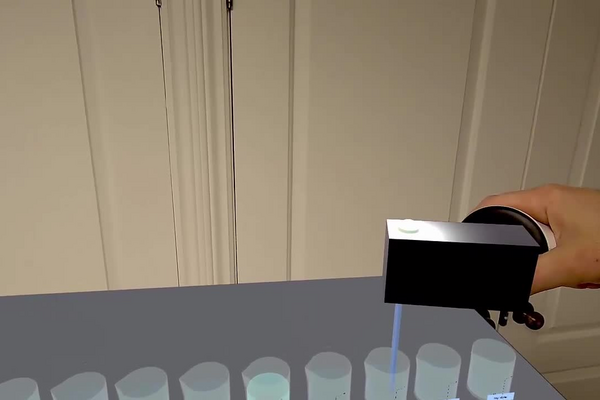
- You have in front of you 10 beakers of 50 mL containing substances identified with their chemical formula.
- To the right of the row of beakers; you have two empty beakers. Pour 50 mL of distilled water into the beaker designated for this purpose and 50 mL of tap water into the other beaker designated for this purpose.
- Take the conductivity detector (DCE) and turn it on by clicking the switch.
- Clean the DCE electrodes with distilled water and wipe them with absorbent paper.
- Dip the electrodes into the first substance and note the brightness of the bulb in the results table (0 or -: off; 1 or +: dim; 2 or ++: bright).
- Repeat steps 3 to 5 for each of the other 11 substances.
- The brightness of each substance is recorded in the results table.
Anticipated Outcomes
The lamp answers a single question for each liquid: are there mobile ions in it, and roughly how many? The twelve readings fall into three clear groups, and the interesting cases are the ones at the boundaries.
| Solution | Luminosity of the lamp | Classification |
|---|---|---|
| NaOH (0.5 mol/L) | ++ | strong electrolyte |
| NaCl (0.5 mol/L) | ++ | strong electrolyte |
| CH3COOH (0.5 mol/L) | + | weak electrolyte |
| HCl (0.5 mol/L) | ++ | strong electrolyte |
| C12H22O11 (0.5 mol/L) | – | non-electrolyte |
| Ca(OH)2 (saturated) | ++ | strong electrolyte |
| (COOH)2 (0.5 mol/L) | + | weak electrolyte |
| C3H8O (50 % V/V) | – | non-electrolyte |
| CH3OH | – | non-electrolyte |
| KOH (0.5 mol/L) | ++ | strong electrolyte |
| Distilled water | – | non-electrolyte |
| Drinking water | + | dilute strong electrolytes |
Classification of the substances
- Strong electrolytes — NaOH, NaCl, HCl, Ca(OH)2, KOH. Every formula unit that goes into solution is present as ions.
- Weak electrolytes — ethanoic (acetic) acid and oxalic acid. Both are molecules in the bottle and only a fraction of them transfer a proton to water.
- Non-electrolytes — sucrose, isopropyl alcohol, methanol and distilled water. All four are excellent solvents or solutes and none of them supplies ions.
- Drinking water is the one reading that does not fit the labels. Its dissolved mineral salts are fully dissociated, so it is a strong electrolyte by nature; the lamp is dim only because those salts are present at millimolar concentrations. Low conductivity here reports a small quantity of ions, not partial dissociation — the same dim glow, arrived at from the opposite direction to ethanoic acid.
Why the lamp lights: conductivity, molar conductivity and concentration
The conductivity of a solution is the sum of the contributions of every ion in it, each weighted by how much of it there is and how fast it moves. For a strong electrolyte at moderate dilution the contributions add independently, which is Kohlrausch’s law: Λ°m = Λ°+ + Λ°−. For sodium hydroxide, with the limiting molar conductivities of Na+ and OH− at 25 °C:
Λ°m(NaOH) = 50.1 + 198.0 = 248.1 S·cm2/mol
The conductivity itself follows from κ = Λm × C, with the concentration converted to moles per cubic centimetre (0.500 mol/L = 5.00 × 10⁻⁴ mol/cm3):
κ = 248.1 × 5.00 × 10−4 = 0.124 S/cm = 124 mS/cm
That is the ideal figure. What the detector actually feels is a resistance, R = K / κ, where K is the cell constant of the electrode pair — the electrode separation divided by their area. For a pair of 1 cm2 electrodes 1 cm apart, K = 1 cm−1, and the sodium hydroxide solution presents about 8 Ω. The table below works this through for the whole set, and it is the quantitative version of the brightness column.
| Liquid | Λ°m (S·cm2/mol) | Calculated κ (mS/cm) | Resistance at K = 1 cm−1 (Ω) | Observed |
|---|---|---|---|---|
| HCl (0.5 mol/L) | 426 | 213 | 4.7 | ++ |
| KOH (0.5 mol/L) | 272 | 136 | 7.4 | ++ |
| NaOH (0.5 mol/L) | 248 | 124 | 8.1 | ++ |
| NaCl (0.5 mol/L) | 126 | 63 | 16 | ++ |
| (COOH)2 (0.5 mol/L) | — | 55 | 18 | + |
| Ca(OH)2 (saturated, 0.023 mol/L) | 515 | 12 | 83 | ++ |
| CH3COOH (0.5 mol/L) | — | 1.2 | 850 | + |
| Drinking water | — | 0.2 to 0.8 | 1000 to 5000 | + |
| Distilled water | — | 0.001 to 0.005 | 2 × 10⁵ to 106 | – |
| Sucrose, isopropanol, methanol | — | below 0.005 | above 2 × 10⁵ | – |
Three things in that table are worth stopping on. Potassium hydroxide out-conducts sodium hydroxide (272 against 248) because K+ carries 73.5 S·cm2/mol against Na+’s 50.1 — the larger bare ion is the faster one, because its charge is spread over a bigger surface and it drags a smaller shell of hydration water with it. Hydrochloric acid leads the whole set because H+ contributes 349.8 and OH− 198.0, four to seven times more than an ordinary ion of the same charge: neither actually swims through the water, they pass along a chain of hydrogen bonds, an oxygen at a time. That mechanism is the same one that makes the acid and base solutions in laboratory 050 conduct so much better than the salt at equal concentration. And the saturated calcium hydroxide is the odd one out at the top: it is bright, but it is not concentrated.
Saturated is not the same as concentrated
Calcium hydroxide dissolves to only about 1.73 g/L at 20 °C, and with M = 74.09 g/mol that is 0.023 mol/L — roughly one twentieth of the concentration of the other bright solutions. Each formula unit does release three ions (0.023 mol/L of Ca2+ plus 0.047 mol/L of OH−, so [OH−] alone puts the solution at pH 12.7, hazardous despite the low concentration), and its calculated conductivity of about 12 mS/cm is still ten times lower than the sodium hydroxide beside it. Both read ++. A student who concludes from the lamp that the two solutions are comparably concentrated has been misled by a saturating detector, not by bad technique.
Weak electrolytes: how little of the acid is actually ionised
Ethanoic acid and hydrochloric acid sit in the row of beakers at the same 0.5 mol/L, and one is bright while the other is dim. The concentration on the label counts molecules; the lamp counts ions. For a weak acid, [H3O+] = √(Ka × C), and with Ka = 1.8 × 10⁻⁵:
[H3O+] = √(1.8 × 10−5 × 0.500) = 3.0 × 10⁻³ mol/L, so α = 3.0 × 10⁻³ / 0.500 = 0.60 %
Six molecules in a thousand have given up their proton. The ion concentration is therefore about 170 times lower than in the hydrochloric acid beaker, and the calculated conductivity follows it down: (349.8 + 40.9) × 3.0 × 10−6 = 1.2 × 10⁻³ S/cm = 1.2 mS/cm against 213 mS/cm. This is the same comparison laboratory 048 makes with a pH meter, where the two 0.10 mol/L acids differ by 1.87 pH units; here it is made with a lamp instead, and the two laboratories should be read together.
Because α = √(Ka/C), the label “weak electrolyte” describes a solution rather than a substance. The same ethanoic acid is 0.60 % ionised at 0.500 mol/L, 6.0 % at 5.0 × 10⁻³ mol/L and 42 % at 1.0 × 10⁻⁴ mol/L. Dilute it far enough and every weak acid becomes a strong one in this sense; what falls is the number of ions per litre, which is what the lamp responds to. Ostwald’s dilution law is the algebra behind that statement, and it is the reason molar conductivity, not conductivity, is the quantity chemists tabulate.
Oxalic acid does not belong beside ethanoic acid, and the calculation says so. Its first ionisation constant is Ka1 = 5.4 × 10⁻², roughly three thousand times larger, so at 0.500 mol/L the square-root shortcut fails and the quadratic must be solved: x2 / (0.500 − x) = 5.4 × 10⁻² gives x = 0.14 mol/L, that is α = 28 %. The predicted conductivity is then about (349.8 + 40) × 1.4 × 10−4 = 55 mS/cm — a quarter of the hydrochloric acid and forty-five times the ethanoic acid. On this reasoning the oxalic acid beaker should glow nearly as brightly as the strong acids, not dimly. It is correctly called a weak acid, because it is a molecule that only partly ionises, but a conductivity lamp is not able to place it in the same bracket as ethanoic acid. This conflict between the recorded reading and the calculation is reported to the development team rather than resolved here; treat the oxalic acid row as the set’s open question and a good discussion prompt.
Dissolving is not dissociating
Sucrose at 0.5 mol/L is 171 g in a litre of water — a heavy load of solute, thoroughly dissolved, and the lamp stays dark. Methanol and aqueous isopropanol behave the same way. All three are held in solution by hydrogen bonds to their hydroxyl groups, exactly the interaction that dissolves them so well, and none of those bonds breaks to give a free ion. Compare that with sodium chloride, where the lattice energy of about +787 kJ/mol is almost exactly repaid by the hydration of the separated ions at about −783 kJ/mol, leaving an enthalpy of solution near zero (+3.9 kJ/mol, the figure laboratory 039 uses) and a solution that is entirely ionic. What makes the difference is not how much dissolves but what the dissolved particle is. Water’s high relative permittivity of 78 is what makes the ionic case possible at all: it weakens the attraction between separated charges by that factor, which is why the same salt is almost insoluble in ethanol (εr 24) and why the 50 % isopropanol mixture in this laboratory has a permittivity nearer 55.
Distilled water is the control that makes all of this legible. Its own ionisation supplies only 1.0 × 10⁻⁷ mol/L of each ion, giving a theoretical conductivity of 0.055 µS/cm; in practice dissolved carbon dioxide raises laboratory distilled water to one or a few µS/cm. Drinking water, at 200 to 800 µS/cm, is a hundred to a thousand times higher — and still a hundred times below the salt solution. Those two beakers between them span the whole range that the word “water” covers.
What a lamp can and cannot report
The detector is a series circuit: source, lamp, solution. If the lamp is an ordinary indicator bulb rated at, say, 6 V and 0.3 A, its hot resistance is about 20 Ω, and the power reaching the filament is P = V2Rlamp / (Rlamp + Rsolution)2. Full brightness therefore requires the solution to present much less than 20 Ω, which the five strong electrolytes do (4.7 to 83 Ω). At Rsolution = 20 Ω the filament receives a quarter of its rated power; by about 45 Ω it is down to a tenth and is barely glowing. The ethanoic acid at roughly 850 Ω would pass about 7 mA and dissipate a milliwatt in the filament — about a thousandth of what it needs to be visible.
In other words, a filament lamp on its own cannot produce the “+” readings recorded for ethanoic acid and drinking water. A detector that resolves three levels across this range has to be electronic — an LED with a series resistor, or an amplifier driving the indicator — and the readings in the results table should be read as the output of such an instrument rather than as literal filament brightness. This matters for teaching, because a student asked to explain a dim glow at 1.2 mS/cm from first principles will find that the circuit as drawn does not permit it.
Two further consequences of the circuit are worth making explicit. First, a direct current through the sample electrolyses it: at 0.24 A for five seconds, 1.2 C passes, which is 1.2 × 10⁻⁵ mol of electrons and enough to raise visible hydrogen at the cathode, while the layer of product left on the electrodes raises the apparent resistance the longer the electrodes stay in. Real conductivity meters drive the cell with alternating current at about 1 kHz for exactly this reason, and the protocol’s instruction to read promptly is the practical equivalent. Second, the rinse in step 4 is a quantitative step: a single 0.05 mL drop of 0.5 mol/L NaOH carried into the next 50 mL beaker makes it 5 × 10⁻⁴ mol/L, with a conductivity near 0.12 mS/cm — sixty times that of distilled water and within a factor of four of drinking water. One unrinsed drop is enough to turn the distilled-water control into a positive result.
Summary of Assignment by Grade Range
Grade 9–10
Focus: observation, vocabulary and the electrolyte / non-electrolyte distinction.
Activities: test all twelve liquids, record the brightness on the three-level scale, and sort the results into a table of conducting and non-conducting liquids. Use the formulas to say which liquids contain a metal and which do not, and describe the pattern found. Rinse and wipe the electrodes between every sample and explain, in one sentence, what would happen if they did not. Expected at this level: correct use of the terms ion, electrolyte and non-electrolyte, a correctly completed results table, and the observation that sucrose dissolves without conducting.
Grade 11
Focus: quantitative treatment — concentration, dissociation and the numbers behind the brightness.
Activities: calculate the conductivity of the sodium chloride, sodium hydroxide and potassium hydroxide solutions from tabulated limiting molar conductivities using κ = Λ°mC, and rank the twelve liquids by the value obtained. Calculate the degree of dissociation of the ethanoic acid from Ka and explain the dim lamp at the same concentration that gives a bright one for hydrochloric acid. Work out the molar concentration of the saturated calcium hydroxide from its solubility and explain why a dilute solution can still be a strong electrolyte and still be corrosive. Expected at this level: correct arithmetic with a substitution shown, a defensible ranking, and the explicit statement that the lamp responds to ion concentration rather than to solute concentration.
Grade 12 / College Level
Focus: derivation, instrument limits and independent criticism of the method.
Activities: derive Ostwald’s dilution law from the acid equilibrium and use it to show that the strong / weak distinction is a statement about a solution and not about a substance. Solve the oxalic acid equilibrium as a quadratic, predict its conductivity, and account for the disagreement with the recorded reading. Convert each calculated conductivity into the resistance seen by a cell of constant K = 1 cm−1, then use the series-circuit power expression to establish over what range of conductivity a filament lamp could in fact act as a three-level indicator, and state what instrument would be required outside that range. Estimate the error introduced by one unrinsed drop and by a ten-degree temperature difference, and specify a calibration procedure with 0.0100 mol/L KCl that would turn this qualitative test into a measurement. Expected at this level: a written argument with the assumptions stated and at least one experimental improvement justified numerically.
Laboratory essentials
Instruments
- Electrical conductivity detector (ECD) — electrode pair in series with an indicator lamp, with an on/off switch
- Beakers (50 mL) × 12 — ten holding the prepared substances, two filled by the student
- Absorbent paper for wiping the electrodes
Products
- NaOH 0.5 mol/L — sodium hydroxide
- KOH 0.5 mol/L — potassium hydroxide
- Ca(OH)2 saturated — calcium hydroxide, about 0.023 mol/L
- HCl 0.5 mol/L — hydrochloric acid
- CH3COOH 0.5 mol/L — ethanoic (acetic) acid
- (COOH)2 0.5 mol/L — oxalic acid
- NaCl 0.5 mol/L — sodium chloride
- C12H22O11 0.5 mol/L — sucrose
- C3H8O 50 % V/V — isopropyl alcohol
- CH3OH — methanol
- Distilled water — one sample, and used to rinse the electrodes between samples
- Drinking water — tap water, one sample