

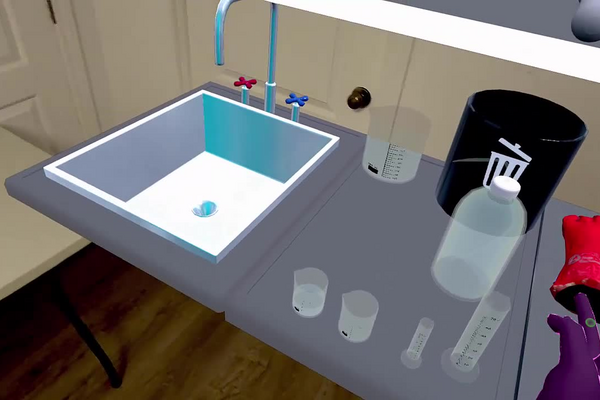
Extracting DNA is the first step of almost every procedure in molecular biology: sequencing a genome, testing a crop variety for a disease-resistance gene, matching a forensic sample or confirming a clinical diagnosis all begin by getting DNA out of cells and into a tube. The chemistry is the same at every scale. A cell keeps its contents behind membranes built from phospholipids, and the DNA inside is a very long polyanion — every phosphate group along its backbone carries one negative charge at neutral pH. A detergent dissolves the membranes and releases what the cell contains; dissolved salt supplies sodium ions that screen those negative charges, so neighbouring strands stop repelling one another; and a cold alcohol, in which DNA is far less soluble than in water, then drives the screened molecules out of solution as a mass large enough to see with the naked eye. Banana is a convenient starting material: the flesh is soft enough to reduce to a paste with a pestle, it contains little fibre, and the cultivated banana is triploid, so every cell carries three sets of chromosomes. In this laboratory you will prepare an extraction solution from distilled water, sodium chloride and dish soap, crush a piece of banana to a homogeneous paste, mix the paste with that solution, filter the mixture through paper into a test tube, and layer cold methanol on top of the filtrate. Within moments a grey, stringy precipitate appears where the two liquids meet — DNA, together with some of the other material released from the cells.
Educational Goals
Familiarization with the laboratory environment
- Identify the balance, the graduated cylinders, the beaker, the mortar and pestle, the stand and clamp, the funnel and the reagent bottles, and state what each one is used for before starting.
- Set up a filtration assembly and judge whether it is stable before pouring anything into it.
Handling a toxic reagent
- Recognise methanol as toxic by inhalation, ingestion and skin contact, and work with gloves and eye protection, away from any flame, in a ventilated area.
- Explain why ethanol 95 % or isopropanol would precipitate the DNA just as well and are the safer choice on a real bench.
Preparation of an aqueous solution
- Measure 30 mL of distilled water in a 70 mL graduated cylinder, reading the bottom of the meniscus at eye level.
- Weigh sodium chloride in a weighing boat on a tared balance, transfer it without loss, and stir with a glass rod until no crystals remain.
- Add a counted number of drops of detergent and mix to a homogeneous solution.
Mechanical disruption of plant tissue
- Crush a piece of banana with a pestle until the paste is uniform, and explain why grinding has to precede chemical lysis.
Gravity filtration
- Clamp a test tube at about 30 cm, seat a funnel with a filter paper, and collect roughly 15 mL of filtrate.
- State what the paper retains — cell wall fragments, starch grains and fibre — and what passes through it.
Alcohol precipitation
- Measure 10 mL of cold methanol and pour it slowly down the wall of the test tube so that it layers on the filtrate instead of mixing with it.
- Mix gently and only enough to bring the two liquids into contact, and explain why vigorous shaking would shear the precipitate.
Observation and interpretation of the result
- Describe the precipitate in terms of colour, position and texture, and attribute each stage of the experiment to the reagent responsible for it.
- Distinguish a crude extract from purified DNA, and name what else is present in the mass that has just been collected.
Protocol
Safety — methanol. This lab uses methanol to precipitate the DNA. Methanol is toxic by inhalation, ingestion and skin contact, and unlike ethanol the body converts it into formic acid, which can permanently damage the optic nerve. Doses well under 30 mL have caused blindness. Wear gloves and eye protection, keep the bottle stoppered and away from any flame, work in a ventilated area, never pipette by mouth, and wash hands afterwards. Ethanol 95 % or isopropanol precipitate DNA just as well and are the safer choice if you repeat this experiment on a real bench.
Part A: Preparation of the extraction solution
- Measure 30 mL of distilled water using a 70 mL graduated cylinder.
- Transfer the distilled water into a 50 mL beaker.
- Weigh the empty weighing boat on the balance.
- Add 2.5 mL (5.4 g) of sodium chloride into the weighing boat on the balance.
- Pour the sodium chloride into the beaker containing the distilled water.
- Stir the mixture with a glass rod until the salt is completely dissolved.
- Add 10 drops of dish soap into the beaker.
- Stir the solution again with the glass rod to ensure a homogeneous mixture.
Part B: DNA extraction procedure
- Place a piece of banana in a mortar.
- Carefully crush the banana with a pestle until you obtain a thick and homogeneous paste.
- Slowly add the extraction solution prepared during steps 1 to 10 of part A, to the banana paste in the mortar.
- Using the glass rod, mix the contents of the mortar well for an even distribution.
- Attach a universal clamp to the stand at a height of about 30 cm.
- Attach a test tube to the universal clamp.
- Position the funnel on the test tube.
- Place a filter paper in the funnel.
- Filter the banana mixture into the test tube, filling about one third of it (about 15 mL).
- Measure 10 mL of cold methanol using a 10 mL graduated cylinder. Methanol is toxic: wear gloves and eye protection, keep it away from any flame, work in a ventilated area, and never pipette by mouth.
- Remove the funnel and the filter from the test tube.
- Slowly pour the methanol along the wall of the test tube. The volume of methanol should be about twice that of the filtrate, so reduce the filtrate to about 5 mL before adding the 10 mL of methanol.
- Gently mix the contents of the test tube with a glass rod. Avoid shaking the test tube so as not to disturb the solution.
The DNA will appear as a gray precipitate, resembling a stringy or gelatinous substance.
Anticipated Outcomes
Every reagent in this protocol has one job, and each one produces a change that can be seen. The table below is the reference a teacher can mark against: it pairs each reagent with the effect it has on the sample.
| Reagent or operation | What it does | Why the extraction needs it |
|---|---|---|
| Mortar and pestle | Tears the cellulose cell walls apart mechanically | A plant cell wall is not dissolved by detergent; it has to be broken by force before the reagents can reach the membranes |
| Distilled water, 30 mL | Carries the other reagents and receives the released cell contents | Distilled rather than tap water, so that no dissolved ions of unknown concentration are added to the salt already measured out |
| Sodium chloride, 5.4 g | Dissociates into Na+ and Cl−; the Na+ ions gather around the phosphate groups of the backbone | Screening the negative charge lets separate DNA molecules approach one another instead of repelling, which is what makes an aggregate possible |
| Dish soap, 10 drops | Its amphiphilic molecules insert into the lipid bilayers and break them into micelles | Dissolves the plasma membrane and the nuclear envelope, releasing the DNA into the liquid; it also helps strip protein from the strands |
| Filter paper | Retains wall fragments, starch grains and fibre | Leaves a filtrate clear enough that a precipitate forming in it can actually be seen |
| Cold methanol, 10 mL | Lowers the permittivity of the liquid and competes for the water that hydrates the DNA | DNA is soluble in water but not in concentrated alcohol, so it leaves solution and becomes visible; cold slows the enzymes that would cut it |
The second table gives the appearance expected at each stage, which is what the observation notebook should record.
| Stage | Expected observation |
|---|---|
| Extraction solution, end of Part A | Clear and colourless, with a little foam on the surface from the detergent; no crystals left on the bottom of the beaker |
| Banana after crushing | A thick, pale yellow, uniform paste with no lumps remaining |
| Mortar after the extraction solution is stirred in | A thin, cloudy slurry, noticeably more fluid than the paste |
| Filtrate in the test tube | Turbid, pale yellow, about 15 mL, that is roughly one third of a 50 mL tube; filtration is slow and the paper clogs |
| Immediately after the methanol is layered on | Two distinct layers with a sharp boundary, the methanol sitting on top of the denser filtrate |
| After gentle mixing | A grey, stringy, gelatinous mass gathering at the boundary between the layers and rising into the alcohol |
The two quantities worth calculating. The concentration of the salt solution follows from c = m / (M × V). With M(NaCl) = 58.44 g/mol, c = 5.4 g / (58.44 g/mol × 0.0300 L) = 3.1 mol/L. Sodium chloride saturates at about 359 g/L at 20 °C, or 6.1 mol/L, so the extraction solution is roughly half saturated and several times more concentrated than the 0.15 to 0.5 mol/L that most classroom extraction buffers use. The precipitation still works, because the screening effect is already saturated far below 3 mol/L, but a student who calculates the value should be told that it is unusually high rather than left to assume it is standard. The second quantity is the alcohol fraction: the tube contains 15 mL of filtrate and receives 10 mL of methanol, so the alcohol represents 10 / (15 + 10) = 40 % by volume. DNA begins to come out of solution at roughly 35 to 40 % alcohol and precipitates completely near 65 to 70 %, which is why this protocol produces its precipitate at the interface, where the local alcohol fraction is much higher than 40 %, and why the tube is mixed only gently rather than inverted.
Why salt and alcohol have to act together. At the pH of the extraction solution every phosphodiester group in the backbone is ionised, so a DNA molecule is a chain of negative charges that repel one another and repel neighbouring molecules. Sodium ions crowd around those charges and screen them. How strongly they are held depends on the medium, through Coulomb’s law F = q1q2 / (4πε0εrr2): the relative permittivity εr is about 78 for water at 25 °C and about 33 for methanol, so replacing part of the water with methanol strengthens the attraction between a sodium ion and a phosphate group by a factor of roughly 78 / 33 ≈ 2.4 at the same separation. The charge is neutralised more effectively, the strands stop repelling, and they aggregate. Alcohol also hydrogen-bonds to the backbone far less readily than water does, so the ordered shell of water molecules that keeps DNA dissolved is stripped away. Neither reagent alone is enough: without salt the screened aggregate never forms, and without alcohol the DNA stays in solution.
Why a mass is visible when a molecule is not. A DNA double helix is about 2 nm across, roughly one hundredth of the 200 nm resolution limit of a visible-light microscope and some 104 to 105 times thinner than a human hair. Nothing seen in the test tube is a single molecule, and the double helix itself cannot be observed here — its structure was established by X-ray diffraction, not by looking at a precipitate. What is visible is an aggregate of an immense number of molecules. The order of magnitude can be checked: the cultivated banana is a triploid Musa acuminata with 3n = 33 chromosomes, and the haploid genome is about 523 million base pairs, so a nucleus holds roughly 1.6 × 10⁹ base pairs. At an average 650 g/mol per base pair the DNA in one nucleus weighs 1.6 × 109 × 650 / (6.02 × 10²³) ≈ 1.7 × 10⁻¹² g, that is about 1.7 picograms. A visible clump of a milligram therefore represents the nuclear content of hundreds of millions of cells, which is why a whole piece of tissue has to be ground up to obtain it.
What the precipitate actually is. No protease and no ribonuclease are used in this protocol, and no washing step follows the precipitation, so the material collected is a crude nucleic acid preparation rather than DNA: nuclear DNA together with chloroplast and mitochondrial DNA, a large amount of RNA, residual protein, polysaccharide from the banana, and trapped detergent. That mixture is why the mass looks grey, lumpy and gelatinous instead of forming the clean white thread of a purified preparation, and it is the honest answer to the question of what has been extracted.
Summary of Assignment by Grade Range
Grade 9–10
- Focus: that DNA is present in every living cell and can be made visible with ordinary reagents, and that each reagent has one identifiable job.
- Activities: carry out the protocol and name each instrument as it is used; record the appearance of the solution, the paste, the filtrate and the precipitate in a table like Table 2; state in one sentence each what the soap, the salt and the alcohol do; list the precautions that apply to methanol and explain why they apply; describe the precipitate without claiming to have seen a double helix.
Grade 11
- Focus: quantitative preparation of a solution and the physical chemistry of precipitation.
- Activities: calculate the concentration of the extraction solution from the mass of salt and the volume of water (3.1 mol/L) and compare it with saturation at 20 °C; calculate the final alcohol fraction (40 % by volume) and relate it to the threshold at which DNA leaves solution; explain charge screening in terms of the negative phosphate groups and the sodium ions; predict what would happen if the salt were halved or the methanol replaced by an equal volume of water, and justify the prediction; explain why the alcohol must be cold and why the tube is mixed gently.
Grade 12 / College Level
- Focus: the distance between a crude lysate and an analytically useful sample, and the design of the controls that would establish the role of each reagent.
- Activities: use Coulomb’s law and the relative permittivities of water and methanol to argue quantitatively why alcohol promotes aggregation; estimate the mass of DNA in one banana nucleus from the triploid genome size and 650 g/mol per base pair, and use it to estimate how many cells a visible clump represents; compare this protocol with a standard plant extraction such as a CTAB procedure or a silica column, and identify the steps missing here — ribonuclease, protease, an alcohol wash, resuspension in buffer; explain what an A260/A280 measurement would reveal about this extract; design the control series that isolates the contribution of grinding, detergent, salt and alcohol, and state what result each control would have to give.
Laboratory essentials
Instruments
- Balance with a tare function, and a weighing boat
- Measuring spoons / spatulas (2.5 mL)
- Tweezers
- Beaker (50 mL)
- Graduated cylinder (70 mL)
- Graduated cylinder (10 mL)
- Glass rod
- Dropper (1 mL)
- Mortar and pestle
- Metal stand with universal clamp
- Funnel and filter paper
- Test tube (50 mL)
Products
- Banana (chunks)
- Distilled water (30 mL)
- NaCl, crystals (2.5 mL, 5.4 g)
- Dish soap, liquid (10 drops)
- Methanol, liquid, cold (10 mL) — toxic, see the safety note in the protocol