

Two solutions can hold the same amount of acid per litre and still be very different in how acidic they are. Water treatment plants, food producers, aquarium keepers and clinical laboratories all depend on that distinction: the label on a bottle states a concentration, but what corrodes a pipe, curdles a protein or kills a fish is the concentration of hydronium ion actually present in the liquid. Choosing an acid, and deciding how much of it to use, therefore means knowing whether it gives up its protons completely or only slightly.
An acid dissolved in water transfers a proton to a water molecule. A strong acid such as hydrochloric acid does this to completion, so every mole dissolved delivers a mole of hydronium ion. A weak acid such as ethanoic acid — acetic acid, the acid of vinegar — reaches an equilibrium instead: at any moment only a small fraction of its molecules have released their proton, and that fraction depends on how dilute the solution is. The pH scale, pH = −log[H3O+], places both cases on the same axis, and a pH meter reads that axis directly by measuring the potential developed across a glass electrode.
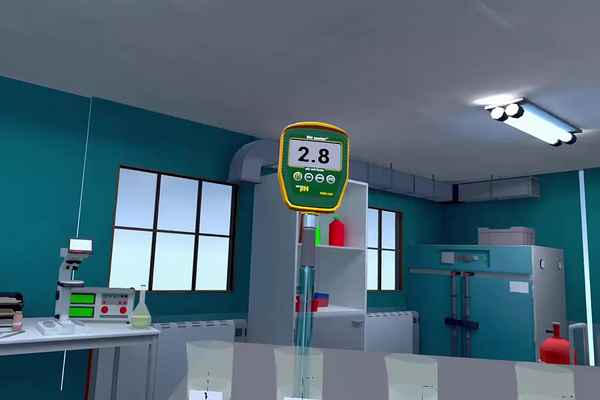
In this laboratory, you will build a series of three ethanoic acid solutions by serial dilution — 1 mol/L, 0.1 mol/L and 0.01 mol/L — each one made from the previous one by transferring 5 mL with a volumetric pipette into a 50 mL graduated cylinder and topping up to the mark with distilled water. A fourth beaker receives hydrochloric acid at 0.10 mol/L, the same concentration as the second ethanoic acid solution. You will then measure the pH of all four with a pH meter, rinsing and drying the electrode between beakers. The three ethanoic acid readings show what dilution does to a weak acid; the pair at 0.10 mol/L shows what the words strong and weak are actually worth in pH units.
Educational Goals
Serial dilution technique
- Perform a tenfold dilution by drawing a 5.00 mL aliquot with a volumetric pipette, transferring it to a 50 mL graduated cylinder and diluting to the mark with distilled water.
- Explain why each solution in the series must be prepared from the one before it rather than directly from the stock, and why the pipette and cylinder are rinsed between transfers.
Use of the pH meter
- Measure the pH of a solution with a glass electrode, and rinse the electrode with distilled water and dry it on absorbent paper between samples so that one reading cannot contaminate the next.
- Read a meter critically: recognise that the displayed figure carries a limited number of decimals and that display resolution is not the same thing as accuracy.
Distinguishing concentration from acidity
- Predict which of two solutions of equal concentration will have the lower pH, and justify the prediction from the extent of proton transfer rather than from the amount of acid present.
- State the concentration of a solution and its pH as two separate pieces of information, and describe a situation in which each one is the figure that matters.
Quantitative interpretation of a pH reading
- Convert a pH to a hydronium concentration and back, and calculate the percent ionization of a weak acid from its measured pH.
- Show that a tenfold dilution raises the pH of a weak acid by about 0.50 unit but raises that of a strong acid by 1.00 unit, and account for the difference.
Safe handling and disposal of acids
- Handle acid solutions wearing gloves, and keep the concentrated stock separated from the diluted series on the bench.
- Dispose of every solution used in the recovery bin rather than the sink, and rinse glassware before setting it down.
Protocol
Part 1: Preparation of diluted solutions
- Locate the four empty beakers, numbered from 1 to 4.
- Pour 1 mol/L ethanoic acid solution (CH3COOH) into beaker 1 and fill it halfway.
- Using the pipette, take the 1 mol/L ethanoic acid solution from beaker 1 and transfer 5 mL into the 50 mL graduated cylinder.
Empty the excess from the pipette into the recovery bin.
- Add distilled water to the graduated cylinder until reaching the final volume of 50 mL.
- Pour the solution obtained from the graduated cylinder into beaker 2 and fill it halfway.
Empty the excess from the graduated cylinder into the recovery bin.
- Clean the pipette and the graduated cylinder with distilled water.
- Repeat the dilution process by taking the solution from beaker 2 using the pipette then transfer 5 mL into the 50 mL graduated cylinder.
Empty the excess from the pipette into the recovery bin.
- Then add distilled water to the graduated cylinder until reaching the final volume of 50 mL.
- Pour this new diluted solution into beaker 3 and fill it halfway.
Empty the excess from the graduated cylinder into the recovery bin.
- Fill beaker 4 halfway with a concentrated hydrochloric acid (HCl) solution at 0.10 mol/L.
Part 2: Measurements
- Use a pH meter to measure the pH of each of the solutions contained in beakers 1 to 4.
Between each measurement, rinse the pH meter electrodes with distilled water and dry with absorbent paper.
- The pH measurements will appear in the results table.
- Properly dispose of the solutions used by pouring them into the recovery bin provided for this purpose. Avoid throwing them into the sink.
Anticipated Outcomes
Three of the four beakers hold the same acid at three concentrations; the fourth holds a different acid at a concentration already present in the series. The whole result of the laboratory is contained in the comparison of the four pH readings.
| Beaker | Contents | Concentration | Acid | Expected pH | [H3O+] (mol/L) | Ionized |
|---|---|---|---|---|---|---|
| 1 | CH3COOH | 1.0 mol/L | weak | 2.37 | 4.2 × 10⁻³ | 0.42 % |
| 2 | CH3COOH | 0.10 mol/L | weak | 2.87 | 1.3 × 10⁻³ | 1.3 % |
| 3 | CH3COOH | 0.010 mol/L | weak | 3.37 | 4.2 × 10⁻⁴ | 4.2 % |
| 4 | HCl | 0.10 mol/L | strong | 1.00 | 0.10 | 100 % |
The dilutions. Each transfer is governed by C1V1 = C2V2. Taking 5.00 mL of the 1.0 mol/L solution and diluting it to 50.0 mL gives C2 = (1.0 mol/L × 5.00 mL) / 50.0 mL = 0.10 mol/L, and repeating the operation on beaker 2 gives 0.010 mol/L in beaker 3. Each step is a dilution factor of exactly ten, so the amount of acid per litre falls by a factor of 100 across the series.
| Step | Aliquot | Final volume | Dilution factor | Concentration | pH | ΔpH |
|---|---|---|---|---|---|---|
| stock → beaker 1 | — | — | — | 1.0 mol/L | 2.37 | — |
| beaker 1 → beaker 2 | 5.00 mL | 50.0 mL | 10 | 0.10 mol/L | 2.87 | +0.50 |
| beaker 2 → beaker 3 | 5.00 mL | 50.0 mL | 10 | 0.010 mol/L | 3.37 | +0.50 |
| a strong acid, for comparison | 5.00 mL | 50.0 mL | 10 | one tenth | — | +1.00 |
Beaker 4, the strong acid. Hydrochloric acid ionizes completely in water: HCl + H2O → H3O+ + Cl−. There is no equilibrium to solve, so [H3O+] is simply the stated concentration and pH = −log(0.10) = 1.00. The same reasoning would give pH 2.00 at 0.010 mol/L and pH 3.00 at 0.0010 mol/L — one whole unit per tenfold dilution.
Beakers 1 to 3, the weak acid. Ethanoic acid reaches an equilibrium: CH3COOH + H2O ⇌ CH3COO− + H3O+, with Ka = [CH3COO−][H3O+] / [CH3COOH] = 1.8 × 10⁻⁵ at 25 °C, so pKa = 4.74. Writing x for [H3O+] and C for the concentration prepared, the equilibrium condition is x2 / (C − x) = Ka. Because x is far smaller than C, the denominator can be replaced by C, which gives x = √(KaC). For beaker 2, x = √(1.8 × 10−5 × 0.10) = √(1.8 × 10⁻⁶) = 1.34 × 10⁻³ mol/L, so pH = −log(1.34 × 10⁻³) = 2.87.
Why the step is half a unit. Taking logarithms of x = √(KaC) gives pH = ½pKa − ½log C. The concentration enters with a coefficient of one half, so dividing C by ten adds 0.50 to the pH rather than 1.00. With pKa = 4.74 the expression predicts 2.37, 2.87 and 3.37 for 1.0, 0.10 and 0.010 mol/L, which is exactly the observed series. The strong acid obeys pH = −log C instead, with a coefficient of one, and so steps a full unit.
Dilution makes a weak acid ionize more, not less. The fraction ionized is α = x / C = √(Ka/C), which rises as C falls — 0.42 % at 1.0 mol/L, 1.3 % at 0.10 mol/L and 4.2 % at 0.010 mol/L, a factor of √10 = 3.16 at every step. This is Ostwald’s dilution law, Ka = Cα2 / (1 − α), and it is what Le Chatelier’s principle requires: the ionization produces two particles from one, so adding water shifts the equilibrium toward the dissociated side. The absolute hydronium concentration still falls on dilution — it simply falls by √10 rather than by 10.
What strong and weak cost in pH. Beakers 2 and 4 hold the same 0.10 mol/L of a monoprotic acid, yet [H3O+] is 0.10 mol/L in one and 1.34 × 10⁻³ mol/L in the other — a ratio of 0.10 / 1.34 × 10−3 = 75, or log 75 = 1.87 pH units. Put the other way round, hydrochloric acid has to be diluted 75-fold, to 1.3 × 10⁻³ mol/L, before it is as mild as 0.10 mol/L ethanoic acid. This single comparison is the reason the concentration on a label cannot be read as a hazard rating.
Acidity is not the same as neutralizing capacity. Beakers 2 and 4 would consume identical volumes of sodium hydroxide to reach neutrality, because each contains the same number of moles of ionizable proton; the 1.87 pH units between them say nothing about how much base they need. What differs is the shape of the neutralization: the ethanoic acid solution passes through pH = pKa = 4.74 when exactly half its acid has been consumed and resists change around that point, while the hydrochloric acid solution has no such plateau. Labs 047 and 052 pursue that difference with a burette; lab 073 pursues it with a conductivity meter, where the same two solutions differ by a comparable factor.
Summary of Assignment by Grade Range
Grade 9–10
Focus: vocabulary, careful transfer of liquids, and ordering four results correctly.
Activities: carry out the two dilutions and label each beaker with the concentration it now holds; measure the four pH values and arrange the beakers from most to least acidic; state in one sentence why beaker 4 is more acidic than beaker 2 even though both were prepared at 0.10 mol/L; identify which readings belong to the same acid and which to a different one; follow the rinse-and-dry step between measurements and explain what it prevents.
Grade 11
Focus: quantitative treatment of the dilution series and of the pH scale.
Activities: verify C1V1 = C2V2 for both transfers and confirm the dilution factor of ten; convert each measured pH to a hydronium concentration; show that the three ethanoic acid readings rise by 0.50 unit per tenfold dilution while a strong acid would rise by 1.00, and use that to classify an unknown acid from two readings; calculate the 75-fold ratio in [H3O+] between beakers 2 and 4 and express it as a difference in pH; calculate the percent ionization of each ethanoic acid solution.
Grade 12 / College Level
Focus: derivation, error analysis and independent interpretation.
Activities: derive pH = ½pKa − ½log C from the equilibrium expression and state the assumptions used; solve the quadratic exactly for beaker 3 and quantify the error the approximation introduces; recover Ka from each measured pH with Ostwald’s dilution law and comment on whether the three values agree within the resolution of the meter; explain why a one-decimal display limits the recovered Ka to about one significant figure; discuss activity coefficients at 1 mol/L and predict the direction of the error; predict the titration curve of beaker 2 against that of beaker 4 and identify the buffer region.
Laboratory essentials
Instruments
- Beakers (4, numbered 1 to 4)
- Graduated cylinder (50 mL)
- Volumetric pipette (5 mL)
- pH meter with glass electrode
- Absorbent paper
- Protective gloves
- Recovery bin
Products
- Ethanoic acid CH3COOH 1.0 mol/L (supplied in a 500 mL beaker on the reagent bench)
- Hydrochloric acid HCl 0.10 mol/L (supplied in a 500 mL beaker on the reagent bench)
- Distilled water