

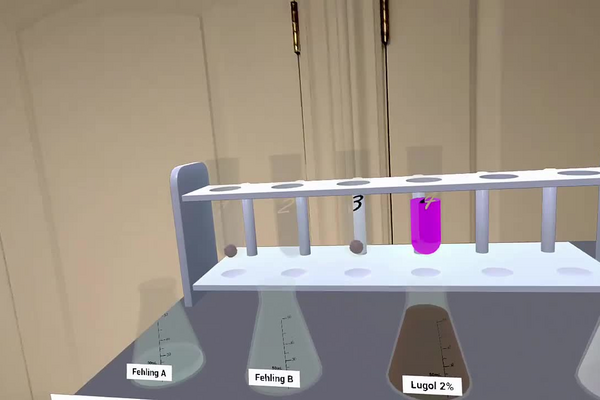
Every food is a mixture of biological molecules, and four families dominate: simple sugars, starches, lipids and proteins. Knowing which of them a food contains is the basis of nutrition labelling, of dietary advice, and of quality control in the food industry — and long before instruments existed, chemists established the answer with a handful of colour reactions that are still taught, and still used as quick screening tests, today.
Each test works because a reagent reacts with one specific chemical feature and produces a visible change. Fehling’s solution is reduced by the free aldehyde group of a reducing sugar, and the copper(II) it contains is converted to brick-red copper(I) oxide. Lugol’s iodine slips into the helical coil of a starch molecule and forms an intensely coloured iodine–starch complex. Sudan IV is a fat-soluble dye that abandons the water and dissolves in any lipid droplet present, staining it red. The Biuret reagent, copper(II) in alkaline solution, forms a violet complex with the peptide bonds that link amino acids in a protein. None of these tests is sensitive to anything else, which is what makes the set informative.
In this laboratory you will analyse four everyday foods — apple juice, egg white, a cereal solution and milk — for all four families of nutrient. Each food is divided between a test tube, for the heated Fehling test, and three wells of a microplate, one for each of the cold tests. You will heat the Fehling tubes in a water bath above 70 °C, add each reagent to its labelled well, and read the resulting sixteen observations into a results table. From those colours you will build a nutrient profile for each food and check it against what you already know about where sugars, starch, fat and protein come from.
Educational Goals
Familiarization with the laboratory environment
- Locate and use the equipment of a biochemistry bench: the test tube rack, the microplates, the hot plate and water bath, stands and clamps, droppers and the micropipette, glass stirring rods and the recovery container.
Use of protective equipment and safe handling of reagents
- Wear gloves and eye protection, and recognise that Fehling’s solution and the Biuret reagent are strongly alkaline and corrosive.
- Empty every container into the recovery bin rather than the sink, and heat test tubes in a water bath rather than directly on the plate.
Preparation and division of samples
- Measure 10 mL of each food with the pipette and transfer it without loss to its numbered test tube.
- Charge the three microplate wells belonging to each food, and understand why the same sample must be split across separate wells rather than tested in sequence in one.
Avoiding cross-contamination
- Clean the glass rod after every stirring.
- Explain how a single unrinsed dropper or rod can turn a negative well positive and invalidate the whole plate.
Performing the four nutrient tests
- Carry out the Fehling test with the water bath brought above 70 °C, and explain why this test alone requires heat.
- Carry out the Lugol, Sudan IV and Biuret tests at room temperature, adding the Biuret reagent in the correct order — alkali first, then copper sulfate.
Reading and recording results
- Record each observation as a colour, and classify it as positive or negative against the stated criteria.
- Assemble the sixteen observations into a nutrient profile for each of the four foods.
Interpreting colour reactions chemically
- Relate each colour change to the chemical group being detected: aldehyde, starch helix, lipid phase, peptide bond.
- Explain why a control observation is needed, and what a colour in a food that should be negative would mean.
Protocol
Preparation of food samples
- Using the pipette measure 10 mL of the apple juice sample.
- Pour the 10 mL of apple juice into test tube 1.
- Using a dropper, place 5 to 10 drops of apple juice into each of the three wells of the spot plate identified “J”.
- Empty the excess from the dropper into the recovery bin.
- Repeat steps 1 to 4 for:
- Egg whites that will go into test tube 2 and into the 3 wells of the spot plate identified “B”
- Cereal solution that will go into test tube 3 and into the 3 wells of the spot plate identified “C”
- Milk that will go into test tube 4 and into the 3 wells of the spot plate identified “L”.
Identification of simple carbohydrates in foods
- Fill 400 mL of tap water into a 500 mL beaker.
- Insert the magnetic stir bar into the beaker.
- Place the beaker on the hot plate and set to 75°C. Wait until the temperature is reached.
- Turn on the magnetic stirrer (left button).
- Using the pipette, add 10 mL of Fehling A to each of test tubes 1 to 4 containing the food.
- Using the pipette, add 10 mL of Fehling B to each of test tubes 1 to 4 containing the foods.
- Mix the contents of test tube 1 by swirling it in a circular motion.
- Repeat the previous step with the other three test tubes.
- Attach a universal clamp to the left stand, above the 500 mL beaker prepared in step 1.
- Secure test tube 1 to the universal clamp above the center of the beaker.
- Verify that a temperature above 70°C is reached in the test tube.
- Take test tube 1 and put it back in its original position on the test tube rack.
- Mix the contents of the test tube by stirring for a few seconds with the glass rod.
- Repeat steps 10 to 13 with test tubes 2, 3 and 4.
- Lower the hot plate temperature to 15 °C.
- Turn off the magnetic stirrer.
Observations of the control reaction are found in the results table.
Identification of complex carbohydrates in foods
- Using the dropper, add 5 to 10 drops of Lugol’s solution into each of the 4 wells identified “Lugol”.
- Empty the excess from the dropper into the recovery bin.
- Mix the contents using the glass rod. Caution: make sure to clean the glass rod well after each stirring to avoid mixing substances!
Identification of lipids in foods
- Using the dropper, add 5 to 10 drops of Sudan IV into each of the 4 wells identified “Sudan IV”.
- Empty the excess from the dropper into the recovery bin.
- Mix the contents using the glass rod.
Identification of proteins in foods
- Using the dropper, place 1 drop of sodium hydroxide (NaOH) into each of the 4 wells identified “Biuret”.
- Empty the excess from the dropper into the recovery bin.
- Use the pipette to draw 1 full pipette (10 mL) of copper sulfate (CuSO4).
- Using the pipette, dispense 1 mL of copper sulfate (CuSO4) into these same wells labeled “Biuret”.
- The well “J” (Biuret)
- The well “B” (Biuret)
- The well “C” (Biuret)
- The well “L” (Biuret)
- Empty the excess from the pipette into the recovery bin.
- Mix the contents using the glass rod.
The observations are found in the results table.
- A positive result for the presence of simple carbohydrates will result in a brick-red precipitate (Cu2O) in the test tube (Fehling reaction).
- A positive result for the presence of complex carbohydrates will result in a purple coloration (iodine – starch complex) in the well (Lugol test).
- A positive result for the presence of lipids will result in a red coloration (Sudan IV – lipids complex) in the well (Sudan IV test).
- A positive result for the presence of proteins will result in a purple coloration (Biuret complex) in the well (Biuret test).
Anticipated Outcomes
The full set of results. Four foods are tested for four nutrients, giving sixteen observations. The Fehling test is read in the heated test tube; the other three are read in the labelled microplate wells.
| Food (sample) | Fehling — simple sugars (tube) | Lugol — starch (well) | Sudan IV — lipids (well) | Biuret — proteins (well) |
|---|---|---|---|---|
| Apple juice (J), tube 1 | positive — brick-red precipitate | no reaction | no reaction | no reaction |
| Egg white (B), tube 2 | no precipitate | no reaction | no reaction | positive — mauve, with a pale-blue precipitate |
| Cereal solution (C), tube 3 | positive — brick-red precipitate | positive — blue-black to deep purple | no reaction | no reaction |
| Milk (L), tube 4 | no precipitate; faint purple tint | no reaction | positive — red | positive — mauve, with a pale-blue precipitate |
Simple sugars — Fehling’s test. Fehling’s solution is copper(II) held in solution by tartrate in strong alkali. A reducing sugar — glucose, fructose, maltose, lactose, any sugar with a free aldehyde or a ring that can open to one — is oxidised by that copper(II), which is itself reduced to copper(I) and precipitates as brick-red copper(I) oxide:
R–CHO + 2 Cu2+ + 5 OH− → R–COO− + Cu2O(s) + 3 H2O
The reaction is slow at room temperature, which is why this test alone needs the water bath above 70 °C; the protocol has you confirm that temperature inside the tube before reading. Apple juice is positive because fruit juice is largely free fructose and glucose. The cereal solution is positive too, because partial breakdown of starch leaves reducing sugars in the suspension. Sucrose, by contrast, would give a negative result even though it is a sugar, because its two rings are locked together and no free aldehyde remains — a useful reminder that “reducing sugar” is a narrower category than “sugar”.
Starch — Lugol’s test. Lugol’s reagent is iodine dissolved in potassium iodide, present mainly as the triiodide ion I3−. Amylose, the linear component of starch, coils into a helix whose interior is just wide enough to accept a chain of these ions. The resulting inclusion complex absorbs strongly across the middle of the visible spectrum and appears blue-black to deep purple. Only the cereal solution turns; the other three foods contain no starch. Because the colour depends on the helix being intact, heating a positive well would make the blue fade — the helix unwinds — and it would return on cooling.
Lipids — Sudan IV test. Sudan IV is a lysochrome: a dye with no affinity for water and a strong affinity for fats. Added to a well, it partitions almost entirely into any lipid phase present and stains it red, leaving the aqueous phase pale. Milk is positive, because milk fat is dispersed through it as an emulsion of fine droplets. Nothing is chemically consumed here — this is a solubility test, not a reaction, which is why it works cold and immediately.
Proteins — Biuret test. The protocol has you add sodium hydroxide first and copper sulfate second, and the order matters: the alkali is what allows the copper(II) ion to coordinate to the nitrogen atoms of the peptide backbone. Four such nitrogens from adjacent peptide bonds chelate one Cu2+, and the resulting complex absorbs around 540 nm, giving the characteristic mauve. Egg white and milk are both positive, as their names in any nutrition table would predict. The test requires at least two peptide bonds in sequence, so a solution of free amino acids would give no colour — the test detects protein, not nitrogen.
Why a positive Biuret well shows both a colour and a precipitate. The two signals are two different compounds of the same copper. The mauve tint of the liquid is the biuret complex itself: the Cu2+ held by the nitrogen atoms of adjacent peptide bonds is soluble, so it colours the whole well evenly. The precipitate is copper(II) hydroxide, formed wherever a Cu2+ ion meets hydroxide ions before it meets a peptide bond: Cu2+ + 2 OH− → Cu(OH)2(s), a pale-blue solid. Copper(II) hydroxide is among the least soluble of the common hydroxides, so once the peptide bonds present have taken their share of the copper, the excess leaves the solution as this solid. The two observations therefore tell one story twice: the protein claims part of the copper as a soluble mauve complex, and the hydroxide claims the remainder as a solid.
Why test tube 4 turns faintly purple. Milk in the Fehling tube develops a pale purple tint but no brick-red precipitate. This is not a Fehling positive. Fehling’s solution supplies copper(II) in strong alkali — exactly the conditions of the Biuret test — so the milk protein forms the violet Biuret complex in the Fehling tube. Read strictly, the result is: no reducing sugar detected. It is a good illustration of why a positive is defined by a named colour and a named form, precipitate or coloration, rather than by “something happened”. Milk does contain lactose, a reducing sugar, so a longer or hotter incubation would be expected to give a genuine brick-red precipitate as well.
Summary of Assignment by Grade Range
Grade 9–10
- Focus: the four nutrient families and the colour that reveals each one, and careful contamination-free technique.
- Activities: prepare the four samples and charge the tubes and wells; run all four tests; record the sixteen observations in the results table as colours; state which nutrients each food contains, and check whether the results match what a nutrition label would say.
Grade 11
- Focus: the chemistry behind each colour change, and the reasoning that turns an observation into a conclusion.
- Activities: name the chemical group detected by each reagent; explain why only the Fehling test needs heating above 70 °C; explain why the sodium hydroxide precedes the copper sulfate in the Biuret test; account for the cereal solution being positive to both Fehling and Lugol; explain the faint purple in test tube 4 without calling it a Fehling positive.
Grade 12 / College Level
- Focus: specificity, controls, and the limits of qualitative analysis.
- Activities: write the redox half-reactions for the Fehling test and identify what is oxidised and what is reduced; predict the result of testing a pure sucrose solution and justify the prediction; design the positive and negative controls this protocol would need to be defensible, and say what each would rule out; discuss the detection threshold of each test and why a negative result is weaker evidence than a positive one; describe how the Biuret test is adapted to measure protein concentration quantitatively.
Laboratory essentials
Instruments
- Test tubes 50 mL ×4
- Test tube rack
- Microplates (well plates) ×2
- Pipette (10 mL)
- Droppers (1 mL)
- Beaker (500 mL)
- Hot plate
- Magnetic stirrer & stir bar
- Thermometer
- Stand & clamps
- Glass rods
- Wash bottle
- Recovery container
- Paper towel
- Gloves and eye protection
Products
- Apple juice
- Egg white in solution
- Cereals in suspension
- Milk 3% fat
- Tap water (water bath, 400 mL)
- Fehling’s reagent, solutions A and B
- Lugol’s iodine solution 2%
- Sudan IV solution
- Biuret reagent — sodium hydroxide, NaOH 2.5 M
- Biuret reagent — copper sulfate, CuSO4 0.0094 M