

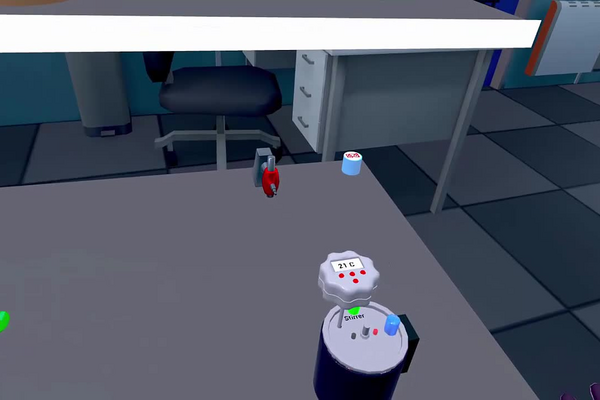
Instant hot packs and instant cold packs are the same object with a different filling. Squeeze one and a sachet bursts, a solid meets water, and within seconds the pack is either uncomfortably warm or cold enough to put on a sprain — with no heater, no refrigerant and no moving parts. The same physics decides whether a cement pour has to be cooled, whether a bag of fertiliser can be stored next to anything, and why a bath bomb feels cool as it fizzes. Every one of these is a process whose energy books do not balance at the temperature you started at, so the difference is taken from, or paid into, the surroundings.
Chemists label the two directions endothermic and exothermic, and the labels refer to the system, not to the thermometer: an exothermic process releases energy, so the surroundings warm and the reading rises. The energy itself comes from bonds and from the forces between particles. Pulling an ionic lattice apart or breaking a covalent bond costs energy; hydrating the freed ions, or forming a new bond, returns it. Which of the two is larger decides the sign, and because the two are usually large numbers of similar size, the measured result is a small difference between them — which is why it has to be measured rather than guessed.
In this laboratory you will run two processes in the same calorimeter, one of each sign, and the pairing is chosen to overturn a common assumption. The first is sodium hydroxide dissolving in water: nothing reacts, no new substance is made, and the temperature rises by more than ten degrees. The second is citric acid attacking sodium bicarbonate: a genuine chemical reaction that fizzes visibly, makes three new substances, and gets colder. You will record the temperature before and after each, classify each process by sign, and convert each temperature change into an energy per mole. The conclusion to take away is that “reaction” and “releases heat” are independent facts about a process, and that only a measurement can tell you which way a given one goes.
Educational Goals
Classifying a process by sign
- Decide from a pair of temperature readings whether a process is endothermic or exothermic, and state the sign of ΔH that goes with each.
- Use the words correctly with respect to the system rather than the thermometer, so that “exothermic” and “the reading went up” are recognised as two statements about the same event.
Calorimetric technique
- Charge a calorimeter, close the lid, run the stirrer and take an initial and a final temperature in the correct order.
- Explain why the reading must be taken with the contents stirred, and why the lid matters more for the experiment that produces a gas than for the one that does not.
Measuring an amount of substance
- Weigh a powder onto a tared weighing boat to the nearest 0.1 g, and deliver 100 mL and 50 mL with a graduated cylinder.
- Convert a mass and a molar mass, or a volume and a concentration, into moles, and identify which reagent is limiting before any energy is calculated.
Turning a temperature change into an energy
- Apply q = m × c × ΔT to the contents of the calorimeter, then ΔH = −q / n to obtain an enthalpy per mole with the correct sign.
- State what mass and what specific heat capacity belong in the calculation, and why they are not those of the water alone.
Separating chemical change from physical change
- Say which of the two processes makes a new substance and which only rearranges the forces between existing ones, and give the evidence for the distinction.
- Explain why that distinction does not predict the sign of the energy change, using these two experiments as the counterexample.
Handling corrosive reagents
- Recognise solid sodium hydroxide as a hazard in its own right, distinct from the hot 1 mol/L solution it becomes, and handle both with gloves and eye protection.
Protocol
Experiment 1 : Water + sodium hydroxide
- Measure 100 mL of distilled water using the graduated cylinder.
- Pour the contents of the graduated cylinder into the calorimeter.
- Immerse the tip of the digital thermometer in the liquid to take its temperature.
- The initial temperature of the liquid in the calorimeter will appear in the results table.
- Using the weighing boat, weigh approximately 4 g (approximately 2 mL) of sodium hydroxide powder.
- Pour the contents of the weighing boat into the calorimeter.
- Attach the calorimeter lid to the calorimeter.
- Activate the green button of the stirrer on the calorimeter lid.
- Insert the digital thermometer into the calorimeter lid.
- The temperature of the mixture will appear in the results table.
- Stop the agitator by pressing the red button.
- Remove the thermometer from the calorimeter lid.
- Remove the lid of the calorimeter and empty its contents into the recovery bin.
- Rinse the calorimeter with distilled water and empty its contents into the recovery tank.
Experiment 2 : Citric acid + sodium bicarbonate
- Measure 50 mL of citric acid using the graduated cylinder.
- Pour the contents of the graduated cylinder into the calorimeter.
- Immerse the tip of the digital thermometer in the liquid to take its temperature.
- The initial temperature of the liquid in the calorimeter will appear in the results table.
- Using the weighing boat, weigh approximately 4.5 g (approximately 2 mL) of sodium bicarbonate.
- Pour the contents of the weighing boat into the calorimeter.
- Attach the calorimeter lid to the calorimeter.
- Activate the green button of the stirrer on the lid of the calorimeter.
- Insert the digital thermometer into the calorimeter lid.
- The temperature of the mixture will appear in the results table.
- Stop the agitator by pressing the red button.
- Remove the thermometer from the calorimeter lid.
- Remove the calorimeter lid and empty its contents into the recovery bin.
- Rinse the calorimeter with distilled water and empty its contents into the recovery tank.
Anticipated Outcomes
Two processes, opposite signs, one apparatus. The table gathers what each should give; the sections below derive the figures and say how far each can be trusted.
| Experiment | Type of change | Limiting reagent | ΔH | Energy exchanged | Heat capacity of contents | Expected ΔT |
|---|---|---|---|---|---|---|
| 1. Water + NaOH | Physical (dissolution) | 4.26 g NaOH = 0.107 mol (recorded) | −44.5 kJ/mol (exothermic) | 4.74 kJ released | ≈ 418 J/K | +11.2 °C (recorded: 21.0 to 32.2 °C) |
| 2. Citric acid + NaHCO3 | Chemical (acid–base, gas evolving) | 4.4 g NaHCO3 = 0.0524 mol (recorded) | +22.5 kJ/mol (endothermic) | 1.19 kJ absorbed | ≈ 227 J/K | −5.2 °C (recorded: 21.0 to 15.8 °C) |
From a temperature change to an energy
Both results are obtained the same way. First the heat that entered or left the contents of the calorimeter, q = m × c × ΔT, where m is the mass of everything in the vessel and c its specific heat capacity; then the molar enthalpy, ΔH = −q / n, where n is the number of moles of the limiting reagent and the minus sign converts “the contents warmed” into “the process released energy”. Experiment 1 worked through: the recorded 4.26 g of NaOH is 0.107 mol at M = 40.00 g/mol, and 100 mL of water gives contents of about 418 J/K, so the recorded rise of 11.2 °C (21.0 to 32.2 °C) is q = 418 × 11.2 = 4.68 kJ, and ΔH = −4.68 / 0.107 = −44 kJ per mole — the accepted enthalpy of solution of sodium hydroxide is −44.5 kJ/mol, so the two agree to within the reading error. Experiment 2 the same way: contents of 50 g of solution plus 4.4 g of solid at about 4.18 J/(g·K) is 228 J/K, and the recorded fall of 5.2 °C (21.0 to 15.8 °C) is 1.19 kJ absorbed, which over 0.0524 mol of bicarbonate is +22.5 kJ/mol.
Experiment 1 — sodium hydroxide dissolving: nothing reacts, and it gets hot
No new substance is made here. Sodium hydroxide is already ionic in the solid, so the sodium and hydroxide ions exist before the water touches them; what changes is that they stop being held in a lattice and start being surrounded by water molecules. Two large terms are traded. Pulling the lattice apart costs the lattice enthalpy, about +887 kJ/mol. Hydrating the freed ions returns about −930 kJ/mol, the sodium ion contributing roughly −406 and the hydroxide roughly −520 kJ/mol. The difference is −44.5 kJ/mol: about five per cent of either term, and negative, so the process releases energy and the water warms. This is exactly why enthalpies of solution cannot be predicted by inspection — a five per cent shift in either large number would change the sign — and why the measurement is worth making.
The magnitude is worth appreciating. 4.26 g in 100 mL of water raises the temperature by 11.2 °C, which for a solution that started at room temperature means finishing at the recorded 32.2 °C, and the protocol notes the change is complete in one or two seconds. That is a warm, 1 mol/L solution of a strong base, pH 14, and it is more dangerous than either of the things that went into the calorimeter. Scale the same figures up and the reason industrial caustic dilution is done slowly, with cooling and with the solid added to the water and never the reverse, becomes arithmetic rather than a rule: a kilogram of sodium hydroxide dissolved in a litre of water would release 1.1 MJ and boil it.
4.26 g in 100 mL is 1.07 mol/L, far below the solubility of about 111 g per 100 mL, so all of it dissolves and no residue should remain. One practical warning that this laboratory cannot show but a teacher should: solid sodium hydroxide is strongly hygroscopic and absorbs carbon dioxide from the air, so a portion weighed on an open balance is part water and part sodium carbonate, and a real bench measurement of this enthalpy comes out low for that reason before any heat is lost.
Experiment 2 — citric acid and bicarbonate: a reaction, and it gets cold
Citric acid is triprotic, so with sodium bicarbonate the fully neutralised equation is C6H8O7(aq) + 3 NaHCO3(s) → Na3C6H5O7(aq) + 3 H2O(l) + 3 CO2(g). Take stock of the amounts before using it, because this laboratory does not run at those proportions. 50 mL of 1 mol/L citric acid is 0.050 mol, which could consume 0.150 mol of bicarbonate, or 12.6 g. Only 4.4 g is weighed out (the mass the balance records), which is 0.0524 mol at M = 84.01 g/mol, so the bicarbonate is limiting and the acid is in nearly threefold excess — only about a third of the acid’s proton-donating capacity is used. That has a practical consequence: the salt actually produced is monosodium citrate, not the trisodium citrate of the tidy equation, because in practice only the first of the three protons on each acid molecule is removed. The useful equation for this experiment is therefore the one that describes what the limiting reagent does: HCO3−(aq) + H+(aq) → H2O(l) + CO2(g).
The fizzing is the visible half and the cooling is the interesting half. Why should a reaction that is, after all, an acid neutralising a base absorb energy, when lab 065’s hydrochloric acid and sodium hydroxide release 54 kJ for every mole? Because the product here is not water. Splitting the overall change into steps shows where the energy goes, and the sum is Hess’s law again.
| Step | Change (per mole of NaHCO3) | ΔH (kJ/mol) |
|---|---|---|
| a | NaHCO3(s) → Na+(aq) + HCO3−(aq) | +17.5 |
| b | H3Cit(aq) → H+(aq) + H2Cit−(aq) | +4.1 |
| c | H+(aq) + HCO3−(aq) → H2O(l) + CO2(aq) | −7.6 |
| d | CO2(aq) → CO2(g) | +20.3 |
| a+b+c | Overall, with the gas still dissolved | +14.0 |
| a+b+c+d | Overall, with the gas fully evolved | +34.3 |
Read down that table and the answer to the question is plain. The proton transfer itself, step c, is very nearly thermoneutral — nothing like the 54 kJ/mol of lab 065, because the proton is not combining with a hydroxide ion to make a covalent O–H bond; it is being handed to a bicarbonate ion which then falls apart. Everything else costs energy: taking the bicarbonate lattice apart, prising the first proton off a weak acid, and lifting dissolved carbon dioxide into the gas phase. The endothermic result is the sum of three modest costs against one modest return, and the process gets cold because the calorimeter is the only thing available to pay for them.
The value of record for this laboratory is a fall of 5.2 °C (21.0 to 15.8 °C), which is 1.19 kJ absorbed and +22.5 kJ per mole of bicarbonate. The bracket above is what a teacher should notice: standard data put the answer between +14.0 kJ/mol if every molecule of carbon dioxide stays in solution and +34.3 kJ/mol if all of it escapes, and +22.5 corresponds to about 40 per cent having left by the time the reading is taken. That is a defensible number for a measurement made within seconds of mixing, because the solution is heavily supersaturated at that moment and the gas continues to work its way out afterwards. It is not the equilibrium answer: 0.0524 mol of carbon dioxide is 1.28 L of gas at room conditions, whereas 50 mL of water at atmospheric pressure can hold only about 1.7 mmol of it, some three per cent of what the reaction makes. Left to stand with the lid off, the mixture should therefore keep cooling, towards a total fall nearer 8 °C. The recorded temperature is not a final state, and a class that watches for another minute will see it drift.
Two further quantities are worth having. The acid starts at pH 1.6, from √(Ka1 × C) with Ka1 = 7.4 × 10⁻⁴; after the reaction the mixture is a citrate buffer holding 0.048 mol of H2Cit− against 0.002 mol of HCit2−, so its pH is pKa2 + log(0.002 / 0.048) = 4.76 − 1.30 ≈ 3.5. Still acidic, which is consistent with the gas coming off: below about pH 5 the dissolved carbonate is essentially all carbon dioxide, and this is why a bath bomb keeps fizzing until the acid is spent rather than until the bicarbonate is.
Putting the two together
The pairing is the point of the laboratory, and it is worth making the students say it out loud. Experiment 1 is a physical change — no new substance, no bonds within molecules broken, the ions were ions before and after — and it releases 44.5 kJ/mol. Experiment 2 is unambiguously a chemical reaction — three new substances, one of them a gas that leaves the vessel — and it absorbs 20 kJ/mol. So the familiar intuitions that reactions release energy and that dissolving is a mild business are both wrong, and wrong in the same experiment pair. What does predict the sign is the arithmetic of what has to be broken against what gets made, and that arithmetic has to be done, or measured, case by case. Lab 065 makes the same point across five processes and gives the neutralisation figure quoted above; lab 067 turns to specific heat capacity itself, the quantity on which every calculation above depends.
Summary of Assignment by Grade Range
Grade 9–10
Focus: the two categories, used correctly, and careful reading of a thermometer. Students should leave able to classify a process from a pair of temperature readings and to say what the words endothermic and exothermic refer to.
Activities: run both experiments, record the initial and final temperature of each in a table of their own making, and give the sign of each change. Predict before mixing which of the two will get warmer, then report whether the prediction held and why it was tempting to get it wrong. Write a word equation for Experiment 2 and identify the gas. Name one everyday use of each direction — a hot pack and a cold pack.
Grade 11
Focus: converting each temperature change into an energy per mole, and identifying the limiting reagent. This is the step from a display reading to a number that can be compared with a data book.
Activities: calculate the moles of sodium hydroxide and of sodium bicarbonate; balance the citric acid equation and show that the bicarbonate is limiting and the acid in nearly threefold excess. Apply q = m × c × ΔT and then ΔH = −q / n to both experiments, and compare Experiment 1’s result with the accepted −44.5 kJ/mol. Explain why Experiment 1 is classed as a physical change although it is far the more energetic of the two, and calculate the volume of carbon dioxide Experiment 2 releases. Determine what mass of bicarbonate would be needed to use up all the acid.
Grade 12 / College Level
Focus: decomposing each enthalpy into its contributing steps.
Activities: account for the −44.5 kJ/mol of Experiment 1 as the difference between a lattice enthalpy and two hydration enthalpies, and comment on what a five per cent error in either would do to the sign. Reproduce the four-step decomposition of Experiment 2 and use it to bracket the expected enthalpy; then determine, from the recorded 5.2 °C, what fraction of the carbon dioxide must still have been in solution when the reading was taken, and test that against the solubility of carbon dioxide at atmospheric pressure. Calculate the pH of the acid before and of the buffer after. Design a calibration step, using only apparatus already on the bench, that would fix the calorimeter’s heat capacity, and state what both results would become if it proved to be 50 J/K. Compare with lab 065, where five processes are treated the same way.
Laboratory essentials
Instruments
- Calorimeter with lid, motorised stirrer and green/red control buttons
- Digital thermometer
- Electronic balance
- Weighing boat
- Graduated cylinder, 100 mL (measures 100 mL in Experiment 1 and 50 mL in Experiment 2)
- Recovery bin and recovery tank
Products
- Distilled water (100 mL in Experiment 1, plus rinsing after each experiment)
- NaOH, solid powder (4.26 g as weighed in the recording, Experiment 1)
- Citric acid 1 mol/L, solution (50 mL, Experiment 2)
- NaHCO3, solid powder (4.4 g as weighed in the recording, Experiment 2)