

Electrolysis is how industry makes the substances that cannot be dug out of the ground. Aluminium is won from its oxide in an electrolytic cell, chlorine and sodium hydroxide are made by electrolysing brine, and every chromed or galvanised surface is an electrode that was once part of a circuit. The version in this laboratory — splitting water into hydrogen and oxygen — is also the one with the largest future: it is the route by which surplus electricity from wind and solar generation is stored as hydrogen, and it is the same reaction a fuel cell runs backwards to release that energy again.
Water is stable, and that is the difficulty. Its free energy of formation is −237 kJ per mole, so pulling it apart costs at least that much work, supplied here as electrical energy. A cell does it by splitting the job between two electrodes: at the negative one, hydrogen ions accept electrons and leave as hydrogen gas; at the positive one, water molecules give up electrons and leave as oxygen. Two conditions have to be met for anything to happen. The solution must conduct, which pure water barely does, so an electrolyte is added; and the applied voltage must exceed the thermodynamic minimum of 1.23 V. Which electrolyte is chosen turns out to matter as much as how much of it — the wrong one is oxidised in place of the water and the cell makes a different gas altogether.
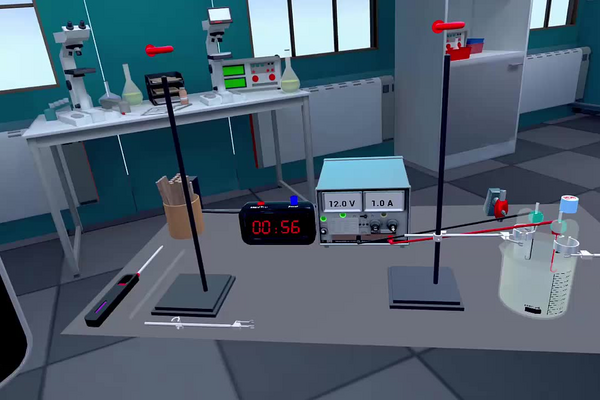
In this laboratory you will build the cell yourself: two test tubes filled with water and inverted over two electrodes in a litre beaker, connected to a direct-current supply. Sulfuric acid is added to make the water conduct, the current is run for about a minute, and the gas that collects in each tube displaces the water above it so that the two volumes can be compared directly. Each tube is then identified by the classical test — a glowing ember for oxygen, a lit splint for hydrogen — and the result should be that the tube on the negative electrode has collected twice as much gas as the other, and that the two gases behave in opposite ways.
Educational Goals
The principle of electrolysis
- Explain how electrical energy is used to drive a reaction that does not happen on its own, and write the overall equation 2 H2O → 2 H2 + O2.
- State the minimum voltage the cell requires and where that number comes from.
Oxidation and reduction at named electrodes
- Write the half-reaction occurring at each electrode and identify which is oxidation and which is reduction, using the terms anode and cathode correctly.
- Trace the path of the electrons through the external circuit and of the ions through the solution, and explain why the two must carry the same current.
Stoichiometry made visible
- Predict the 2 : 1 volume ratio from the balanced equation before the tubes are compared, and explain why volumes of gas may be compared directly where masses may not.
- Use Faraday’s law to relate the charge passed to the quantity of gas produced.
The choice of electrolyte
- Explain why pure water cannot be electrolysed usefully, and why the acid is a conductor rather than a reactant — it is not consumed overall.
- Compare candidate electrolytes by asking which of their ions could be discharged instead of water, and say what would come out of the cell if the wrong one were chosen.
Identifying the products
- Perform and interpret the two classical gas tests, and state what each result rules out as well as what it confirms.
- Explain why oxygen relights a glowing ember while hydrogen extinguishes it, in terms of which substance is the fuel and which the oxidant.
Assembly and safety
- Assemble a cell from a power supply, two leads and two electrodes with the polarities correct, and invert a filled tube over an electrode without trapping air in it.
- Handle a dilute strong acid, a live circuit and a flammable gas in the same experiment, and explain why the hydrogen test is done on a small volume in a downward-facing tube.
Protocol
PART A: The electrolysis of water
- Attach the universal clamps to the 2 universal supports on the right, one clamp per support, at approximately 20 cm from the base.
- Fill the beaker with 1 L of water using tap water.
- Place the 1 L beaker in the center of the 2 supports, under the 2 clamps.
- Fill to the brim the two test tubes with tap water.
- Put the stoppers on the openings of the test tubes.
- Fix the two test tubes to the universal clamps by positioning them upside down, so that they are immersed in the 1 L beaker filled with water (the opening of the test tubes must remain immersed at all times).
- Once the test tubes are attached to the clamps, remove the stoppers from the openings. Ensure that air bubbles have not lodged at their upper end.
- Attach an electrode to each test tube: the positive electrode (red electrode) to test tube 1, and the negative electrode (black electrode) to test tube 2.
- You will find two conducting wires (1 red, 1 black) in front of the current generator.
- Connect the flat part of the red conductor wire to the positive terminal of the current generator (red terminal on the right), and the other end (crocodile clip) to the electrode of test tube 1.
- Connect the flat part of the black conductor wire to the negative terminal of the current generator (black terminal on the left), and the other end (alligator clip) to the electrode of test tube 2.
- Measure 15 mL of sulfuric acid using the graduated cylinder.
- Pour the contents of the graduated cylinder into the 1 L beaker.
- Mix everything for a few seconds using the glass rod.
- Turn on the current generator. Start the stopwatch.
- Let the reaction occur for about 1 minute. Stop the stopwatch.
- Turn off the generator.
PART B: Product Analysis
- Attach a clamp to the left universal support, approximately 40 cm from the base.
- Remove the electrodes and the alligator clips from the immersed test tubes.
- Remove test tube 1 from the water, always upside down, and ensure that any residual liquid flows into the beaker below. Then fix the test tube upside down to the left-hand stand using its clamp.
- Light a wooden splint, then shake it out so that it glows as a red ember.
- Bring the splint close to test tube 1 and, while keeping the test tube opening facing downward, quickly insert the wooden splint without touching the sides.
- Light a second wooden splint but keep the flame alive, then bring it close to the opening of test tube 1 (positive) and quickly insert the splint into the test tube without touching the sides.
- Put test tube 1 back on the metal test tube rack, on the top right shelf.
- Redo steps 18 to 22 with test tube 2 (negative).
- The results of the observations are found in the results table.
- Empty the liquids into the recovery beaker on the right counter, and deposit the used splints into the waste container.
Anticipated Outcomes
Gas appears on both electrodes within a few seconds of the generator being switched on, rises into the inverted tubes and displaces the water in them. The tube on the negative electrode fills roughly twice as fast as the other, and the two gases then answer the two tests in opposite ways.
| Test tube | Electrode | Gas collected | Relative volume | Glowing ember | Lit splint |
|---|---|---|---|---|---|
| Test tube 1 | Positive, red (anode) | Oxygen, O2 | 1 volume | Rekindles into flame | Burns more brightly |
| Test tube 2 | Negative, black (cathode) | Hydrogen, H2 | 2 volumes | Goes out | Sharp pop |
The two half-reactions, and where 1.23 V comes from
In acid solution the cathode reduces hydrogen ions, 2 H+(aq) + 2 e− → H2(g) with E° = 0.00 V, and the anode oxidises water, 2 H2O(l) → O2(g) + 4 H+(aq) + 4 e− with E° = +1.23 V. Adding the two, after doubling the first so that the electrons cancel, gives 2 H2O → 2 H2 + O2 with E°cell = 0.00 − 1.23 = −1.23 V. The negative sign is the statement that the reaction will not run by itself; 1.23 V is the smallest voltage that can force it.
That number is worth checking against thermodynamics, because the two routes must agree. ΔG = −nFE gives 4 × 96 485 C/mol × 1.23 V = 475 kJ per mole of oxygen, which is 237 kJ per mole of hydrogen — and the standard free energy of formation of liquid water is −237.1 kJ/mol. The cell voltage and the thermochemical table are the same fact written two ways.
Two refinements follow from it. First, the minimum voltage does not depend on the acidity: lowering the pH shifts both half-reactions by the same −0.0592 V per pH unit, because both involve H+ in the same proportion to the electrons, so their difference stays at 1.23 V. The acid makes the cell conduct; it does not make the reaction easier. Second, 1.23 V is the figure that applies if the surroundings supply the entropy term as heat. If instead the cell is to be self-sufficient thermally, the voltage must cover the whole enthalpy: Etn = ΔH/nF = 285 800 / (2 × 96 485) = 1.48 V. Below that a working cell cools itself, above it the cell warms up — and every real cell runs above it, because of overpotential.
Overpotential is the reason a school power supply is set to 6 or 12 V rather than 1.3 V. Getting oxygen off an electrode requires four electrons, four bonds broken and an O–O bond made, and that mechanism is slow; a few tenths of a volt in excess of the thermodynamic value must be supplied to make it proceed at a useful rate. Hydrogen evolution is far easier and costs little. Adding the resistance of the solution itself, a practical cell of this kind operates near 1.8 to 2.0 V per pair of electrodes. A class that measures the actual voltage across the cell and compares it with 1.23 V has not made an error — it has measured the overpotential.
Finally, note what the acid does not do. The anode produces four hydrogen ions for every oxygen molecule and the cathode consumes four for every two hydrogen molecules, so the sulfuric acid is exactly as concentrated at the end as at the start. It is a catalyst for conduction, not a reagent, which is why the equipment list needs only 15 mL of it for a litre of water.
How much gas, and how quickly
Faraday’s law converts charge into substance: n = It/(zF), where z is the number of electrons per molecule — two for hydrogen, four for oxygen. At 25 °C and atmospheric pressure a mole of gas occupies 24.45 L, so one ampere flowing for one minute passes 60 C and yields 60 / (2 × 96 485) = 3.11 × 10⁻⁴ mol of hydrogen, which is 7.6 mL of hydrogen and 3.8 mL of oxygen per ampere-minute. That single rule answers most quantitative questions about this laboratory. Filling a 20 mL test tube with hydrogen in the sixty seconds the protocol allows would need about 2.6 A, and at 2 V that is a little over 5 W — so a low current, or a short run, gives a few millilitres in each tube rather than a full one, and the tubes should be compared with each other rather than expected to fill.
| Quantity | Value | Where it comes from |
|---|---|---|
| Electrolyte after mixing | 0.0148 mol/L H2SO4 | 15 mL of 1.0 M diluted into 1.015 L |
| [H+] and pH | 0.020 mol/L, pH 1.69 | First proton complete, second with Ka2 = 1.2 × 10⁻² |
| Conductivity of the bath | About 0.85 mS/cm | Sum of λ°c, mostly the 350 S·cm2/mol of H+ |
| Same figure for pure water | 5.5 × 10⁻⁵ mS/cm | A factor of 15 000 — why the acid is needed |
| Thermodynamic minimum voltage | 1.23 V | Difference of the two standard electrode potentials |
| Energy per mole of hydrogen | 237 kJ minimum | ΔG = nFE = 2 × 96 485 × 1.23 |
| Thermoneutral voltage | 1.48 V | ΔH/nF = 285 800 / (2 × 96 485) |
| Gas produced per ampere-minute | 7.6 mL H2, 3.8 mL O2 | n = It/zF, then V = nRT/P at 25 °C |
| Current to fill a 20 mL tube with H2 in 60 s | About 2.6 A | The same rule read backwards |
| Efficiency at a working voltage of 2.0 V | About 74 % | 1.48 / 2.0, on the higher heating value of hydrogen |
Why the acid, and why this acid
Pure water contains only 10−7 mol/L of each ion and conducts about fifteen thousand times more poorly than the bath prepared here; a cell built with it would pass almost no current whatever voltage was applied. The sulfuric acid supplies the mobile ions that carry the current between the electrodes, and it is chosen rather than any other acid because of what it will not do: the sulfate ion is far harder to oxidise than water (+2.01 V against +1.23 V), so it takes no part in the reaction and water remains the only species oxidised at the anode. The acid also supplies the hydrogen ions reduced at the cathode, and, as shown above, is regenerated in exactly the amount it is consumed.
Why not hydrochloric acid? The choice of electrolyte determines what is produced. If the acid supplied chloride ions, chloride would be oxidised at the positive electrode in competition with water (2 Cl− → Cl2 + 2 e−), and that electrode would release chlorine rather than oxygen — a toxic gas that extinguishes a glowing splint instead of rekindling it. Although the oxidation of water is favoured thermodynamically (+1.23 V against +1.36 V), oxygen evolution carries a much larger overpotential than chlorine evolution, so chloride discharges preferentially at practical current densities. This is the same principle that allows the chlor-alkali industry to produce chlorine from brine. A suitable electrolyte for the electrolysis of water is therefore one whose ions are both harder to discharge than water itself: sulfate, nitrate or perchlorate paired with hydrogen, sodium or potassium.
The two identification tests
The tests are chosen so that each gas gives a positive result on one and a negative result on the other, which is what makes the pair conclusive rather than suggestive. In tube 1 a glowing ember relights, because oxygen at close to 100 % is five times richer than the air the splint was burning in and the ember’s own residual heat is enough to restart combustion; the gas is not itself a fuel, so a splint already in flame simply burns more brightly. In tube 2 the ember goes out — hydrogen is a fuel, not an oxidant, and it displaces the air the ember needs — but a flame ignites the hydrogen where it mixes with air at the mouth of the tube, and the small confined volume burns in a few milliseconds with the characteristic pop. A student who reports a pop from tube 1 or a relit ember from tube 2 has swapped the tubes or the polarity.
Taken together, the tests and the volume ratio establish the composition of water from three independent directions: which gas is at which electrode, in what proportion, and with what chemical character. That is a stronger conclusion than any one of the three on its own, and it is the reason the protocol asks for both tests on both tubes rather than the obvious test on each.
Summary of Assignment by Grade Range
Grade 9–10
Focus. What electrolysis is, which gas comes off which electrode, and how each one is identified.
Activities. Assemble the cell with the red lead on the positive terminal and the black on the negative, and describe where bubbles appear. Record which tube fills faster and by roughly how much. Carry out both tests on both tubes and tabulate the four results, then use the table to name the gas in each tube. Write the overall equation and explain in a sentence why the tube with twice the gas must be the hydrogen one.
Grade 11
Focus. Half-reactions, stoichiometry and the role of the electrolyte.
Activities. Write the half-reaction at each electrode, balance the electrons and combine them into the overall equation, identifying the oxidation and the reduction. Explain why the acid is needed and show, by counting hydrogen ions produced and consumed, that it is not used up. Calculate the concentration of the acid after dilution into the litre of water. Given a current and a time, use Faraday’s law to predict the volume of each gas, and compare the prediction with the volumes seen in the tubes.
Grade 12 / College Level
Focus. Cell thermodynamics, kinetics and efficiency.
Activities. Derive the minimum cell voltage from the two standard potentials, then confirm it independently from ΔG° of formation of water, and show that the result does not depend on the pH of the electrolyte. Calculate the thermoneutral voltage from ΔH and explain the difference between the two figures in terms of the entropy of the reaction. Account for the gap between 1.23 V and the voltage a real cell needs, distinguishing overpotential from ohmic loss, and explain why the oxygen electrode carries almost all of the former. Use the standard potentials of sulfate and chloride to justify the choice of electrolyte, and explain why the thermodynamically favoured product is not the one obtained from brine. Finally, estimate the round-trip efficiency of storing electricity as hydrogen and recovering it in a fuel cell, and say which step dominates the loss.
Laboratory essentials
Instruments
- Beaker (1000 mL)
- Recovery beaker
- Direct-current power supply (current generator)
- Conducting wires with crocodile clips, one red and one black
- Electrodes × 2
- Glass rod
- Graduated cylinder (25 mL)
- Universal stands × 3, with one clamp each
- Test tubes × 2, with stoppers
- Metal test-tube rack
- Stopwatch
- Wooden splints, and a means of lighting them
- Waste container for the used splints
Products
- Tap water (1 L for the beaker, plus enough to fill both test tubes)
- H2SO4 1.0 M (solution, 15 mL)