

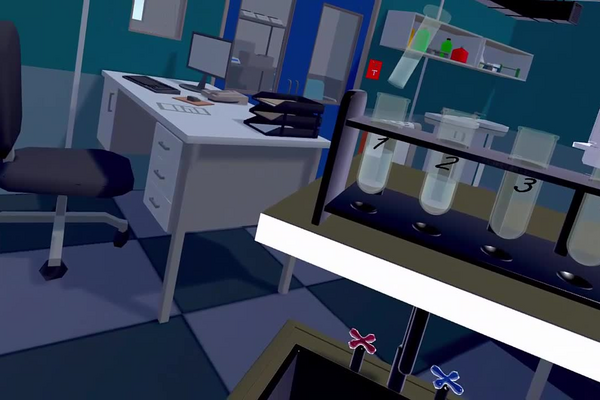
Solubility equilibrium is the reason a salt can be called “insoluble” and still be present in solution. Calcium sulfate is the standard industrial example: it is the scale that forms in boilers, cooling towers, desalination plants and oil-well tubing, it is the gypsum of plaster and drywall, and it is what sets the sulfate content of well water. Water-treatment chemists decide where it will deposit and where it will redissolve from a single number, its solubility product.
When a sparingly soluble salt sits in contact with a solution of its own ions, two processes run at the same time: ions leave the surface of the solid, and ions in the liquid return to it. Equilibrium is reached when the two rates become equal, not when either one stops. For calcium sulfate the condition is [Ca2+][SO42−] = Ksp = 4.9 × 10⁻⁵ at 25 °C. A solution whose ion product exceeds that value deposits solid until it no longer does; a solution below it dissolves solid until it reaches it. Adding more of either ion therefore does not change Ksp — it moves the position of the equilibrium, and the surplus appears as solid.
In this laboratory you will approach the same equilibrium from both sides. First from the ion side: mixing calcium chloride with sodium sulfate, both 0.10 M, gives an immediate white precipitate, and adding more of either reagent to the settled tubes drives further precipitation. Then from the solid side: solid calcium sulfate is stirred into a concentrated sodium chloride solution, and the clear liquid standing above it — in which nothing appears to have happened at all — is tested with each reagent in turn. Both tests give a precipitate, and that is the evidence that the “insoluble” solid has been feeding ions into the solution the whole time.
Educational Goals
Chemical equilibrium as a dynamic state
- Explain that a reaction at equilibrium has not stopped: the forward and reverse processes continue at equal rates, so reactants and products coexist indefinitely.
- Distinguish a dynamic equilibrium from a reaction that has simply exhausted one of its reagents.
Solubility equilibria and the solubility product
- Write the dissolution equilibrium and the solubility-product expression for a sparingly soluble salt, and use Ksp to calculate the concentration of each ion in a saturated solution.
- Form the ion product Q of two solutions about to be mixed and compare it with Ksp to decide in advance whether a precipitate will appear.
Le Châtelier’s principle and the common-ion effect
- Predict the direction in which added Ca2+ or SO42− shifts the equilibrium, and state what happens to the concentration of the other ion.
- Explain why the equilibrium constant is unchanged by the addition even though the quantity of solid changes.
Complete versus incomplete reactions
- Recognise that a reaction which looks finished can leave a substantial concentration of both reactants behind, and calculate how much — here 14 % of the calcium.
- Use that residue to justify why the second half of the laboratory works at all.
Qualitative analysis and the logic of a spot test
- Use a precipitation reaction as a detection test, stating which ion each addition detects and what a negative result would have meant.
- Identify the control this protocol does not include, and say what it would establish.
Laboratory technique
- Weigh a solid on an electronic balance, measure volumes with a graduated cylinder, and decant a supernatant without carrying the solid over with it.
- Record qualitative observations in a form precise enough for another student to reproduce.
Protocol
Preparation of a NaCl solution
- Weigh about 4.3 g (2 mL) of sodium chloride (NaCl) crystals.
- Transfer the crystals into the empty 100 mL beaker.
- Using the 70 mL graduated cylinder, measure 50 mL of distilled water and transfer into the 100 mL beaker.
- Stir the contents using the glass rod.
Observe the initial appearance of the three solutions studied : the sodium chloride (NaCl) solution, the calcium chloride (CaCl2) solution and the sodium sulfate (Na2SO4) solution.
Study of the forward reaction: CaCl₂(aq) + Na₂SO₄(aq) ⇌ 2 NaCl(aq) + CaSO₄(s) — net ionic: Ca²⁺(aq) + SO₄²⁻(aq) ⇌ CaSO₄(s)
- Using the graduated cylinder, measure 10 mL of calcium chloride (CaCl2) solution.
- Pour the contents of the graduated cylinder into test tube 1.
- Using the graduated cylinder, measure another 10 mL of calcium chloride (CaCl2) solution.
- Pour the contents of the graduated cylinder into test tube 2.
- Using the graduated cylinder, measure 10 mL of sodium sulfate (Na2SO4) solution.
- Pour the contents of the graduated cylinder into test tube 1.
- Using the graduated cylinder, measure another 10 mL of sodium sulfate (Na2SO4) solution.
- Pour the contents of the graduated cylinder into test tube 2.
- Stir the contents of both test tubes using the glass rod, or by placing a stopper and shaking.
- Let the mixtures stand for a few seconds and wait until there is no more observable change.
- Using the graduated cylinder, measure 10 mL of the calcium chloride (CaCl2) solution and transfer it into test tube 1.
- Using the graduated cylinder, measure 10 mL of the sodium sulfate (Na2SO4) solution and transfer it into test tube 2.
- Stir the contents of both test tubes using the glass rod, or by placing a stopper and shaking.
- Let the mixtures stand for a few seconds and wait until there is no more observable change.
- Empty the test tubes into the black recovery bin and rinse them well with distilled water.
Study of the reverse reaction: CaSO₄(s) ⇌ Ca²⁺(aq) + SO₄²⁻(aq)
A saturated solution of calcium sulfate is prepared in concentrated sodium chloride solution. Sodium and chloride ions take no part in the reaction, but the high ionic strength allows appreciably more calcium sulfate to dissolve, leaving enough Ca²⁺ and SO₄²⁻ in the supernatant to be detected. + Na2SO4(aq)
- Weigh about 3 g (1 mL) of calcium sulfate (CaSO4).
- Add the calcium sulfate (CaSO4) to the 50 mL beaker of the sodium chloride solution prepared at the beginning of the laboratory.
- Stir the solution for at least 30 seconds, using the glass rod, then let it stand until no further change is observed.
- Let the mixture stand and wait until there is no more observable change.
- Using the graduated cylinder, measure 10 mL of supernatant liquid from this same solution (taking care not to pour the solid) then, pour the liquid into test tube 3.
- Using the graduated cylinder, measure another 10 mL of supernatant liquid from this same solution (taking care not to pour the solid) then, pour the liquid into test tube 4.
- Using the graduated cylinder, measure 10 mL of the calcium chloride (CaCl2) solution and transfer it into test tube 3.
- Using the graduated cylinder, measure 10 mL of the sodium sulfate (Na2SO4) solution and transfer it into test tube 4.
- Stir the contents of both test tubes using the glass rod, or by placing a stopper and shaking.
- Let the mixtures stand for a few seconds and wait until there is no more observable change.
- Empty the test tubes into the recovery bin and rinse them well with distilled water.
Anticipated Outcomes
Nothing in this laboratory changes colour and no gas is released. Every result is a white solid appearing, or failing to appear, in a clear liquid — so the whole exercise rests on knowing what each addition should produce and why. The table below is what the student should see; the sections after it account for all of it from the two stock concentrations and one equilibrium constant.
| Stage | What is seen | What it establishes |
|---|---|---|
| The three stock solutions: NaCl, CaCl2 0.10 M, Na2SO4 0.10 M | Clear, colourless, transparent | All three salts are freely soluble; nothing has reacted yet |
| Tubes 1 and 2: 10 mL CaCl2 + 10 mL Na2SO4 | Immediate dense white precipitate; the liquid above is clear | The ion product exceeds Ksp about fifty-fold, so CaSO4 deposits |
| Tube 1 + a further 10 mL of CaCl2 | Slightly more white solid; the supernatant stays clear | Added Ca2+ shifts the equilibrium toward the solid |
| Tube 2 + a further 10 mL of Na2SO4 | Slightly more white solid | Added SO42− does the same from the other side |
| 3 g of CaSO4 stirred into the sodium chloride solution | Most of the powder stays on the bottom; the liquid above remains clear | Only about 0.08 g can dissolve — under 3 % of what was added |
| Tube 3: 10 mL of that supernatant + 10 mL CaCl2 | Immediate dense white precipitate; the liquid above is clear | The supernatant contained SO42− |
| Tube 4: 10 mL of that supernatant + 10 mL Na2SO4 | Immediate dense white precipitate; the liquid above is clear | The supernatant contained Ca2+ |
| All four tubes after standing | White solid at the bottom, clear colourless liquid above; no gas, no colour change | The system is at rest macroscopically while exchange continues at the surface |
The forward reaction, worked through
The reaction as written is CaCl2(aq) + Na2SO4(aq) ⇌ 2 NaCl(aq) + CaSO4(s), but sodium and chloride are spectators: they begin dissolved and end dissolved. The equilibrium that matters is the net ionic one, Ca2+(aq) + SO42−(aq) ⇌ CaSO4(s), whose constant is the reciprocal of the solubility product, 1/Ksp = 2.0 × 10⁴.
Mixing 10.0 mL of 0.10 M CaCl2 with 10.0 mL of 0.10 M Na2SO4 gives 20.0 mL holding 1.0 mmol of each ion, so before any reaction [Ca2+] = [SO42−] = 1.0 mmol / 20.0 mL = 0.050 M. The ion product is therefore Q = 0.050 × 0.050 = 2.5 × 10⁻³, which is fifty-one times Ksp = 4.9 × 10⁻⁵. Precipitation is not a possibility to be tested but a certainty that can be calculated before the tubes are touched.
Because the two ions are present in equal amounts they stay equal, so at equilibrium [Ca2+] = [SO42−] = √Ksp = √(4.9 × 10⁻⁵) = 7.0 × 10⁻³ M. The quantity that leaves the solution is (0.050 − 0.0070) M × 0.0200 L = 8.6 × 10⁻⁴ mol, and at 136.14 g/mol that is 0.117 g of calcium sulfate in each tube, about 0.12 g.
The number to dwell on is the one left behind. Of the 0.050 M of calcium put in, 7.0 × 10⁻³ M stays dissolved: 14 % of the calcium never precipitates, and the same is true of the sulfate. The reaction is 86 % complete, not complete, and it stops there not because a reagent has run out — both are still present in millimolar quantities — but because the rate at which ions join the solid has fallen to the rate at which they leave it.
What the extra reagent does: the common-ion effect
Adding 10.0 mL of 0.10 M CaCl2 to tube 1 brings the contents to 2.0 mmol of calcium and 1.0 mmol of sulfate in 30.0 mL. Writing n for the millimoles of solid present at the new equilibrium, [Ca2+] = (2.0 − n)/30 and [SO42−] = (1.0 − n)/30, and Ksp requires (2.0 − n)(1.0 − n) = 4.9 × 10−5 × 302 = 0.0441, which solves to n = 0.958 mmol. So the solid rises from 0.86 mmol to 0.958 mmol, the calcium settles at 3.5 × 10⁻² M and the sulfate falls from 7.0 × 10⁻³ to 1.4 × 10⁻³ M — and the product of those two is 4.9 × 10⁻⁵ again, as it must be. Tube 2 behaves identically with the two ions exchanged.
Two things follow, and they pull in opposite directions. Ksp has not moved: the constant is the same before and after, and only the position of the equilibrium has shifted. But the mass of solid has risen only from 0.117 g to 0.130 g, an increase of 11 %, while the sulfate left in solution has fallen by a factor of five. The change a student can see is the small one and the change that matters chemically is the large one, which is why this step should be marked on the prediction and the explanation rather than on the appearance of the tube.
| Quantity | Tubes 1 and 2 at mixing | Tube 1 after the extra CaCl2 | Tubes 3 and 4 (reverse test) |
|---|---|---|---|
| Total volume | 20.0 mL | 30.0 mL | 20.0 mL |
| Calcium present | 1.0 mmol | 2.0 mmol | 1.12 mmol |
| Sulfate present | 1.0 mmol | 1.0 mmol | 0.12 mmol |
| Ion product Q before reaction | 2.5 × 10⁻³ | — | 3.4 × 10⁻⁴ |
| Q / Ksp | 51 | — | 6.9 |
| [Ca2+] at equilibrium | 7.0 × 10⁻³ M | 3.5 × 10⁻² M | 5.1 × 10⁻² M |
| [SO42−] at equilibrium | 7.0 × 10⁻³ M | 1.4 × 10⁻³ M | 9.7 × 10⁻⁴ M |
| CaSO4(s) at equilibrium | 0.86 mmol = 0.117 g | 0.96 mmol = 0.130 g | 0.10 mmol = 0.014 g |
| Fraction of the scarcer ion left dissolved | 14 % | 4.2 % | 16 % |
The reverse reaction, and why the sodium chloride is there
Read from the other side the same equilibrium is CaSO4(s) ⇌ Ca2+(aq) + SO42−(aq), and in pure water it gives a saturated solution of √Ksp = 7.0 × 10⁻³ M, which is 0.95 g/L. In 50 mL of water that is 0.048 g — so stirring 3 g of the powder into plain water would dissolve about one part in sixty and look exactly like nothing happening. That is why the protocol dissolves the calcium sulfate in concentrated sodium chloride instead: 4.3 g of NaCl in 50 mL is 1.5 M, and neither Na+ nor Cl− takes any part in the equilibrium being studied.
The salt works through activity. Ksp is properly a product of activities, Ksp = γCa[Ca2+] × γSO4[SO42−], and in a 1.5 M salt solution the ionic strength is I = 1.5 M. The Davies equation, log γ = −0.509 z2 (√I/(1 + √I) − 0.3 I), gives γ ≈ 0.6 for each doubly charged ion, so the conditional product that governs concentrations is K′ = Ksp / (γCa γSO4) = 4.9 × 10⁻⁵ / 0.36 = 1.4 × 10⁻⁴, and the solubility becomes √K′ = 1.2 × 10⁻² M, or 0.082 g in the 50 mL beaker. Surrounding each ion with a cloud of oppositely charged spectator ions lowers its effective concentration, so more of the solid has to dissolve before the product reaches Ksp again. The measured effect for gypsum in 1.5 M sodium chloride is nearer two to three times rather than 1.7, partly because the Davies equation is being used well beyond its stated range of about 0.5 M and partly for the reason in the next paragraph.
The ideal treatment also understates the solubility of calcium sulfate in plain water, and the discrepancy is instructive. √Ksp predicts 0.95 g/L, whereas the measured solubility of gypsum at 25 °C is about 2.4 g/L. The missing species is the neutral, undissociated ion pair CaSO40, whose association constant is roughly 200 L/mol: at equilibrium [CaSO40] ≈ 200 × 4.9 × 10−5 = 9.8 × 10⁻³ M, which added to the 7.0 × 10⁻³ M of free ions gives 1.7 × 10⁻² M, or 2.3 g/L — the measured figure. More than half of the dissolved calcium sulfate is therefore travelling as neutral pairs that do not enter Ksp and cannot precipitate, which is invisible to this experiment but is the reason its arithmetic is a model rather than a measurement.
The two spot tests then follow the same rule as the first half of the laboratory. Ten millilitres of supernatant at 1.2 × 10⁻² M plus 10 mL of 0.10 M CaCl2 gives Q = 0.056 × 0.006 = 3.4 × 10⁻⁴, seven times Ksp, and deposits about 14 mg of calcium sulfate — but roughly an eighth of what the tubes in the first part produced. Had the calcium sulfate been dissolved in plain water instead, the same test would deposit only about 7 mg, so the concentrated sodium chloride roughly doubles the signal. That is the practical reason it is in the protocol, and it is worth telling students, because a reagent that takes no part in the reaction is otherwise hard to justify.
Why this counts as evidence of a dynamic equilibrium
Ions leave the solid at a rate that depends on how much surface is exposed, and rejoin it at a rate proportional to [Ca2+][SO42−]. Setting those two equal is what makes the ion product a constant, so Ksp is not an arbitrary tabulated number but the ratio of two rate constants. If the precipitate in the first part were simply inert, the liquid poured off the beaker in the second part would contain nothing, and both spot tests would be negative. They are positive, from a beaker in which the powder visibly did not dissolve — and that is as direct a demonstration of two-way traffic across a solid surface as a school laboratory can produce. The same argument read backwards explains the 14 % of calcium that stays in the first two tubes: precipitation cannot continue past the point where the two rates match.
Summary of Assignment by Grade Range
Grade 9–10
Focus. What a precipitate is, what “soluble” and “insoluble” mean, and the idea that a reaction can run in both directions at once.
Activities. Describe the appearance of the three stock solutions and of every tube after each addition, using consistent vocabulary for clear, cloudy and precipitate. Write the reaction in words, name the white solid and say which two ions it is made of. State which ion each of the two spot tests detects, and explain in a sentence why a precipitate in tube 3 proves that sulfate was present in a liquid that looked like water.
Grade 11
Focus. The solubility product used quantitatively, and Le Châtelier’s principle applied to a common ion.
Activities. Calculate the concentration of each ion immediately after mixing (0.050 M), form the ion product and compare it with Ksp. Calculate the mass of calcium sulfate expected in tubes 1 and 2 and the concentration of each ion left in solution. Predict, before making the addition, the direction in which the extra calcium chloride will shift the equilibrium and what will happen to the sulfate concentration. Then account for the fact that 14 % of the calcium never precipitates at all, and use it to explain why the second half of the laboratory can work.
Grade 12 / College Level
Focus. Derivation, non-ideality, and the design of a measurement rather than a demonstration.
Activities. Derive s = √Ksp from the dissolution equilibrium, then re-derive the composition of tube 1 after the common-ion addition from the two mass balances and Ksp, solving the quadratic rather than assuming the excess. Estimate the activity coefficients in 1.5 M sodium chloride with the Davies equation, form the conditional solubility product and predict how much calcium sulfate dissolves in the second part. Reconcile √Ksp with the measured solubility of gypsum using the CaSO40 ion pair, and say which of the two figures belongs in each calculation. Finally, calculate the mass of precipitate expected in tube 3, judge whether 14 mg is detectable by eye, and specify the controls and the gravimetric or titrimetric step that would turn this qualitative laboratory into a determination of Ksp.
Laboratory essentials
Instruments
- Beaker (100 mL)
- Beaker (50 mL)
- Electronic balance
- Glass rod
- Graduated cylinder (10 mL)
- Graduated cylinder (70 mL)
- Spatula
- Test tubes (50 mL) × 4, with stoppers
- Recovery bin
Products
- Distilled water (50 mL for the solution, plus rinsing)
- Sodium chloride, crystals (4.3 g)
- Calcium sulfate, powder (3 g)
- Calcium chloride 0.10 M (solution, 40 mL)
- Sodium sulfate 0.10 M (solution, 40 mL)