

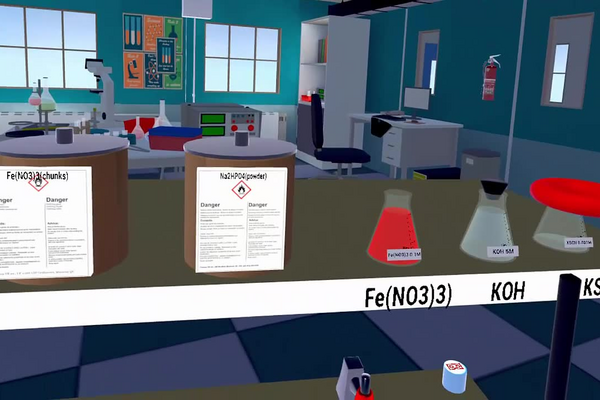
Le Châtelier’s principle is the rule that lets a chemical engineer squeeze more product out of a reaction that refuses to go to completion. It is why ammonia is synthesised under pressure, why a blast furnace is run with excess carbon monoxide, and why the oxygen your blood picks up in the lungs is released again in working muscle. The system used to teach it in almost every laboratory in the world is the one on this bench: iron(III) and thiocyanate, which combine to give a complex so intensely coloured that a change in concentration can be read off by eye, with no instrument at all.
The reaction is Fe3+(aq) + SCN−(aq) ⇌ [FeSCN]2+(aq), and the deep blood-red belongs entirely to the complex on the right; both reactants are almost colourless at these concentrations. At equilibrium the concentrations satisfy Kf = [FeSCN2+] / ([Fe3+][SCN−]) ≈ 1.4 × 10² at 25 °C. Disturb the mixture — add one of the reactants, take one away, warm it or cool it — and the reaction quotient Q no longer equals Kf; the system responds by consuming or releasing the complex until it does. That is Le Châtelier’s principle stated precisely: not that a system “opposes” a change, but that it moves in whichever direction returns Q to K.
In this laboratory you will prepare one equilibrium mixture and divide it into eight identical portions, keeping the first as a reference to compare the others against. Then you will stress seven of them in six different ways: more thiocyanate, more iron, both at once, hydroxide to precipitate the iron out of the system, hydrogen phosphate to bind it, an ice bath and an 80 °C water bath. Every tube is compared against tube 1 in front of a black card, and the direction each one moves — darker toward the complex, paler toward the free ions — is the whole result.
Educational Goals
Le Châtelier’s principle, stated and applied
- State the principle in terms of the reaction quotient and the equilibrium constant, and use it to predict the direction of a shift before making the addition.
- Distinguish between shifting the position of an equilibrium, which concentration changes do, and changing the equilibrium constant, which only temperature does.
Complexation equilibria and colour as a measure
- Write the formation equilibrium of a coloured complex ion and its formation constant, and calculate the concentration of the complex in a mixture of known composition.
- Use the Beer–Lambert law to relate the depth of colour to concentration, and identify the range over which the eye can actually rank two tubes.
Adding a species, and removing one
- Predict the effect of adding either reactant, and explain why the effect saturates once one of the two is fully consumed.
- Explain how precipitating an ion out of the mixture removes it from the equilibrium as surely as pouring it away, and calculate how little of it is left behind.
Temperature as a stress
- Use the van ’t Hoff relation to connect the direction of a temperature shift to the sign of the enthalpy change.
- Recognise when an observed temperature effect has more than one possible cause, and say what extra measurement would separate them.
Controlled qualitative comparison
- Explain why a reference tube drawn from the same stock, and a black background behind all eight, are what make a colour comparison evidence rather than impression.
- Record a ranking rather than an adjective, and state the point beyond which the ranking is no longer reliable.
Technique and safety
- Prepare a set of identical portions from a single stock, weigh solids, and run a hot and a cold bath with tubes clamped to a stand.
- Handle thiocyanate salts with the one precaution they require: their waste must never be acidified, because thiocyanate and strong acid release hydrogen cyanide.
Protocol
Part A : Preparation of the basic solutions
- Measure 50 mL of 0.001M KSCN solution using the graduated cylinder.
- Pour the measured solution into a 50 mL beaker.
- Using the dropper; add 10-12 drops of 0.1M Fe(NO3)3 solution into the beaker.
- Stir the mixture with the glass rod.
- Using the 10 mL graduated cylinder; distribute the resulting solution into the eight test tubes (about 6 mL per test tube).
Part B : Change of the equilibrium point
- Add about between 1.5 and 2 g of KSCN powder (5 mL) into test tube 2 using the spatula.
- Shake test tube 2.
- Add between 1.5 and 2 g of Fe(NO3)3 (1 piece) into test tube 3 using the tongs.
- Shake test tube 3.
- Add between 1.5 and 2 g of KSCN powder (5 mL) into test tube 4 using the spatula.
- Shake test tube 4.
- Add between 1.5 and 2 g of Fe(NO3)3 (1 piece) into test tube 4 using the tongs.
- Shake test tube 4.
- Add 2 drops of KOH into test tube 5.
- Shake test tube 5.
- Add between 1.5 and 2 g of Na2HPO4 powder (5 mL) into test tube 6.
- Shake test tube 6.
- Prepare an ice bath by filling the 250 mL beaker containing ice with cold tap water.
- Then place the beaker to the right of the right universal stand.
- Attach a clamp to the right universal stand; above the ice beaker.
- Attach test tube 7 to the clamp; so that the test tube will be positioned in the ice beaker
- Mix test tube 7 during its immersion in the ice bath with the glass rod.
- Fill a second 250 mL beaker with tap water.
- Place the second beaker on the hot plate.
- Attach a clamp to the left universal stand; above the beaker that is on the hot plate.
- Attach test tube 8 to the clamp on the left stand; so that the test tube will be positioned in the beaker that is on the hot plate.
- Insert the magnetic stir bar into the beaker on the plate and start the stirrer.
- Adjust the temperature of the hot plate to 80 °C.
- Once the temperature of 80 °C has been reached; mix test tube 8 during its immersion in the hot water bath with the glass rod.
- Observe the changes in test tubes 7 and 8; noting differences in color or precipitation.
- Stop the magnetic stirrer and lower the temperature of the hot plate to 15°C.
- Remove the magnetic stir bar from the beaker.
- Shake all the test tubes one last time to homogenize the reactions.
- Take a photo of test tubes 2 to 8; and note their colors with reference to control test tube 1.
Note: Make sure that the solutions are in front of a black cardboard; in order to clearly distinguish the color changes.
- Empty the contents of the test tubes into the recovery bin and rinse the used equipment with distilled water.
Anticipated Outcomes
Tube 1 is never touched. Everything reported below is a comparison against it, made in front of the black card, and the result of the laboratory is the direction each tube moves rather than any number read off it.
| Tube | What is added | Size of the addition | Expected appearance | Direction of the shift |
|---|---|---|---|---|
| 1 | Nothing — the reference | — | Clear reddish-orange | At equilibrium; 12 % of the thiocyanate is complexed |
| 2 | KSCN powder, 1.5–2 g | About 3000 × the thiocyanate already in the tube | Much deeper red, tending to reddish-brown | Toward the complex: added reactant |
| 3 | Fe(NO3)3 crystals, 1.5–2 g | About 660 × the iron already in the tube | Intense red | Toward the complex: the other reactant |
| 4 | Both of the above | Both excesses at once | Very dark brown, the deepest of the eight | Toward the complex from both sides |
| 5 | KOH, 2 drops | Enough to precipitate all the iron if it is about 0.2 M | Colourless liquid over a red-brown solid | Toward the free ions: Fe3+ removed as Fe(OH)3 |
| 6 | Na2HPO4 powder, 1.5–2 g | Far more than can dissolve | Red fades; a pale buff solid appears | Toward the free ions: Fe3+ bound as FePO4 |
| 7 | Ice bath | About 0 to 4 °C | Slightly deeper red than tube 1 | Toward the complex on cooling |
| 8 | Water bath at 80 °C | Plate setpoint 80 °C | Red fades toward pale yellow; returns on cooling | Toward the free ions on heating |
The reference mixture, worked out
Everything the laboratory does is measured against tube 1, so it is worth knowing what is in it. Fifty millilitres of 0.001 M KSCN contains 5.0 × 10⁻⁵ mol of thiocyanate. Eleven drops of 0.10 M Fe(NO3)3, at about 0.05 mL a drop, add 0.55 mL and 5.5 × 10⁻⁵ mol of iron, bringing the volume to 50.6 mL. Before any reaction, therefore, [SCN−]0 = 9.9 × 10⁻⁴ M and [Fe3+]0 = 1.09 × 10⁻³ M — very nearly a one-to-one mixture, which is exactly what a reference mixture should be, because it can then be pushed in either direction.
Solving Kf = x / ((9.9 × 10⁻⁴ − x)(1.09 × 10⁻³ − x)) = 1.4 × 10² for x gives [FeSCN2+] = 1.2 × 10⁻⁴ M, leaving [SCN−] = 8.7 × 10⁻⁴ M and [Fe3+] = 9.7 × 10⁻⁴ M. Only about 12 % of the thiocyanate is tied up in the complex, and that is the single most useful number in the laboratory: the reference tube is not a finished reaction but a mixture in which the great majority of both reactants is still free and available, which is precisely why every one of the seven stresses produces a visible response.
| Quantity | Value | Where it comes from |
|---|---|---|
| Thiocyanate taken | 5.0 × 10⁻⁵ mol | 50.0 mL × 0.001 M |
| Iron added | 5.5 × 10⁻⁵ mol | 11 drops × 0.05 mL × 0.10 M |
| Total volume | 50.6 mL | 50.0 + 0.55 mL |
| [FeSCN2+] at equilibrium | 1.2 × 10⁻⁴ M | Kf and the two mass balances |
| Thiocyanate complexed | 12 % | 1.2 × 10⁻⁴ / 9.9 × 10⁻⁴ |
| Complex in one 6 mL portion | 7 × 10⁻⁷ mol | 1.2 × 10−4 M × 6.0 mL |
| Absorbance across a test tube at 447 nm | About 0.8 | A = εcl with ε = 4700 L mol−1 cm−1, l ≈ 1.5 cm |
| Concentration at which a tube stops getting visibly darker | About 3 × 10⁻⁴ M | A = 2, i.e. 1 % of the light transmitted |
Tubes 2, 3 and 4: adding a reactant
Each 6.0 mL portion holds 5.9 × 10⁻⁶ mol of thiocyanate and 6.5 × 10⁻⁶ mol of iron in all forms. Against that, 1.75 g of KSCN is 1.8 × 10⁻² mol — about three thousand times as much thiocyanate as the tube already contains, and a concentration of roughly 3 mol/L. Similarly 1.75 g of Fe(NO3)3·9H2O is 4.3 × 10⁻³ mol, some six hundred and sixty times the iron present, or about 0.7 mol/L. These are not nudges. Whichever reagent is added, the other one is driven essentially to exhaustion: in tube 2 all the iron ends up complexed, in tube 3 all the thiocyanate does, and the colour rises to the ceiling set by whichever species was scarce.
That ceiling is worth calculating, because it is the honest limit of what tubes 2 and 3 can show. Complexing all the iron in a tube would give 1.09 × 10⁻³ M of FeSCN2+, nine times the reference value; complexing all the thiocyanate would give 9.9 × 10⁻⁴ M, about eight times. So even an infinite excess buys roughly one order of magnitude, and both tubes reach it. Tube 4, which receives both excesses at once, is no longer limited by either original species: it becomes a concentrated solution of iron(III) thiocyanate in its own right, which is why it is the darkest of the eight and also why it is the least informative — the equilibrium it displays is no longer the one the reference tube was prepared to demonstrate.
One further consequence deserves mention because the tube’s colour depends on it. At thiocyanate concentrations of the order of 1 mol/L the 1:1 complex is not the only one present: successive equilibria give Fe(SCN)2+, Fe(SCN)3 and, in strongly thiocyanate-rich solutions, species up to Fe(SCN)63−. These absorb at longer wavelengths than FeSCN2+, which is why tube 2 turns reddish-brown rather than simply a deeper red. The brown is therefore evidence of the shift, but not of the shift the simple equation describes.
Tubes 5 and 6: removing a reactant
These two tubes are the stronger half of the laboratory, because nothing is poured out of them and yet a reactant disappears. Hydroxide precipitates iron(III) as Fe(OH)3: Fe3+(aq) + 3 OH−(aq) ⇌ Fe(OH)3(s), with Ksp = 2.8 × 10−39. The number that follows is spectacular. Once the solution reaches even pH 7, [Fe3+] = Ksp/[OH−]3 = 2.8 × 10−39 / (1.0 × 10⁻⁷)3 = 2.8 × 10⁻¹⁸ M — about one iron ion in every hundred millilitres. There is simply no iron left for the thiocyanate to bind, so the complex dissociates completely and the liquid goes colourless above a red-brown solid. This is not a partial shift; it is the whole equilibrium collapsing, and it makes the point that a species removed by precipitation is as gone as a species removed by decanting.
The arithmetic of the addition is also worth doing: each tube contains 6.5 × 10⁻⁶ mol of iron, so precipitating all of it needs 2.0 × 10⁻⁵ mol of hydroxide, which two drops (about 0.1 mL) supply if the potassium hydroxide is 0.2 mol/L. A more concentrated solution overshoots by whatever factor it is stronger, and drives the pH well past the point where the excess matters.
Hydrogen phosphate works the same way with a different sink: Fe3+(aq) + HPO42−(aq) ⇌ FePO4(s) + H+(aq), with iron(III) phosphate one of the least soluble common iron salts (Ksp of order 10−22, with tabulated values spanning several orders of magnitude depending on the hydration state). Removing the iron pulls the complexation equilibrium back toward the free ions and the red fades. Two honest qualifications: a concentrated sodium hydrogen phosphate solution is itself alkaline, at about pH 9, and at that pH iron(III) hydroxide precipitates on its own — so the pale buff solid is very likely a mixture of phosphate and hydrous oxide rather than pure FePO4, and tubes 5 and 6 may be demonstrating the same chemistry twice by two routes. And most of the powder added to tube 6 cannot dissolve at all.
Tubes 7 and 8: temperature, and what it can and cannot prove
Temperature is the only stress in this laboratory that changes the equilibrium constant itself. The van ’t Hoff relation, ln(K2/K1) = −(ΔH°/R)(1/T2 − 1/T1), says how much. Taking the two baths as 275 K and 353 K and asking what enthalpy change would be needed to alter K by a factor of three — roughly the smallest change that is unambiguous by eye — gives ln 3 = 1.10 = −(ΔH°/8.314)(1/353 − 1/275) = −(ΔH°/8.314)(−8.03 × 10−4), so |ΔH°| ≈ 11 kJ/mol. A visible difference between the ice bath and the hot bath therefore implies an enthalpy change of at least about that size, and the direction observed — darker cold, paler hot — makes the formation of the complex exothermic.
That is the conclusion the laboratory is designed to reach, and it should be reported with one qualification that a strong student will find anyway. A second, entirely different process fades the same colour on heating: iron(III) is a weak acid in water, Fe3+ + H2O ⇌ FeOH2+ + H+ with Ka = 6.5 × 10⁻³, and that hydrolysis is strongly endothermic, ΔH ≈ +43 kJ/mol. Putting that into the same van ’t Hoff expression between 298 K and 353 K gives a fifteen-fold rise in the hydrolysis constant, which removes free Fe3+ from the hot tube and pales it regardless of the complexation enthalpy. This experiment cannot separate the two, and it does not need to in order to teach the principle — but the honest statement is that tube 8 shows the system moving away from the complex on heating, not that it measures ΔH for the complexation. Suppressing the hydrolysis with a little nitric acid, as the quantitative version of this experiment does, is what would make the temperature result mean only one thing.
The same hydrolysis matters for the reference tube. At 1.09 × 10⁻³ M and with no acid added, solving x2/(1.09 × 10−3 − x) = 6.5 × 10⁻³ puts the solution near pH 3 with the majority of the iron present as the pale yellow FeOH2+ rather than as Fe3+. The complex still forms — the equilibria are coupled and the thiocyanate pulls iron back out of the hydroxo form — but a mixture prepared without acid is paler than the ideal calculation predicts, and the 1.2 × 10⁻⁴ M above should be read as an upper bound.
Summary of Assignment by Grade Range
Grade 9–10
Focus. Observation, vocabulary, and the idea that a reaction which has settled can still be pushed one way or the other.
Activities. Rank all eight tubes against tube 1 in front of the black card, recording for each one what was added and whether the red became stronger or weaker. Write the reaction and name the species responsible for the colour. Explain in a sentence each why adding thiocyanate deepens the colour and why adding hydroxide destroys it, and say which two tubes show the effect of temperature and in which direction.
Grade 11
Focus. The reaction quotient, the formation constant, and Le Châtelier’s principle used to predict rather than to explain after the fact.
Activities. Calculate the concentrations of iron and thiocyanate in the stock mixture from the volumes used, then use Kf to find the concentration of the complex and show that only about 12 % of the thiocyanate is bound. Work out how many times more thiocyanate tube 2 receives than it already contains. Predict the direction of every tube before looking at it, in each case by saying what happens to Q. Then explain the hardest case: why tubes 5 and 6 lose their colour when nothing was taken out of them.
Grade 12 / College Level
Focus. The quantitative treatment and the limits of the model.
Activities. Derive the equilibrium composition of the stock from the two mass balances and Kf by solving the quadratic rather than assuming an excess, and calculate the ceiling concentration of the complex that tubes 2 and 3 can reach. Use the Beer–Lambert law with ε = 4700 L mol−1 cm−1 to compute the absorbance of tube 1 and the concentration at which a tube stops getting visibly darker, and use the result to say what tubes 2 to 4 can and cannot establish. Estimate the extent of iron(III) hydrolysis at the working concentration from Ka = 6.5 × 10⁻³ and state its effect on the reference colour. Apply the van ’t Hoff equation to find the enthalpy change a visible shift between the two baths would require, then explain why the observed fading on heating does not by itself establish the sign of ΔH for the complexation. Finally, specify the acidified, spectrophotometric version of this experiment that would measure Kf and ΔH instead of inferring their signs.
Laboratory essentials
Instruments
- Beaker (50 mL)
- Beakers (250 mL) × 2 — one for the ice bath, one for the hot bath
- Black cardboard, as a background for the colour comparison
- Dropper
- Electronic balance
- Glass rod
- Graduated cylinder (10 mL)
- Graduated cylinder (70 mL)
- Hot plate with magnetic stirrer, and a stir bar
- Recovery bin
- Spatula
- Test tubes × 8, numbered
- Tongs
- Universal stands × 2, with clamps
Products
- Distilled water (for rinsing)
- Ice, and cold tap water for the ice bath
- Iron(III) nitrate 0.10 M (solution, 10–12 drops)
- Iron(III) nitrate (crystals, 1.5–2 g per tube, two tubes)
- Potassium hydroxide (solution, 2 drops — the concentration is not specified by the build)
- Potassium thiocyanate 0.001 M (solution, 50 mL)
- Potassium thiocyanate (powder, 1.5–2 g per tube, two tubes)
- Sodium hydrogen phosphate (powder, 1.5–2 g)