

Stoichiometry is the arithmetic of chemistry: the set of rules that lets a chemist predict, before anything is mixed, exactly how much product a reaction will make. A pharmaceutical plant uses it to size a batch, a water-treatment operator uses it to dose a coagulant, and an engine designer uses it to set an air-fuel ratio. The rules follow from a single fact, the conservation of matter — a reaction rearranges atoms but never creates or destroys them — so the coefficients of a balanced equation fix the ratio in which substances combine. That ratio is a ratio of moles, not of grams and not of millilitres, which is why every stoichiometric calculation passes through the mole on its way from what is measured out to what is predicted.
This laboratory puts that prediction to the test on a neutralization. Sulfuric acid is diprotic: each formula unit can release two protons, so it requires two moles of sodium hydroxide for every one of its own, and the balanced equation reads H2SO4(aq) + 2 NaOH(aq) → Na2SO4(aq) + 2 H2O(l). Both products are invisible at the moment they form — the sodium sulfate stays dissolved and the new water simply joins the water already there — so the only way to see what was made is to take the solvent away.
In this laboratory you will pipette 10 mL of 1.0 mol/L sulfuric acid and 10 mL of 2.0 mol/L sodium hydroxide into a porcelain dish that has already been weighed, boil the water off on a hot plate, dry the residue at 70 °C, and weigh the dish again. Because the dish, the filter paper and the stir bar sit on the balance both times, their masses cancel in the subtraction and the difference is the mass of salt alone. That measured mass is then set against the mass the balanced equation predicts. The comparison, rather than the salt, is the result of the experiment.
Educational Goals
Interpreting a balanced chemical equation
- Read the coefficients of an equation as a ratio of moles rather than of masses or volumes.
- Explain why a diprotic acid consumes two moles of a monobasic hydroxide, and predict the ratio for other acid-base pairs.
Converting between concentration, volume, amount and mass
- Apply n = C × V to obtain the amount of substance delivered by a measured volume of a solution of known concentration.
- Calculate a molar mass from atomic masses and use m = n × M to convert a predicted amount into a predicted mass.
Recognising stoichiometric and limiting quantities
- Test whether two reactants have been supplied in the ratio the equation demands, instead of assuming that they have.
- Identify which reactant would be limiting if the ratio were different, and calculate the yield that limitation would impose.
Quantitative laboratory technique
- Deliver a defined volume with a volumetric pipette and state the tolerance that instrument carries.
- Weigh by difference, keeping every item that is not the analyte on the balance for both readings so that its mass cancels.
- Operate a hot plate with magnetic stirring and a drying oven to isolate a non-volatile solid from solution.
Isolating a dissolved product
- Explain why a soluble product must be recovered by evaporation rather than by filtration.
- State why the drying temperature matters for a salt that can crystallise as a hydrate.
Comparing a measurement with a prediction
- Calculate a percent yield and say what a value above or below 100 % would imply.
Safe handling of corrosives and hot equipment
- Work with 1 mol/L acid and 2 mol/L base using the appropriate protective equipment, and add the base to the acid rather than the reverse.
- Use thermal gloves to move a hot porcelain dish and to open a drying oven.
Protocol
Before beginning the experiment, calculate the mass of Na2SO4 produced following the mixing of 10 mL H2SO4 1M and 10 mL NaOH 2M. The stoichiometric equation is as follows: H2SO4(aq) + 2 NaOH(aq) = Na2SO4(aq) + 2 H2O(l).
- Insert a magnetic stir bar into the porcelain beaker.
- Place the filter paper in the porcelain beaker.
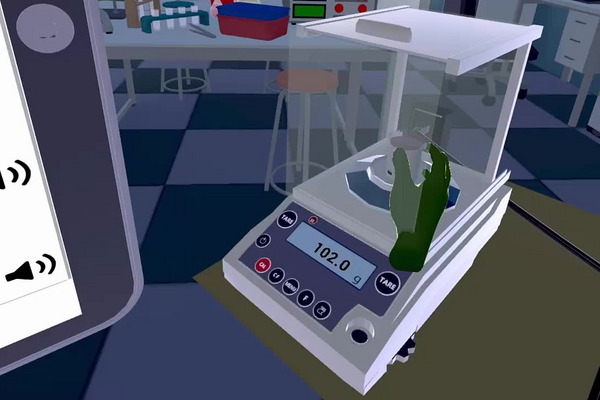
- Weigh the porcelain beaker with filter paper and the stir bar using the electronic balance.
- The mass is found on the results table.
- Remove the filter paper from the porcelain beaker and place it on the counter.
- Measure 10 mL of 1M sulfuric acid (H₂SO₄) with the volumetric pipette.
- Pour all the sulfuric acid (H₂SO₄) into the porcelain beaker.
- Measure 10 mL of 2M sodium hydroxide (NaOH) solution with the volumetric pipette.
- Gently add the sodium hydroxide (NaOH) into the porcelain beaker containing sulfuric acid.
- Place the filter paper in the beaker. The filter is present to avoid any splashing.
- Place the porcelain beaker on the hot plate.
- Attach a universal clamp to the stand.
- Attach the thermometer to the universal clamp, so that the tip of the thermometer is positioned in the beaker.
- Start the magnetic stirrer.
- Adjust the hot plate temperature to 105 °C, to reach the boiling point of water.
Note: After reaching a temperature of 100 °C, the water can take up to 1 minute before changing to the vapor state (due to the latent heat of vaporization). Indeed, during vaporization, energy is added, but the thermometer does not move. This energy serves only to change the physical state, not to heat the liquid.
- Heat until the temperature of the liquid in the beaker has reached 100 °C. Once boiling has begun, proceed to the next step.
- Turn off the stirrer and lower the target temperature of the hot plate to 15 °C.
- Remove the thermometer from its support and place it on the table.
- Remove the universal clamp from the stand.
- Turn on the drying oven with the power button on the central panel.
- Open the door of the drying oven.
- Grasp the porcelain beaker using the thermal gloves.
- Then place the beaker in the center of one of the shelves of the drying oven.
- Close the door of the drying oven.
- Set the drying oven to 70 °C.
- Let dry at 70 °C for 24 hours. To do this, press the button to the right of the clock.
- Open the door of the drying oven.
- Remove the beaker from the drying oven and weigh it with its contents, the filter paper and the magnetic stir bar using the balance.
- Close the door of the drying oven.
- Turn off the drying oven.
- The final mass is found on the results table.
- Remove the filter paper and the magnetic stir bar from the porcelain beaker.
- Take a photo of the salt obtained at the bottom of the beaker (the camera is located with the safety accessories near the recovery bin).
After the experiment
- Calculate the mass of salt formed by the difference between the masses measured in step 3 and step 26.
- Compare this mass with the theoretical mass expected according to the stoichiometric calculations suggested in the introduction.
Anticipated Outcomes
The reaction and the mole ratio. The neutralization studied is H2SO4(aq) + 2 NaOH(aq) → Na2SO4(aq) + 2 H2O(l). Written as an ionic process it is nothing more than 2 H3O+ + 2 OH− → 4 H2O: the sodium and sulfate ions are spectators and remain in solution unchanged until the water is removed. The coefficient 2 in front of the hydroxide is the whole of the stoichiometry of this lab, and it comes from the acid being diprotic.
Amounts delivered. Each pipetted volume gives an amount through n = C × V:
n(H2SO4) = 1.0 mol/L × 0.0100 L = 0.0100 mol
n(NaOH) = 2.0 mol/L × 0.0100 L = 0.0200 mol
The ratio n(NaOH) / n(H2SO4) = 0.0200 / 0.0100 = 2.00 is exactly the ratio of the coefficients, so the reactants are present in stoichiometric proportions and neither is limiting: both are consumed to completion at the same instant. The concentrations 1.0 and 2.0 mol/L were chosen for this reason, and the equal volumes are what make the ratio of concentrations the ratio of amounts.
Theoretical mass of the product. The equation makes one mole of sodium sulfate for every mole of sulfuric acid, so n(Na2SO4) = 0.0100 mol. Its molar mass is M = 2 × 22.99 + 32.06 + 4 × 16.00 = 45.98 + 32.06 + 64.00 = 142.04 g/mol, and therefore
m(Na2SO4) = n × M = 0.0100 mol × 142.04 g/mol = 1.42 g
| Species | Role | Amount (mol) | M (g/mol) | Mass (g) |
|---|---|---|---|---|
| H2SO4 | reactant | 0.0100 | 98.08 | 0.98 |
| NaOH | reactant | 0.0200 | 40.00 | 0.80 |
| Na2SO4 | product | 0.0100 | 142.04 | 1.42 |
| H2O | product | 0.0200 | 18.02 | 0.36 |
What the balance should read. The dish is weighed empty in step 3 and again with its dried contents in step 26. The values below are the ones the simulation records in its results table.
| Quantity | Protocol step | Expected | Recorded in the simulation |
|---|---|---|---|
| Dish + filter paper + stir bar | 3 | the tare mass, whatever it is | 102.0 g |
| Dish + filter paper + stir bar + dried salt | 26 | tare + 1.42 g | 103.42 g |
| Mass of sodium sulfate, by difference | calculated | 1.42 g | 103.42 − 102.0 = 1.42 g |
| Temperature of the mixture | 13 | about 33 °C on mixing, 100 °C while boiling | 18.9 °C |
| Percent yield | calculated | 100 % | 100.0 % |
Why the dish is weighed twice rather than tared. The quantity wanted is msalt = mfinal − minitial. The dish, the filter paper and the stir bar appear in both terms and cancel exactly — provided that not one of them is removed between the two weighings, which is why the protocol leaves the stir bar in the dish right through the oven. The method therefore never needs to know what the dish weighs, only that it weighed the same both times.
The precision this method can reach. Weighing by difference has a cost: the wanted quantity is 1.42 g but each reading is near 102 g, so a small relative error on a large number becomes a large relative error on the small one. If each reading is good to ±0.05 g, the difference carries √(0.052 + 0.052) = 0.07 g, giving 1.42 ± 0.07 g, or ±5 %. The two 10 mL Class A volumetric pipettes, by contrast, are each ±0.02 mL — 0.2 % — so in quadrature the amounts delivered are known to 0.3 %, some seventeen times better than the mass recovered. Weighing, not measuring out, is what limits this experiment. A dish of a tenth the mass, or a balance reading to 0.001 g, would improve the result far more than any amount of extra care with the pipette.
Why the water has to be driven off, and how much of it there is. Sodium sulfate is soluble to about 28 g per 100 mL of water at 25 °C. The 1.42 g formed here sits in roughly 20 mL of solution, about 7 g per 100 mL — a quarter of saturation — so nothing precipitates on mixing and there is nothing to see or filter. Recovering it means removing about 20 g of water: heating that water from room temperature to its boiling point takes 20 g × 4.18 J/g·K × 81 K = 6.8 kJ, and vaporising it takes a further 20 g × 2257 J/g = 45 kJ, roughly 52 kJ in all. Nine tenths of the energy goes into the phase change rather than the heating, which is why the plate sits at its setpoint for a long time with the thermometer refusing to climb past 100 °C, and why this stage dominates the real experiment.
Why the oven is set to 70 °C and not left at room temperature. This is the step most often treated as a formality, and it is the one that decides whether the prediction can be tested at all. Below 32.4 °C the stable solid phase of sodium sulfate in contact with water is not the anhydrous salt but the decahydrate, Na2SO4·10H2O — Glauber’s salt — of molar mass 322.20 g/mol. Ten waters of crystallisation more than double the mass: the same 0.0100 mol would weigh 0.0100 × 322.20 = 3.22 g, an apparent yield of 227 %. Drying at 70 °C holds the salt above that transition temperature and drives it to the anhydrous form, so that the 1.42 g being predicted is a prediction about Na2SO4 and not about a hydrate. A dish air-dried on the bench instead will come to rest somewhere between 1.42 and 3.22 g, and a student who cannot name the transition will have no way to explain the number.
The heat the reaction itself releases. Neutralization of a strong acid by a strong base liberates close to 57.3 kJ for every mole of water formed, because in every such reaction the same process occurs at the molecular level. Here 0.0200 mol of water is formed, so the heat released is 0.0200 mol × 57.3 kJ/mol = 1.15 kJ. Spread through about 21 g of solution with a specific heat capacity near 4.0 J/g·K, that gives ΔT = 1150 J / (21 g × 4.0 J/g·K) ≈ 14 °C. The mixture should therefore be warm to the touch — near 33 °C from a 19 °C start — before the hot plate is switched on at all, and a thermometer placed in the dish at step 13 should register the jump.
What the residue should look like. Anhydrous sodium sulfate is a white, free-flowing crystalline powder. Because it is the salt of a strong acid and a strong base, neither of its ions hydrolyses appreciably and the solution stays at pH 7 throughout the evaporation. Nothing corrosive is being concentrated as the volume falls, which is precisely what makes this reaction safe to boil down to dryness and a poor choice of reaction to teach the opposite lesson.
What would change if the reactants did not match. Suppose the sodium hydroxide had been 1.0 mol/L instead of 2.0. Then n(NaOH) = 0.0100 mol against n(H2SO4) = 0.0100 mol, a ratio of 1.00 where the equation demands 2.00. Sodium hydroxide would be limiting, only 0.00500 mol of sodium sulfate could form, and the recovered mass would fall to 0.00500 × 142.04 = 0.71 g — half the yield — while half of the sulfuric acid stayed behind unreacted and was steadily concentrated by the evaporation into something genuinely hazardous. Running the calculation for that case is the quickest way to show why the ratio, and not merely the quantity, is what has to be got right.
Summary of Assignment by Grade Range
Grade 9–10
Focus. Reading a balanced equation and following a quantitative procedure carefully enough that the answer means something. The mole is introduced as a counting unit rather than derived, and the calculation is set up for the class.
- Identify the reactants and the products, and state in words what the coefficient 2 in front of NaOH means.
- Follow the given calculation from concentration and volume to a predicted mass of 1.42 g, substituting the numbers into equations supplied by the teacher.
- Record the two balance readings and obtain the mass of salt as their difference, explaining why the dish had to be weighed before as well as after.
- Describe the appearance of the residue and name it.
- Vocabulary to be used correctly by the end: neutralization, salt, mole, molar mass, evaporation, residue.
Grade 11
Focus. Carrying out the full stoichiometric treatment unaided, and interpreting the yield.
- Balance the equation from the formulas of the reactants and products, then compute n = C × V for both solutions and demonstrate that the ratio is 2.00.
- Calculate the molar mass of sodium sulfate from atomic masses and obtain the theoretical mass without being given the route.
- Compute the percent yield from the measured mass and say what a value above 100 % and a value below 100 % would each imply physically.
- Verify that mass is conserved across the whole reaction (1.78 g in, 1.78 g out) and account for where the 0.36 g of product water goes.
- Explain why the sodium sulfate cannot be recovered by filtration, using its solubility.
- Recalculate the yield for the case where the sodium hydroxide is 1.0 mol/L, identifying the limiting reactant.
Grade 12 / College Level
Focus. Hydrate chemistry and the design of the method. Students are expected to justify each step rather than execute it.
- Explain the 70 °C drying step in terms of the 32.4 °C decahydrate transition, calculate the mass that Na2SO4·10H2O would give (3.22 g), and describe how drying to constant mass would be demonstrated.
- Calculate the heat released by the neutralization from ΔH = −57.3 kJ per mole of water and predict the temperature rise of the mixture; compare that prediction with what the simulation records.
- Estimate the total energy required to evaporate the solvent and comment on the proportion that goes into the phase change rather than the temperature rise.
- Propose a redesign that would raise the precision by an order of magnitude — a lighter vessel, an analytical balance, a larger scale of reaction — and quantify the improvement each would give.
- Discuss why the ionic equation reduces to a proton transfer, and why the enthalpy of neutralization is nearly the same for every strong acid and strong base pair.
Laboratory essentials
Instruments
- Porcelain evaporating dish
- Filter paper (used as a splash cover, not for filtration)
- Volumetric pipette (10 mL)
- Magnetic stir bar
- Hot plate with magnetic stirrer
- Retort stand and universal clamp
- Digital thermometer
- Drying oven
- Electronic balance
- Thermal gloves
- Camera
- Recovery bin
Products
- Sulfuric acid H2SO4 1.0 mol/L (10 mL)
- Sodium hydroxide NaOH 2.0 mol/L (10 mL)