

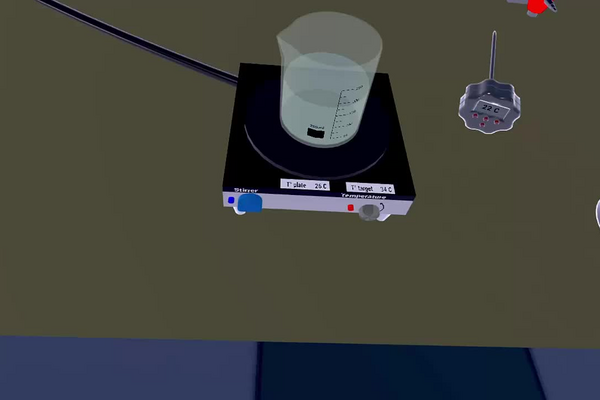
Every substance charges a different price for a degree of temperature. Pour equal volumes of water and cooking oil into identical pans on identical burners and the oil is smoking while the water is still merely warm; the sea in September is warmer than the land beside it although both have had the same sunshine. The quantity behind all of this is specific heat capacity, the energy needed to raise one gram of a substance by one degree, and it is one of the most consequential numbers in engineering. It decides what a car radiator is filled with, how much concrete a thermal store needs, why coastal winters are mild, and why water is the coolant of choice almost everywhere it can be used.
The way to measure it is to let two things at different temperatures come to equilibrium and see where the common temperature lands. Energy is conserved, so whatever the hot substance gives up the cold one takes: m1c1(Tf − T1) + m2c2(Tf − T2) = 0. Rearranged, that says the final temperature is the average of the two starting temperatures weighted by each substance’s heat capacity — so the equilibrium point sits closer to whichever substance has more capacity to hold heat. Measure the three temperatures and every quantity in the equation is known except the one you are after.
In this laboratory you will mix 50 mL of hot water, heated to about 80 °C, with 50 mL of a cold liquid in a calorimeter, twice: first with cold water, then with cold ethanol. The water-with-water mixture is the control, and its answer can be predicted without knowing any heat capacity at all. The ethanol mixture cannot, and it finishes markedly hotter than the control — for two separate reasons that this laboratory lets you separate and measure one at a time. You will predict both equilibrium temperatures from the energy balance, compare them with what the calorimeter reports, and account for the difference.
Educational Goals
The energy balance as a working tool
- Write the conservation-of-energy equation for two liquids mixing, and rearrange it to give the final temperature explicitly.
- Read the result as a heat-capacity-weighted average of the two starting temperatures, and predict which way the answer will shift before doing the arithmetic.
Specific and molar heat capacity
- Convert between specific heat capacity in J/(g·K) and molar heat capacity in J/(mol·K), and state which of the two the experiment actually needs.
- Explain why water has the larger capacity per gram while ethanol has the larger capacity per mole, and why that is not a contradiction.
Calorimetric technique
- Heat a liquid to a target temperature, take its temperature rather than the heater’s, transfer it promptly, and read the equilibrium temperature with the contents stirred.
- Identify each point in the procedure at which heat leaves the system, and say which of them is the largest.
Using a control experiment
- Explain why mixing water with water is worth doing even though the answer is known in advance, and use the discrepancy it reveals as a correction to the second experiment.
Separating two effects that push the same way
- Distinguish the contribution of ethanol’s lower heat capacity from the contribution of the exothermic mixing of ethanol with water, and give each a number.
Handling a volatile flammable liquid and hot water
- Handle ethanol with the awareness that it boils at 78 °C, below the temperature of the water being poured onto it, and keep it away from the hot plate.
Protocol
Experiment 1
- Measure 50 mL of distilled water in the graduated cylinder.
- Pour the water into the calorimeter.
- Immerse the tip of the digital thermometer in the calorimeter in order to take the temperature of the liquid.
- Fill the 250 mL beaker halfway with cold tap water.
- Place the beaker on the hot plate.
- Set the hot plate to 80 °C.
- Once the temperature of the hot plate has reached 80 °C, immerse the tip of the digital thermometer in the beaker in order to take the temperature of the liquid.
- Take the beaker from the hot plate and pour 50 mL of heated water into the graduated cylinder. Then place the beaker back on the hot plate.
- Pour the contents of the graduated cylinder into the calorimeter.
- Put the lid on the calorimeter.
- Start the stirrer by pressing the green button on the lid of the calorimeter.
- Insert the digital thermometer into the lid of the calorimeter.
- The temperature of the mixture will appear in the results table.
- Stop the stirrer by pressing the red button.
- Remove the thermometer from the lid of the calorimeter.
- Remove the lid of the calorimeter and empty its contents into the recovery bin.
- Rinse the calorimeter with distilled water and empty its contents into the recovery bin.
Experiment 2
- Measure 50 mL of ethanol in the graduated cylinder.
- Pour the ethanol into the calorimeter.
- Immerse the tip of the digital thermometer in the calorimeter in order to take the temperature of the liquid.
- Take the beaker from the hot plate and pour 50 mL of heated water into the graduated cylinder. Then place the beaker back on the hot plate.
- Pour the contents of the graduated cylinder into the calorimeter.
- Put the lid on the calorimeter.
- Start the stirrer by pressing the green button on the lid of the calorimeter.
- Insert the digital thermometer into the lid of the calorimeter.
- The temperature of the mixture will appear in the results table.
- Stop the stirrer by pressing the red button.
- Remove the thermometer from the lid of the calorimeter.
- Remove the lid of the calorimeter and empty its contents into the recovery bin.
- Rinse the calorimeter with distilled water and empty its contents into the recovery bin.
- Lower the temperature of the hot plate to 15°C.
Anticipated Outcomes
Two mixtures, both starting from 50 mL at about 20 °C and 50 mL of water at about 80 °C. The control finishes at the midpoint; the ethanol mixture finishes some nineteen degrees higher. The table gives the predictions, and the sections below derive them and separate the two reasons for the difference.
| Experiment | Cold liquid, 50 mL | Mass | Moles | Heat capacity of that portion | Predicted Tf |
|---|---|---|---|---|---|
| 1 | Water at 20 °C | 50.0 g | 2.78 | 209.61 J/K | 50.0 °C |
| 1 | Water at 80 °C (the hot portion) | 50.0 g | 2.78 | 209.61 J/K | — |
| 2 | Ethanol at 20 °C | 40.0 g | 0.87 | 97.01 J/K | 61.02 °C from the balance alone |
| 2 | Water at 80 °C (the hot portion) | 50.0 g | 2.78 | 209.61 J/K | 69.10 °C once the heat of mixing is added |
Experiment 1 — the control, whose answer needs no data at all
Mixing two liquids obeys m1c1(Tf − T1) + m2c2(Tf − T2) = 0, which rearranges to Tf = (m1c1T1 + m2c2T2) / (m1c1 + m2c2). When the two liquids are the same substance and the two masses are equal, m and c cancel from top and bottom and the whole expression collapses to (T1 + T2) / 2. So 50 mL of water at 20 °C mixed with 50 mL of water at 80 °C gives (20 + 80) / 2 = 50.0 °C, and no heat capacity had to be looked up to say so. That is what makes this a control worth running: the prediction cannot be wrong, so anything the calorimeter reports below 50 °C is a direct measure of what the apparatus loses, and it can be subtracted from the second experiment.
Expect it to come out low, and by more than a degree. The hot water is not in a vacuum on its way to the calorimeter: it is poured into a room-temperature glass cylinder, then into a calorimeter whose walls, lid, stirrer and thermometer are all at room temperature. A 50 mL glass cylinder alone has a heat capacity of roughly 50 J/K against the hot water’s 209 J/K, so even a brief contact costs several degrees. On a real bench a result of 46 to 49 °C would be normal; the shortfall is not an error to apologise for but the number that makes the rest of the laboratory quantitative.
Specific heat capacity per gram and per mole — the ordering reverses
Before the second calculation, one point that decides how it comes out and is very easily got the wrong way round.
| Substance | M (g/mol) | Density (g/mL) | c, per gram (J/(g·K)) | Cp,m, per mole (J/(mol·K)) | Capacity of 50 mL (J/K) |
|---|---|---|---|---|---|
| Water | 18.015 | 1.0 | 4.18 | 75.4 | 209.61 |
| Ethanol | 46.07 | 0.8 | 2.42 | 111.5 | 97.01 |
| Ratio, water to ethanol | — | — | 1.73 × | 0.68 × | 2.16 × |
Both statements in that table are true and they point opposite ways. Per gram, water wins comfortably: 4.18 against 2.42 J/(g·K), which is the fact behind the sea being cooler than the sand and behind water being used as a coolant. Per mole, ethanol wins: 111.5 against 75.4 J/(mol·K), because a mole of ethanol is nine atoms with a great many vibrational and rotational modes to be excited, where a mole of water is only three. Water’s advantage per gram comes from its very small molar mass together with the stiff hydrogen-bond network that has to be loosened as it warms; ethanol’s advantage per mole comes from having far more internal degrees of freedom per molecule. Neither is a misprint, and a student who quotes one where the other is needed will be out by a factor of two and a half.
What the experiment actually sees is the last column, because the liquids are measured out by volume. 50 mL of water is 50.0 g and 2.78 mol, giving 2.78 × 75.4 = 209.61 J/K. 50 mL of ethanol is only 40.0 g and 0.87 mol, giving 0.87 × 111.5 = 97.01 J/K. So even though ethanol has the higher molar capacity, a 50 mL portion of it holds barely half the heat of a 50 mL portion of water — the lower density and the higher molar mass together outweigh the molar capacity twice over. Working in moles or in grams gives the same answer, as it must; the numbers below use moles because that is how the page’s data are tabulated.
Experiment 2 — the balance, worked out in full
With two different substances nothing cancels and the weighted average has to be evaluated. Written in moles and molar capacities it is Tf = (n1Cp,m1T1 + n2Cp,m2T2) / (n1Cp,m1 + n2Cp,m2), with subscript 1 for the ethanol and 2 for the hot water. Substituting: n1Cp,m1 = 0.87 × 111.5 = 97.01 J/K and n2Cp,m2 = 2.78 × 75.4 = 209.61 J/K, so the numerator is 97.01 × 20 + 209.61 × 80 = 1940.10 + 16768.96 = 18709.06 and the denominator is 97.01 + 209.61 = 306.62 J/K, giving Tf = 18709.06 / 306.62 = 61.02 °C.
That result is worth reading rather than just recording, because the weighting is visible in it. 61.02 °C sits 41.02 degrees above the cold liquid and 18.98 below the hot one, so it lands 68.4 per cent of the way from 20 to 80 — and 209.61 / 306.62 = 68.4 per cent is exactly the hot water’s share of the total heat capacity. The equilibrium temperature is always at the position along the interval given by the other substance’s fraction of the total capacity. That is a prediction a student can make in their head before touching a calculator, and it is the cleanest statement of what specific heat capacity does.
One notational warning. The temperatures may be substituted in degrees Celsius or in kelvin and the answer is correct either way, because a weighted mean of temperatures transforms in the same way as a temperature does — work in kelvin and 61.02 °C comes out as 334.17 K, which is the same thing. What must not happen is a mixture of the two, or substituting 293.15 and 353.15 and then reporting 334.17 as a Celsius answer. Pick one scale and stay in it.
Why the measurement comes out above 61 °C
The energy balance above assumes that the only thing happening is heat moving from one liquid to the other. For water and water that is true. For water and ethanol it is not, because the act of mixing them releases energy of its own: hydrogen bonds formed between water and ethanol molecules return more than is spent breaking the water–water and ethanol–ethanol interactions that existed before. Lab 065 measures this directly and finds 2.85 kJ per mole of ethanol, and that figure transfers to this experiment almost exactly, because the composition is nearly the same — lab 065 mixes 100 mL with 100 mL, giving an ethanol mole fraction of 0.236, and this laboratory’s 50 mL with 50 mL gives 0.238. The enthalpy of mixing is strongly composition-dependent, so that agreement is not a coincidence to be relied on in general, but here it holds.
The correction follows in one line. 0.87 mol of ethanol at 2.85 kJ/mol releases 2.48 kJ, and spread over the mixture’s heat capacity of 306.62 J/K that is 2480 / 306.62 = 8.08 °C of extra warming. Added to the balance result: 61.02 + 8.08 = 69.10 °C. So the ethanol mixture should be reported at about 69 °C, and a student who predicts 61 and measures 69 has not made a mistake — they have discovered a term the equation did not contain, which is a better outcome than agreement would have been.
Two effects, separated and measured
The ethanol mixture finishes 19.1 °C above the water control, and the single most valuable thing this laboratory can do is split that difference into its two causes, which it is able to do because the intermediate value is calculable. The first cause is heat capacity: 50 mL of ethanol holds only 97.01 J/K against water’s 209.61, so the hot water has to surrender less energy to bring it up to any given temperature and equilibrium therefore settles higher. That accounts for 61.02 − 50.00 = 11.02 °C, or 58 per cent of the difference. The second cause is the exothermic mixing, which accounts for the remaining 8.08 °C, or 42 per cent. Both push in the same direction, which is unfortunate pedagogically because it makes them easy to conflate — but the numbers separate them cleanly, and a student who can say “eleven degrees from heat capacity, eight from the heat of mixing” has understood the experiment in a way that “it came out hotter” does not capture.
It is worth noticing what the experiment would look like if the second effect were absent. A liquid of similar heat capacity to ethanol that does not interact with water — a light hydrocarbon, say — would give the 61 °C and stop there, and the discrepancy would vanish. That is the natural extension for a class that has finished this laboratory, and it is the cleanest way to prove that the extra 8 degrees really is chemistry between the two liquids rather than a property of ethanol on its own.
Summary of Assignment by Grade Range
Grade 9–10
Focus: observation, vocabulary and the idea that substances differ in how much heat they hold. Students should leave able to say that the ethanol mixture finished hotter and to give a reason in their own words.
Activities: run both experiments and record all three temperatures for each in a table of their own making. Predict the water-with-water result before mixing, using nothing but the two starting temperatures, and check it. Then say which mixture finished hotter and by how much. Measure the mass of 50 mL of each liquid, or calculate it from the densities given, and use the difference to explain in plain language why equal volumes are not equal amounts. Practise the safety points: the ethanol stays away from the hot plate, hot water is poured slowly, the calorimeter is rinsed between trials.
Grade 11
Focus: the energy balance applied quantitatively, and the difference between specific and molar heat capacity. This band is the arithmetic of the weighted average and the confidence to interpret it.
Activities: derive Tf = (m1c1T1 + m2c2T2) / (m1c1 + m2c2) from conservation of energy and show that it reduces to the arithmetic mean for Experiment 1. Compute the heat capacity of each 50 mL portion, in both grams and moles, and confirm that the two routes give the same Tf. Predict 61.02 °C for Experiment 2 and locate that result as a fraction of the interval from 20 to 80 °C, then show that the fraction equals the hot water’s share of the total heat capacity. Compare both predictions with the measurements, use the control’s shortfall as a loss correction, and explain what remains. Relate the result to why a coastal climate is milder than an inland one.
Grade 12 / College Level
Focus: separating two effects that act in the same direction, and an error analysis in which the dominant term is identified rather than merely listed.
Activities: split the 19.1 °C difference between the two experiments into the heat-capacity contribution (11.02 °C) and the heat-of-mixing contribution (8.08 °C), and justify each independently. Explain why ethanol has the larger molar heat capacity while water has the larger specific heat capacity, in terms of molar mass and internal degrees of freedom. Take the 2.85 kJ/mol of lab 065, verify that the two laboratories are at the same composition, and discuss whether a room-temperature enthalpy of mixing may legitimately be applied to a mixture finishing at 69 °C. Design a calibration step for the calorimeter using only apparatus already on the bench, and state what both predictions become if its heat capacity proves to be 50 J/K. Propose a third mixture that would isolate the heat-capacity effect from the mixing effect, and say what it should give. Cross-reference lab 065, which measures the heat of mixing directly, and lab 066, which uses the same calorimeter for enthalpies of solution and reaction.
Laboratory essentials
Instruments
- Calorimeter with lid, motorised stirrer and green/red control buttons
- Digital thermometer
- Hot plate with temperature setpoint
- Beaker, 250 mL (filled to about half, roughly 125 mL, to supply both 50 mL hot portions)
- Graduated cylinder, 50 mL
- Recovery bin
Products
- Distilled water (50 mL in the calorimeter for Experiment 1, plus rinsing after each experiment)
- Tap water (about 125 mL, heated in the beaker to supply the hot portion of both experiments)
- Ethanol, liquid (50 mL, Experiment 2)