

Solubility is the property that decides whether a substance can be used in solution at all, and it is the first number a chemist looks up before designing a preparation, a purification or a formulation. It sets how concentrated a reagent can be made, whether a drug can be given as a syrup or must be given as a tablet, why sugar can be dissolved into hot tea but not into iced tea, why limescale forms in a kettle rather than dissolving away in it, and why a recrystallisation works: a solid is dissolved in hot solvent and recovered pure when the solution cools and the solubility falls back.
Two factors decide the answer. The first is the chemical nature of the solute and the solvent — the rule of thumb that like dissolves like, which in practice means that a solvent dissolves a solute when the interactions it can offer are strong enough to pay for breaking apart the solid. Water, with its very high dielectric constant and its ability to hydrogen bond, is an excellent solvent for ions and for small molecules covered in hydroxyl groups, and a poor one for a polymer whose chains are hydrogen bonded to each other or for a salt whose lattice is held together too tightly. The second factor is temperature. Dissolution absorbs or releases heat, and the direction of that heat flow determines the direction in which solubility moves when the solution is warmed: an endothermic dissolution becomes easier at higher temperature, an exothermic one becomes harder. Most solids in water fall in the first category, but not all of them, and the exceptions are the interesting cases.
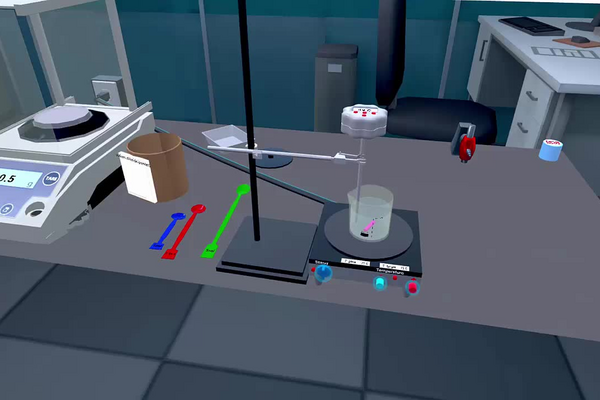
In this laboratory you will add a solid to 100 mL of cold water in small weighed portions, with a magnetic stir bar keeping the solution mixed, until the solid stops dissolving and starts to collect on the bottom of the beaker. That point is saturation, and the total mass you have added defines the solubility of that solid at room temperature. You will then heat the beaker on a hot plate to 75 °C with a thermometer clamped in the liquid, watch whether the undissolved solid goes into solution, and record the temperature at which it disappears. Repeating the whole sequence with table salt, glucose, chalk powder, sodium bicarbonate and corn starch gives five very different answers, and it is the differences between them — not the numbers themselves — that the laboratory is designed to reveal.
Educational Goals
By the end of this laboratory, students will be able to:
Recognising and reaching saturation
- Identify the point at which a solution is saturated, and distinguish undissolved solid from a solid that simply has not yet had time to dissolve.
- Determine the solubility of a solid at a given temperature by adding weighed portions until saturation and totalling the mass added.
- Express a solubility with its units and its temperature, and explain why a solubility quoted without a temperature is meaningless.
The effect of temperature
- Predict, and then observe, whether undissolved solid dissolves when the solution is heated to 75 °C.
- Relate the direction of the change to whether the dissolution absorbs or releases heat.
- Explain why the effect is large for some solids and barely detectable for others.
The effect of the chemical nature of solute and solvent
- Apply the principle that like dissolves like to predict which of the five solids will dissolve appreciably in water.
- Account for the solubility of an ionic solid in terms of hydration of its ions, and for that of glucose in terms of hydrogen bonding.
- Explain why a solid can be insoluble without being chemically inert, and why an insoluble solid still has a measurable, if tiny, solubility.
Operation of the apparatus
- Assemble the hot plate, magnetic stirrer, stand and clamp, and position a thermometer in a liquid so that it reads the liquid and not the vessel.
- Weigh successive portions of a solid on an electronic balance and keep a running total.
- Set a hot plate to a target temperature and read the temperature of the solution independently of the plate’s own setpoint.
Observation, recording and honest interpretation
- Record what was seen at each stage, including the appearance of the solid on the bottom of the beaker and any gas evolved.
- Distinguish dissolution from other processes that also make a solid disappear or change, such as decomposition or the swelling of a starch grain.
- Compare the five solids in a single table and draw a conclusion that covers all of them.
Protocol
- Water measurement
Use a graduated cylinder to measure 100 mL of cold tap water and pour it into a 100 mL beaker.
- Preparation for heating
a) Place a magnetic stir bar in the beaker.
b) Place the beaker on the hot plate without turning it on.
- Installation of the thermometer
a) Attach a universal clamp to the support above the center of the beaker.
b) Place the thermometer in the beaker by securing it with a universal clamp without it touching the bottom.
- Weighing of salt
a) Using a spatula, add approximately 10 g of table salt (sodium chloride) into the pan.
b) Pour the salt into the cold water of the beaker.
- Dissolution of salt
a) Activate the magnetic stirrer to mix well.
b) Add successively 10 g portions of salt up to an additional total of 20 g, waiting each time for complete dissolution.
c) Continue to add 2 g of salt at a time until the salt no longer dissolves and begins to accumulate at the bottom of the beaker.
Note the total amount of salt that was poured into the beaker to reach this point where the salt no longer dissolves and begins to accumulate at the bottom of the beaker.
- Heating
a) Set the hot plate to 75°C to heat the solution.
b) Observe whether the accumulated salt dissolves with the increase in temperature.
c) Note the temperature displayed on the thermometer at the moment when the salt becomes completely dissolved.
- Reproduction of the experiment
a) Repeat the same steps with the sugar (glucose), the chalk powder (calcium carbonate), the sodium bicarbonate, and the corn starch (starch) to compare the solubility of these substances.
b) Thoroughly empty the contents of the glassware into the recovery container and clean with distilled water between experiments.
c) For each solid, the quantity you will have to add to the beaker of water to obtain complete dissolution will vary from one solid to another.
Anticipated Outcomes
The five solids give five different answers. Two of them dissolve freely, one dissolves moderately, and two do not dissolve at all — and of the two that do not, one behaves in a way that is easy to mistake for dissolving. The table below gives the expected result for each, using the accepted solubility in water at 25 °C. Because the experiment adds solid to 100 mL of water (about 100 g), these figures can be compared directly with the running total the student keeps; note that published solubility tables are normally quoted per 100 g of water, not per 100 mL of finished solution, and for a solid as soluble as salt the two are not the same thing.
| Solid | Formula | Solubility in water at 25 °C | Expected result in cold water | On heating to 75 °C |
|---|---|---|---|---|
| Table salt | NaCl | 36 g / 100 mL | Dissolves; saturates after roughly 36 g has been added | A small additional amount dissolves — about 2 g per 100 mL |
| Sugar (glucose) | C6H12O6 | 91 g / 100 mL | Dissolves freely; takes about two and a half times as much solid as salt to saturate | Markedly more dissolves; the effect is large and obvious |
| Sodium bicarbonate | NaHCO3 | 10.3 g / 100 mL | Dissolves, but saturates after about 10 g — a third of the salt figure | More dissolves, and gas bubbles appear as the bicarbonate begins to decompose |
| Chalk powder | CaCO3 | ≈ 0.001 g / 100 mL | Does not dissolve; clouds the water, then settles | Still does not dissolve — its solubility falls as the water warms |
| Corn starch | (C6H10O5)n | Insoluble | Does not dissolve; forms a milky suspension that settles | Between about 62 and 72 °C the grains swell and the mixture thickens — gelatinisation, not dissolution |
Why temperature moves solubility, and in which direction. Dissolution reaches equilibrium when the free energy change is zero, ΔGsoln = ΔHsoln − TΔSsoln = 0. The temperature dependence of the resulting solubility s follows the van ’t Hoff relation, ln(s2/s1) = −(ΔHsoln/R)(1/T2 − 1/T1), which says something simple: if dissolving absorbs heat, warming the solution helps and solubility rises; if dissolving releases heat, warming hinders it and solubility falls. That single sign controls every entry in the last column of the table above.
| Solid | Enthalpy of solution, ΔHsoln | Sign | Predicted effect of heating |
|---|---|---|---|
| NaCl | +3.9 kJ/mol | Weakly endothermic | Solubility rises, but only slightly |
| Glucose | ≈ +11 kJ/mol | Endothermic | Solubility rises steeply |
| NaHCO3 | +17.2 kJ/mol | Strongly endothermic | Solubility rises steeply |
| CaCO3 | −12.3 kJ/mol | Exothermic | Solubility falls — the reverse of the usual case |
The salt result, worked through. Sodium chloride is the solid the protocol takes first, and it is deliberately the least dramatic. Its accepted solubility runs from 35.7 g per 100 g of water at 0 °C to 39.1 g at 100 °C — a rise of less than 10 % over the entire liquid range of water. Interpolating to the 75 °C setpoint of the protocol gives about 38 g / 100 mL, so of the solid lying on the bottom of a saturated beaker only about 2 g per 100 mL will go into solution when the plate is switched on. Students who expect a dramatic clearing will be disappointed, and that disappointment is the point: it sets up the contrast with glucose and bicarbonate, and it explains why salt cannot be purified by recrystallisation from water while many other solids can.
| Temperature | Solubility of NaCl (g per 100 g water) |
|---|---|
| 0 °C | 35.7 |
| 20 °C | 35.9 |
| 40 °C | 36.4 |
| 60 °C | 37.1 |
| 75 °C (protocol setpoint) | ≈ 38 |
| 100 °C | 39.1 |
A calculation worth doing, and worth getting wrong. Putting the salt figures into the van ’t Hoff relation with ΔHsoln = +3.9 kJ/mol, from T1 = 298 K to T2 = 348 K, gives ln(s2/s1) = −(3900 / 8.314)(1/348 − 1/298) = 469 × 4.82 × 10−4 = 0.226, so s2/s1 = 1.25 and s2 ≈ 45 g / 100 mL. The measured value is about 38. The prediction is 18 % too high, and the reason is instructive rather than embarrassing: the van ’t Hoff relation assumes an ideal solution with a constant enthalpy of solution, and a saturated salt solution — about 6 mol/L, with every water molecule involved in hydrating an ion — is about as far from ideal as an aqueous solution gets. Comparing the prediction with the measurement is a better exercise than either one alone.
Why water dissolves some of these solids and not others. For an ionic solid, dissolution is a competition between the lattice energy holding the ions together and the hydration energy released when water surrounds them. Water wins for sodium chloride because its relative permittivity of about 78 weakens the electrostatic attraction between the separated ions by nearly two orders of magnitude, and because each ion is stabilised by an ordered shell of water dipoles. In ethanol, whose relative permittivity is only about 24, the same salt dissolves to roughly 0.065 g per 100 mL — some five hundred times less. Water loses to calcium carbonate because the lattice holds a doubly charged cation against a doubly charged anion: the solubility product is Ksp = 3.3 × 10⁻⁹, so the saturated concentration is √Ksp = 5.7 × 10⁻⁵ mol/L, which at 100.09 g/mol is 0.6 mg per 100 mL — roughly one part in two hundred thousand, and entirely invisible against a beaker of settled powder. Glucose dissolves for a different reason again: it is not ionic at all, but its five hydroxyl groups and one ring oxygen each hydrogen bond to water, so the molecule is solvated as effectively as an ion. Starch is built from the same glucose units, but as chains of hundreds of them, hydrogen bonded to one another inside semi-crystalline grains; water cannot separate the chains at room temperature, and when it finally penetrates them on heating the result is a swollen paste rather than a solution.
A visible check that something has dissolved. Dissolved solid occupies volume. The apparent molar volume of sodium chloride in water is about 16.6 cm3/mol, so the 36 g needed to saturate 100 mL (36 / 58.44 = 0.616 mol) adds roughly 0.616 × 16.6 ≈ 10 mL to the liquid, taking the level in the beaker from 100 mL to about 110 mL. A student who does not see the level rise has not dissolved as much salt as they think they have — and a student who measures the rise has taken a second, independent measurement of the same quantity.
Summary of Assignment by Grade Range
Grade 9–10
Focus. Observation and vocabulary: solute, solvent, saturated, soluble, insoluble, suspension.
- Add salt in weighed portions until it stops dissolving, and report the total mass added as the solubility at room temperature.
- Sort the five solids into soluble and insoluble from what is seen in the beaker, and say what evidence was used.
- Record whether the solid on the bottom dissolves when the plate is set to 75 °C, and at what temperature it disappears.
- Write one sentence explaining why sugar dissolves better in hot water than in cold, using the word saturated.
Grade 11
Focus. Quantitative comparison between solids, and reasoning from structure to solubility.
- Tabulate the mass required to saturate 100 mL for each of the five solids, and convert each result to grams per litre and to moles per litre where a molar mass exists.
- Rank the solids before doing the experiment, using the ionic or molecular structure of each, and compare the ranking with the result.
- Explain why the salt result changes so much less on heating than the glucose result, in terms of the heat absorbed on dissolving.
- Identify which of the five solids cannot give a clean solubility measurement at 75 °C, and say why.
Grade 12 / College Level
Focus. Thermodynamic treatment and equilibrium calculation.
- Use the van ’t Hoff relation with ΔHsoln = +3.9 kJ/mol to predict the solubility of NaCl at 75 °C, compare it with the accepted value of about 38 g / 100 mL, and account for the discrepancy in terms of non-ideality at 6 mol/L.
- Calculate the solubility of calcium carbonate from Ksp = 3.3 × 10⁻⁹, express it in mg per 100 mL, and explain why the value measured in water open to the air is higher.
- Explain, with reference to ΔG = ΔH − TΔS, how a dissolution that releases heat can still occur spontaneously, and why its solubility nevertheless falls on heating.
- Estimate the volume increase on saturating 100 mL of water with NaCl from the apparent molar volume, and propose how it could be measured well enough to serve as a check on the mass added.
Laboratory essentials
Instruments
- Electronic balance (resolution 0.01 g, with a tare button)
- Weighing boat
- Spatula
- Graduated cylinder (100 mL)
- Beaker (100 mL) for the experiment; beakers (50 mL and 500 mL) also on the bench
- Hot plate with magnetic stirrer, showing both a plate temperature and a target temperature
- Magnetic stir bar
- Thermometer
- Laboratory stand with universal clamp, for the thermometer
- Recovery container, for emptying the beaker between solids
Products
- Sodium chloride, table salt (powder)
- Glucose, sugar (powder)
- Sodium bicarbonate, baking soda (powder)
- Calcium carbonate, chalk (powder)
- Starch, corn starch (powder)
- Tap water, for the 100 mL portions
- Distilled water, for rinsing the glassware between solids
- Ethanol and olive oil are on the bench but are not used by any step of this protocol, which tests solubility in water only