

Preparing a solution of known concentration is the most frequently performed operation in any laboratory. A calibration standard for an instrument, a reagent for a titration, a buffer for a cell culture, an intravenous fluid, a syrup on a production line — all of them are made by the same three-step routine: calculate the mass of solute the target concentration requires, weigh that mass, and bring it to a known final volume. The technique is worth learning carefully, because every quantitative result obtained later rests on the concentration of the solutions used to obtain it.
Two things make the routine less obvious than it looks. The first is that concentration can be written in several ways that are numerically different but describe the same quantity: a mass concentration in grams per litre, a percent mass per volume, or a molar concentration in moles per litre. Converting between them correctly is half the exercise. The second is that volumes of liquids and solids are not additive. Dissolving a solid in 100 mL of water does not give 100 mL of solution — it gives slightly more, because the dissolved particles occupy space of their own. That is why a solution is always made up by dissolving the solute in less than the final volume and then topping up to a calibrated mark, and why the vessel used is a volumetric flask rather than a beaker or a graduated cylinder.
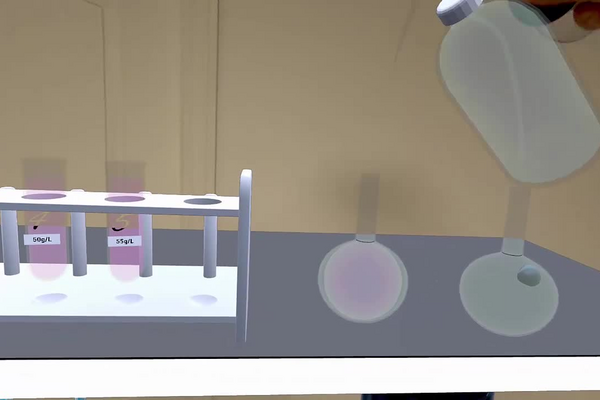
In this laboratory you will prepare two solutions of juice crystals, each with a final volume of 100 mL: solution A at a mass concentration of 25 g/L, and solution B at 5 % m/v, which you must first convert to grams per litre. For each one you will calculate the mass required, weigh it on an electronic balance in a tared weighing boat, dissolve it in about 50 mL of distilled water in a 100 mL volumetric flask, top up to the calibration mark, mix, and transfer the result to a labelled beaker. You will then hold both solutions against a series of reference solutions in front of a black card and identify which reference each one matches — a purely visual estimate of concentration, and a first look at the principle behind colorimetry.
Educational Goals
By the end of this laboratory, students will be able to:
Calculation of the mass of solute
- Rearrange the definition of mass concentration, C = m / V, to obtain the mass required for a stated concentration and volume.
- Convert a percent mass per volume into grams per litre, and explain why 5 % m/v is 50 g/L and not 5 g/L or 50 g/kg.
- State why a molar concentration cannot be quoted for juice crystals, and calculate one for a pure substance of known molar mass.
Use of the electronic balance
- Place a weighing boat on the pan and zero the balance with the tare function, and explain what taring does to the displayed value.
- Add a solid with a spatula in small increments up to a target mass, rather than overshooting and removing material.
- Read the display to the resolution of the instrument and record the mass with the correct number of significant figures.
Volumetric technique
- Use a graduated cylinder for an approximate volume and a volumetric flask for the final volume, and justify the choice of each.
- Dissolve the solute in less than the final volume, then top up to the calibration mark, and explain why the reverse order gives a solution that is too dilute.
- Bring the meniscus onto the mark with a dropper for the last fraction of a millilitre.
Dissolution and homogenisation
- Recognise dissolution as a physical change that produces a homogeneous mixture, and identify the solute and the solvent.
- Mix by inversion and swirling until no crystals remain, and explain why a solution must be mixed again after it has been topped up to the mark.
Estimating a concentration by colour
- Compare a coloured solution with a series of references of known concentration, viewed against a black card, and assign the closest match.
- Explain why colour intensity increases with concentration, and state the limits of a visual comparison.
Record keeping
- Record masses, volumes and observations as the work proceeds rather than reconstructing them afterwards.
Protocol
Two 100 mL beakers are on your right, labeled A and B.
Preparation of sweet solution A
- We want to add juice crystals to obtain a concentration of 25 g/L in 100 mL of solution. This mass is designated as m crystals.
- Place the empty weighing boat on the balance and make sure the balance is at zero by pressing the tare button.
- Use a spatula to add juice crystals into the weighing boat until the mass of juice crystals reaches the desired mass.
Preparation of the solution
- Measure 50 mL of distilled water using the 50 mL graduated cylinder.
- Then pour the water into a 100 mL volumetric flask.
- Transfer the juice crystals from the weighing boat to the volumetric flask using a funnel.
- Put the stopper on the volumetric flask and shake with a circular motion until the juice crystals are completely dissolved.
- Top up with distilled water until precisely reaching the final volume of 100 mL.
Finalizing the solution
- Put the stopper on the volumetric flask and gently mix the solution.
- Pour the solution from the volumetric flask (solution A) into the beaker identified A.
Comparison
- Visually compare solution A with the prepared reference solutions (20, 25, 35, 50 and 55 g/L). Solution A should match the 25 g/L reference.
- Note: Make sure the solutions are in front of a black card, in order to clearly distinguish changes in coloration
Preparation of solution B
- We want to add juice crystals to obtain a concentration of 5% m/v in 100 mL of solution. Convert this concentration to g/L before weighing. This mass is designated as m crystals.
- Place the empty weighing boat on the balance and make sure the balance is at zero by pressing the tare button.
- Use a spatula to add juice crystals into the weighing boat until the mass of juice crystals reaches the desired mass.
Preparation of the solution
- Measure 50 mL of distilled water using the 50 mL graduated cylinder.
- Pour the water into a 100 mL volumetric flask.
- Transfer the juice crystals from the weighing boat to the volumetric flask using a funnel.
- Put the stopper on the volumetric flask and shake with a circular motion until the juice crystals are completely dissolved.
- Top up with distilled water until precisely reaching the final volume of 100 mL.
Finalizing the solution
- Put the stopper on the volumetric flask and gently mix the solution.
- Pour the solution from the volumetric flask (solution B) into the beaker identified B.
Comparison
- Visually compare solution B with the prepared reference solutions (20, 25, 35, 50 and 55 g/L).
- Solution B, at 5% m/v, should match the 50 g/L reference and be visibly darker than solution A.
Anticipated Outcomes
The two masses to be weighed. Mass concentration is defined as C = m / V, so the mass of solute required for a stated concentration and volume is m = C × V. For solution A the concentration is given directly: mA = 25 g/L × 0.1000 L = 2.50 g. For solution B the concentration is given as a percentage and has to be converted first. A percent mass per volume means grams of solute per 100 mL of solution, so 5 % m/v = 5 g / 100 mL = 50 g/L, and mB = 50 g/L × 0.1000 L = 5.00 g. Solution B is therefore exactly twice as concentrated as solution A, which is the relationship the visual comparison at the end of the laboratory is meant to make obvious. The most common error in this calculation is to read 5 % m/v as 5 g/L, a factor of ten too low; the second most common is to treat it as 5 % by mass, which would require the density of the solution to convert.
| Solution | Concentration as stated | As a mass concentration | Mass of crystals for 100 mL | Reference it should match |
|---|---|---|---|---|
| A | 25 g/L | 25 g/L | 2.50 g | 25 g/L (tube 2) |
| B | 5 % m/v | 50 g/L | 5.00 g | 50 g/L (tube 4) |
What the balance shows, and what taring does. The weighing boat is placed on the pan and the tare button pressed, which subtracts the boat from every subsequent reading, so the display then shows the mass of crystals alone and the student never has to do the subtraction. The evidence that this is what happened is visible at the end of the weighing: when the tared boat is lifted off the pan, the balance reads −0.5 g, which is the mass of the boat with its sign reversed. The crystals arrive from the spatula in fixed 1.25 g portions, so the display steps 1.25 → 2.50 g for solution A and 1.25 → 2.50 → 3.75 → 5.00 g for solution B, and both targets are hit exactly.
Why the solute is dissolved in less than the final volume. Volumes are not additive when a solid dissolves: the dissolved particles take up space of their own, so the solution occupies more than the solvent did. For sucrose the apparent molar volume in dilute aqueous solution is about 211 cm3/mol, so the 5.00 g of solute in solution B (5.00 / 342.30 = 0.0146 mol) adds roughly 0.0146 × 211 ≈ 3.1 mL. A student who dissolved 5.00 g in a measured 100 mL of water would end up with about 103 mL of solution at a concentration of 5.00 g / 0.103 L = 48.5 g/L — 3 % low, which is far larger than any other error in the procedure. Dissolving in about 50 mL and then topping up to the calibration mark removes the problem entirely, because the mark defines the volume of the solution, not of the water. This is also why the flask is stoppered and inverted again after topping up: the last few millilitres of water sit on top of an already concentrated solution and will not mix on their own.
Why the concentration is not quoted in mol/L. A molar concentration requires a molar mass, and juice crystals are a mixture of sucrose, an acid, a colourant and flavouring, with no single molar mass. For pure sucrose (M = 342.30 g/mol) the two solutions would correspond to 25 / 342.30 = 0.073 mol/L and 50 / 342.30 = 0.146 mol/L, and those figures are worth calculating as an exercise — but they must not be written on the label of a solution made from a commercial powder. Mass concentration and percent m/v are the correct units here precisely because they make no assumption about what the solute is.
The comparison against the reference series. The five reference tubes present in the simulation are labelled 20, 25, 35, 50 and 55 g/L, and they are viewed against a black card because a dark background removes the transmitted light of the room and leaves only the colour of the solution. Colour intensity increases with concentration for the reason set out by the Beer–Lambert law, A = εlc: with the path length l fixed by the tube and the molar absorptivity ε fixed by the colourant, absorbance is proportional to concentration alone. Solution A should be matched to the 25 g/L tube and solution B to the 50 g/L tube, and B should be visibly darker than A because it is twice as concentrated. The rest of the series is there as distractors, and one of them is a genuinely hard call: 50 and 55 g/L differ by only 10 %, which is at or below what the eye can reliably separate, so a student who assigns solution B to tube 5 rather than tube 4 has not made an unreasonable judgement.
| Tube | Label | Relative to solution A (25 g/L) | Role in the comparison |
|---|---|---|---|
| 1 | 20 g/L | 0.8 × | Palest of the series; nearest distractor below A |
| 2 | 25 g/L | 1.0 × | Expected match for solution A |
| 3 | 35 g/L | 1.4 × | Intermediate; sits between the two prepared solutions |
| 4 | 50 g/L | 2.0 × | Expected match for solution B (5 % m/v) |
| 5 | 55 g/L | 2.2 × | Darkest; only 10 % above tube 4 and hard to tell from it |
What the two solutions do and do not establish. Juice crystals are a mixture, not a pure compound, so they have no molar mass and the solutions have no molarity. Any figure quoted in mol/L above is an illustration of how the calculation would run for a pure solute such as sucrose; it is not a description of what is actually in the flask. This is the honest reason the laboratory works in g/L and in percent m/v, and it is worth saying to students, who often assume every concentration must eventually become a molarity.
Two points about the weighing. The dispenser delivers crystals in fixed 1.25 g portions, so both target masses are reached exactly and the reading never overshoots. Students should know that on a real balance the last approach to a target mass is the delicate part of the operation, and that it is done by tapping the spatula rather than pouring. And because any mass that is weighed will be accepted, the arithmetic has to be checked on paper before weighing begins: a student who calculates 0.5 g where 5 g was required will finish the laboratory without difficulty and simply produce a solution that looks too pale. Catching that on the page, not at the balance, is the habit worth building.
Temperature, and why the mark matters. A volumetric flask is calibrated at a stated temperature, usually 20 °C, because both the volume of the glass and the density of the solution change with it. Precise work therefore allows the solution to reach room temperature before the final adjustment to the mark. This is also why the water is added in two stages rather than measured out in full at the start: dissolving a solid changes the volume of the liquid, sometimes upward and sometimes downward, so the only way to obtain exactly 100 mL of solution is to dissolve first and top up afterwards. Measuring 100 mL of water and then adding the crystals would give a different, and unknown, final volume.
Summary of Assignment by Grade Range
Grade 9–10
Focus. The vocabulary and the routine: solute, solvent, solution, concentration; weigh, dissolve, make up to volume, mix.
- Calculate the 2.50 g needed for solution A from C = m / V, with the units written out at every step.
- Carry out both preparations and record the mass shown on the balance and the reference tube each solution matches.
- Explain in their own words why the balance is tared with the weighing boat on the pan.
- Arrange the five reference tubes in order of concentration by eye alone, then check the order against the labels.
Grade 11
Focus. Unit conversion, quantitative comparison and the reasoning behind each step of the technique.
- Convert 5 % m/v to g/L and to mol/L for pure sucrose, and explain why only the first conversion is legitimate for juice crystals.
- Predict, before looking, which reference tube solution B should match, and justify the prediction from the ratio of the two concentrations.
- Explain why the solute is dissolved in about 50 mL and only then topped up to the mark, and what the concentration would be if the crystals were instead added to a measured 100 mL of water.
- State the concentration of each solution with the number of significant figures the instruments justify.
Grade 12 / College Level
Focus. The physical basis of the colour comparison.
- Use the apparent molar volume of sucrose to calculate the volume change on dissolution.
- Argue from the Beer–Lambert law why a visual comparison against a reference series works at all, and estimate the smallest concentration difference the eye could be expected to detect in this series.
- Propose a design for the reference series that would let a student assign a concentration to within 10 %, and say how many tubes it would need over the range 20–55 g/L.
- Identify the steps at which the simulation cannot reproduce a real laboratory error, and describe how a teacher should compensate when marking.
Laboratory essentials
Instruments
- Electronic balance (resolution 0.01 g, with a tare button)
- Weighing boats × 2 (mass about 0.5 g; called the basket in the simulation)
- Spatula
- Graduated cylinder (50 mL)
- Volumetric flasks (100 mL, with stoppers) × 2
- Funnel
- Dropper, for bringing the meniscus onto the calibration mark
- Beakers (100 mL) × 2, labelled A and B
- Test-tube rack holding the five reference solutions
- Black comparison card
Products
- Juice crystals (powder)
- Distilled water
- Reference solutions of juice crystals: 20, 25, 35, 50 and 55 g/L