

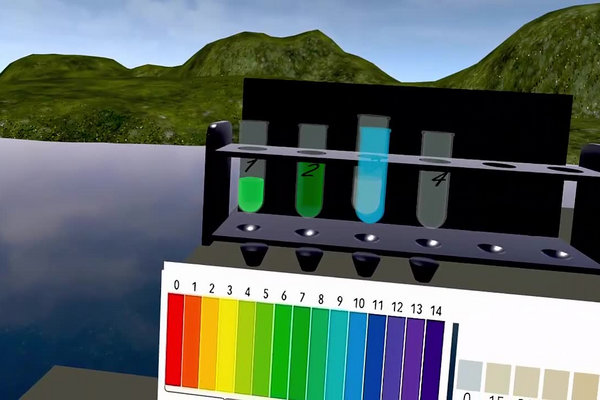
Water-quality monitoring is one of the most routine analytical jobs in the world: municipal laboratories, environmental agencies and watershed associations all run the same short battery of tests on river, lake and well samples, week after week. Four parameters carry most of the information. The pH fixes which chemical species can exist in the water and how metals behave; the hardness reports the total concentration of dissolved calcium and magnesium, which comes from the rock the water has crossed; the nitrate and phosphate concentrations report how much fertiliser, manure or waste water the catchment is delivering, because these two ions are the nutrients that limit algal growth. Each parameter is measured by a different family of method: potentiometry and an acid–base indicator for pH, a complexometric titration with EDTA for hardness, and two colour-forming reactions read against a printed colour card for the nutrients. In this laboratory you will collect a sample of river water at the bank, then run all four determinations on four separate 20 mL portions: you will read the pH from a universal indicator and a pH meter, titrate a buffered portion with 0.010 M EDTA using Eriochrome Black T as the endpoint indicator, reduce the nitrate and develop the Griess azo dye, and develop the phosphomolybdate colour with ammonium molybdate and ascorbic acid. You will then translate the four raw readings into a judgement about the health of the river, which is exactly what the analyst who signs the report has to do.
Educational Goals
Familiarization with field sampling
- Collect a representative 100 mL sample of surface water and explain why the sampling point and the sampling time are part of the result.
- Measure four equal 20 mL portions with a graduated cylinder so that the four tests are run on the same water.
Use of the pH meter and of colorimetric charts
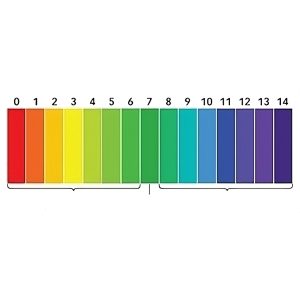
- Add an indicator, mix, and match the colour obtained against a printed pH chart, then rinse and dry the electrode between uses.
- Explain why a colour card is read against a black background and why it can only be trusted to about one swatch.
Complexometric titration technique
- Buffer a sample above pH 10, add Eriochrome Black T, and add 0.010 M EDTA in 1 mL increments until the indicator changes colour.
- Recognise the endpoint as the moment the last free Ca2+ has been complexed, and record the titre in millilitres.
Colorimetric determination of nutrients
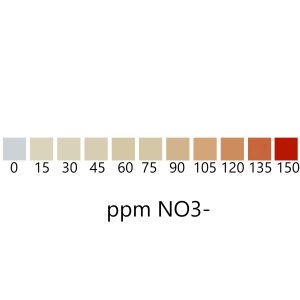
- Reduce nitrate to nitrite and develop the Griess azo dye, then read the concentration in ppm NO3− from the card.
- Develop the phosphomolybdate complex with ammonium molybdate and reduce it with ascorbic acid, then read the concentration in ppm PO43−.
Quantitative treatment of the data
- Convert a titre into a hardness expressed in mg/L of CaCO3 and into mmol/L of Ca2+.
- Convert a nutrient reading in ppm of the ion into the equivalent concentration of nitrogen or phosphorus.
Interpretation and laboratory discipline
- Compare each result with a published guideline value and state whether the water is acceptable, borderline or problematic, with the reason.
- Record every reading in the logbook as it is taken, and dispose of all four test tubes into the recovery tray.
Protocol
Preparation
To collect river water, you have two choices :
- Choice 1 : Using an empty 100 mL beaker, collect a sample of the river water at your feet
- Choice 2 : Use directly the water already collected this morning in the beaker “river water”
PART A : pH measurement
- Using the graduated cylinder, measure 20 mL of river water.
- Transfer the 20 mL of river water into test tube 1.
- Using the dropper, add 2 drops of universal pH indicator (pH i) into test tube 1.
- Empty the excess from the dropper into the recovery tray.
- Immerse the pH meter electrode in test tube 1.
- Using a glass rod, mix the contents of test tube 1.
- Compare the color obtained to the pH chart.
- Rinse the pH meter electrode with distilled water.
- Dry the pH meter electrode with a paper towel.
PART B : Water hardness measurement
- Using the graduated cylinder, measure 20 mL of river water.
- Transfer the 20 mL of river water into test tube 2.
- Using the dropper, add 10 drops of buffer solution into test tube 2.
- Empty the excess from the dropper into the recovery tray.
- Check the pH of the solution using the pH meter. Make sure it is greater than 10.
- Using the pipette, add 10 mL of 0.5% Eriochrome Black (EB) into test tube 2.
- Mix with the glass rod and note the color of the solution.
- Using the pipette, add 1 mL of 0.010 M EDTA solution into test tube 2.
- Stir the solution using the glass rod.
Note: Make sure the specimen is placed in front of a black cardboard background in order to clearly distinguish color changes.
- Repeat steps 8 and 9 until the solution changes color again. Note the number of mL added.
- The volume of EDTA added is found in the results table.
- According to the quantity added, determine the hardness of the river water.
- Low hardness: 5.0 mL or less of EDTA added (up to 250 mg/L as CaCO₃)
- Medium hardness: more than 5.0 mL and up to 10.0 mL (250 to 500 mg/L as CaCO₃)
- High hardness: more than 10.0 mL and up to 15.0 mL (500 to 750 mg/L as CaCO₃)
- Very high hardness: more than 15.0 mL (above 750 mg/L as CaCO₃).
Note: The colorimetric scale is approximate, additional quantitative tests are required to determine the exact result.
- Make sure the pipette is completely empty (0 mL).
PART C : Nitrate concentration measurement
- Using the graduated cylinder, measure 20 mL of river water.
- Transfer the 20 mL of river water into test tube 3.
- Using the dropper, add 10 drops of nitrate reducing agent solution (NO3 (R)).
- Empty the excess from the dropper into the recovery tray.
- Mix with the glass rod.
- Using the dropper, add 10 drops of Griess reagent.
- Empty the excess from the dropper into the recovery tray.
- Mix with the glass rod.
- Consult the colorimetric scale (ppm NO3) to determine the nitrate concentration of the river water.
Note: Make sure the specimen is placed in front of a black cardboard background in order to clearly distinguish color changes.
Note: The colorimetric scale is approximate, additional quantitative tests are required to determine the exact result.
PART D : Phosphate concentration measurement
- Using the graduated cylinder, measure 20 mL of river water.
- Transfer the 20 mL of river water into test tube 4.
- Using the dropper, add 10 drops of ammonium molybdate solution (MoO42-).
- Empty the excess from the dropper into the recovery tray.
- Mix with the glass rod.
- Using the dropper, add 10 drops of ascorbic acid solution (Vit C).
- Empty the excess from the dropper into the recovery tray.
- Mix with the glass rod.
- Consult the colorimetric scale (ppm PO4) to determine the phosphate concentration of the river water.
Note: Make sure the specimen is placed in front of a black cardboard background in order to clearly distinguish color changes.
Note: The colorimetric scale is approximate, additional quantitative tests are required to determine the exact result.
- Empty the test tubes into the recovery tray.
Anticipated Outcomes
Four independent determinations are run on the same river water, so the outcome is a small data set rather than a single number. The values below are the ones recorded in the reference session of this simulation; a class reading the colour cards will scatter by about one swatch on either side.
| Parameter | Test tube | Reagents added to 20 mL of river water | What is observed | Value recorded |
|---|---|---|---|---|
| pH | 1 | 2 drops of universal indicator; pH meter electrode immersed | A green colour, read against the neutral part of the pH chart | pH 5.9 |
| Total hardness | 2 | 10 drops of pH 10 buffer, 10 mL of 0.5 % Eriochrome Black T, then 0.010 M EDTA in 1 mL steps | Wine-red on adding the indicator, colour change at the endpoint | 6 mL of EDTA → 300 mg/L as CaCO3 |
| Nitrate | 3 | 10 drops of nitrate reducing agent, then 10 drops of Griess reagent | A pale tint against the ppm NO3− card | 60 ppm NO3− |
| Phosphate | 4 | 10 drops of ammonium molybdate, then 10 drops of ascorbic acid | A pale yellow-green tint against the ppm PO43− card | 40 ppm PO43− |
The three reference charts used to read tubes 1, 3 and 4:

What the four numbers mean
| Parameter | Result | Reference value | Reading |
|---|---|---|---|
| pH | 5.9 | 6.5 – 9.0 for the protection of aquatic life | Below the range: slightly acidic water, and metals such as Al3+ become more soluble |
| Total hardness | 300 mg/L as CaCO3 (3.0 mmol/L) | < 60 soft · 60 – 120 moderately hard · 120 – 180 hard · > 180 very hard | Very hard by the usual classification; no health concern, but scaling and soap consumption |
| Nitrate | 60 ppm NO3− = 13.6 mg/L as N | 50 mg/L NO3− (11.3 mg/L as N) in drinking water | Above the drinking-water limit; points to agricultural or waste-water input |
| Phosphate | 40 ppm PO43− = 13.0 mg/L as P | Rivers are already at risk of eutrophication above about 0.03 mg/L of total P | Hundreds of times the eutrophication trigger; algal bloom expected |
pH. The pH is the negative logarithm of the hydronium-ion concentration, pH = −log[H3O+], so pH 5.9 corresponds to [H3O+] = 10−5.9 = 1.3 × 10⁻⁶ mol/L, about eight times the 1.0 × 10⁻⁷ mol/L of neutral water at 25 °C. Universal indicator is a blend of weak acid–base dyes whose successive colour changes tile the whole scale, which is why it gives a continuous rainbow rather than one sharp transition; each dye contributes its colour when the pH is within roughly one unit of its own pKa. Because it is a mixture, it is only good to about half a pH unit, which is exactly why the protocol also has you immerse a pH meter electrode: the meter measures the potential of a glass membrane, E = E0 − 0.059 · pH volts at 25 °C, and resolves 0.01 unit.
Hardness by EDTA titration. EDTA (the anion Y4− of ethylenediaminetetraacetic acid) wraps six donor atoms around a divalent metal ion and forms a 1:1 chelate, so the stoichiometry of the titration is one mole of EDTA per mole of Ca2+ or Mg2+: Ca2+ + Y4− → CaY2−. The titre therefore converts directly into moles. With 6.0 mL of 0.010 M EDTA, n(EDTA) = C · V = 0.010 mol/L × 6.0 × 10⁻³ L = 6.0 × 10⁻⁵ mol, and since the sample was 20.0 mL, the total concentration of hardness ions is 6.0 × 10⁻⁵ mol ÷ 0.0200 L = 3.0 × 10⁻³ mol/L. Hardness is conventionally reported as though all of it were calcium carbonate: 3.0 × 10⁻³ mol/L × 100.09 g/mol = 0.300 g/L, that is 300 mg/L as CaCO3. The same 3.0 mmol/L expressed as magnesium would be 3.0 × 10⁻³ mol/L × 24.31 g/mol = 73 mg/L Mg2+ — the same measurement in different clothes, not a second result, because the titration cannot tell calcium from magnesium.
Why the buffer and the indicator behave as they do. Eriochrome Black T is itself a weak acid; in its free form at pH 10 it is blue, and the complex it forms with Ca2+ and Mg2+ is wine red. EDTA binds the metal far more strongly than the dye does, so while free metal ions remain the titrant strips them from solution and nothing changes; at the equivalence point the next drop of EDTA takes the metal off the dye itself and the solution reverts to the colour of the free indicator. The pH 10 buffer is not optional: EDTA is a polyprotic acid and only the fully deprotonated Y4− form chelates strongly, so the useful stability constant is the conditional one, K′ = αY · KCaY, where αY is the fraction of EDTA present as Y4−. At pH 10 αY ≈ 0.35 and KCaY = 5.0 × 10¹⁰, giving K′ ≈ 1.8 × 10¹⁰ and a sharp endpoint; two pH units lower, αY falls by four orders of magnitude and the endpoint smears out. Above about pH 11 the opposite problem appears and Mg(OH)2 starts to precipitate, which is why the protocol asks you to confirm that the pH is greater than 10 but does not ask for more.
Nitrate by the Griess reaction. Nitrate itself is colourless and unreactive towards the colour-forming reagent, so it is first reduced to nitrite by the reducing agent (a zinc- or cadmium-based reagent): NO3− + 2 H+ + 2 e− → NO2− + H2O. The Griess reagent then does two things in sequence: the nitrite diazotises an aromatic amine (sulfanilamide) to give a diazonium ion, and that ion couples to a second aromatic (N-1-naphthylethylenediamine) to give an intensely coloured azo dye with an absorption maximum near 540 nm. The colour is proportional to the amount of dye, and therefore to the nitrate, through the Beer–Lambert law A = ε · ℓ · c; the printed card is simply that calibration expressed as swatches instead of a graph. Reading 60 ppm NO3− means 60 mg/L ÷ 62.00 g/mol = 9.7 × 10⁻⁴ mol/L, or 60 × (14.01/62.00) = 13.6 mg/L expressed as nitrogen, which is the unit most drinking-water regulations use.
Phosphate by the molybdenum-blue method. In acid solution, orthophosphate condenses with molybdate to a single large heteropoly acid: PO43− + 12 MoO42− + 27 H+ → H3[P(Mo3O10)4] + 12 H2O. That complex is only faintly yellow; ascorbic acid then reduces part of its Mo(VI) to Mo(V), and the resulting mixed-valence ion carries an intense charge-transfer absorption — the “molybdenum blue” that gives the method its name and its sensitivity. Because twelve molybdenum atoms are recruited per phosphorus atom, the method amplifies a very small amount of phosphate into a strong colour, which is why it remains the standard determination for phosphorus in natural waters. Reading 40 ppm PO43− corresponds to 40 mg/L ÷ 94.97 g/mol = 4.2 × 10⁻⁴ mol/L, or 40 × (30.97/94.97) = 13.0 mg/L expressed as phosphorus.
Why this river reads the way it does. The three signals are consistent with one another and tell a single story. A total hardness of 3.0 mmol/L means the water has been in long contact with carbonate rock, dissolving it by the equilibrium CaCO3 + CO2 + H2O ⇌ Ca2+ + 2 HCO3−. Nitrate and phosphate at tens of mg/L are not geological: both are the signature of fertiliser run-off or of treated or untreated waste water, and they arrive together because both are applied together. The one reading that does not fit the pattern is the pH, since a river this hard is normally buffered by its own bicarbonate to pH 7.5–8.3; a pH of 5.9 in the presence of 3.0 mmol/L of hardness implies an additional acid input that the bicarbonate has not fully neutralised, and it is the kind of internal tension a student should be asked to notice and account for rather than smooth over.
Summary of Assignment by Grade Range
Grade 9–10
Focus: observation, vocabulary and the idea that a colour can be a measurement. Students run the four tests, describe each colour change in their own words, and place each result on the printed card. Activities: define pH, hardness, nitrate and phosphate in one sentence each; state which test tube received which reagents; report the four readings in a table; say for each one whether it is low, normal or high, and name one thing in a watershed that could put it there.
Grade 11
Focus: quantitative treatment. Students convert the titre into a concentration and the concentrations into the units used by regulations. Activities: calculate n(EDTA) = C · V and hence the hardness in mmol/L and in mg/L as CaCO3; convert 60 ppm NO3− to mol/L and to mg/L as N, and 40 ppm PO43− to mg/L as P; compare each figure with the reference value in the table above; explain why the buffer must hold the pH above 10; write a short water-quality verdict citing all four parameters.
Grade 12 / College Level
Focus: derivation, error analysis and independent interpretation. Activities: derive the conditional formation constant K′ = αY · KCaY and show quantitatively why the endpoint degrades at pH 8; use the Beer–Lambert law to explain why the molybdenum-blue method is sensitive enough for natural waters while the eye is not; account for the internal tension between a hardness of 3.0 mmol/L and a pH of 5.9 in terms of the carbonate buffer system; design the sampling campaign that would be needed to establish that the nutrient load comes from a particular source, and specify the controls and replicates it would require.
Laboratory essentials
Instruments
- Beaker (100 mL)
- Graduated cylinder (25 mL)
- Dropper
- Pipette (10 mL)
- Glass rod
- pH meter
- Test tubes (50 mL) × 4
- Test tube rack
- Wash bottle
- Paper towel
- Recovery tray
- Black cardboard background
Products
- River water
- Distilled water
- Universal pH indicator
- Buffer solution (pH 10)
- Eriochrome Black T 0.5 % (solution)
- EDTA 0.010 M (solution)
- Nitrate reducing agent (NO3 R)
- Griess reagent
- Ammonium molybdate solution (MoO42−)
- Ascorbic acid solution (Vitamin C)