

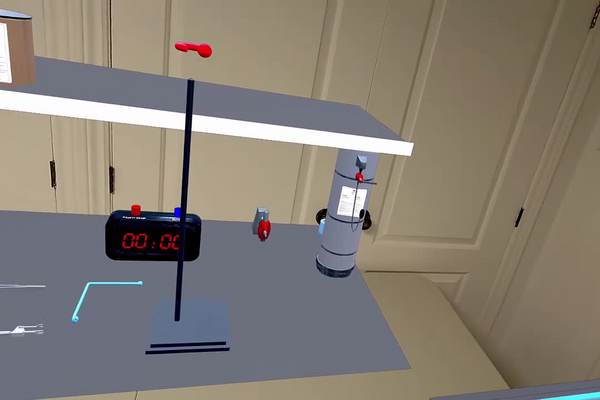
Volume is measured differently for each state of matter, and this tutorial teaches all three techniques in one session. A liquid can be poured into a graduated cylinder and read directly — provided the reading is taken at the base of the meniscus, the curve the liquid’s surface tension forms against the glass. A solid, especially an irregular one that no ruler can capture, is measured by displacement: immersed in a brim-full overflow vessel, it pushes out exactly its own volume of water, which is caught and read in a cylinder. A gas is measured by letting it displace water from an inverted, water-filled burette — the gas bubbles up, the water level falls, and the graduations record how much space the gas has claimed. In this tutorial, you will measure 70 mL of water in a graduated cylinder, determine the volume of five pieces of lead with the overflow vessel, and collect a gas over water in a burette while a stopwatch and the tablet’s Volume-versus-Time graph record the flow.
Educational Goals
Measurement technique for each state of matter
- Measure a liquid’s volume directly in a graduated cylinder, reading at the base of the meniscus.
- Measure an irregular solid’s volume by water displacement, and a gas’s volume by collection over water in a burette.
Application of physical principles
- Apply the displacement principle: a fully immersed object pushes out exactly its own volume of fluid, whatever its shape.
- Recognise that a gas expands to fill whatever space it is given, which is why its volume must be read from what it displaces.
Instrument handling
- Assemble the gas-collection apparatus — stand, clamp, inverted burette, connector and gas cylinder — in the correct order, and handle dense solids with tweezers.
Reading and recording
- Choose the graduated cylinder appropriate to the volume being measured, and use the tablet’s Volume-versus-Time graph to read a result that changes while it is being collected.
Protocol
PART 1 : Measuring the volume of a liquid
- In the appropriate graduated cylinder, pour 70 mL of tap water.
- Check the base of the meniscus of the graduated cylinder to confirm the volume.
PART 2 : Measuring the volume of a solid using an overflow vessel
To measure the volume of a solid, we can use water displacement.
- With tap water, fill a vase to overflowing at its full capacity before spillage (500 mL). Let the excess water drain into the sink.
- Replace the overflow vessel in its initial position to the left of the counter, right next to the 25 mL graduated cylinder (which will be positioned under the overflow opening of the overflow vessel).
- Place five pieces of lead into the overflow vessel using tweezers.
- Using the overflow from the overflow vessel and the meniscus in the graduated cylinder, determine the volume of the solid.
PART 3 : Measuring the volume of a gas
To measure the volume of a gas, we can use a gas burette.
- Fill a 1 L beaker with at least 800 mL of tap water.
- Place the 1 L beaker to the right of the stand
- Place a universal clamp above the center of the 1 L beaker, in order to support the gas burette.
- Fill the beaker with 250 mL of tap water.
- Fill the gas burette to the brim with water from the 250 mL beaker, then place a rubber stopper in it.
One-hand mode : Attach a universal clamp to the stand to the right of the sink and place the gas burette in it to fill it to the brim, then insert a rubber stopper.
- Attach the gas burette to the universal clamp upside down, so that the opening with the stopper is near the bottom of the 1 L beaker.
- Remove the rubber stopper (the tip of the burette must be immersed in the beaker).
- If water flows out of the burette, it means there is not enough water in the beaker or the burette is too high. Repeat steps 4 to 7.
- Place a plastic connector so that its J-shaped opening is under the opening of the gas burette.
- Connect the gas cylinder fitting to the blue plastic connector.
- Start the stopwatch.
- Open the valve of the cylinder (touch with the tip of the finger).
- Let the gas burette fill halfway with gas.
- Close the gas valve and read the volume on the gas burette.
- Stop the stopwatch.
- The results are also displayed in graphical form in the Results tab, under Volume vs. Time.
Anticipated Outcomes
This is a practical session: its outcome is fluency with the graduated cylinder, the overflow vessel and the gas burette, rather than a hypothesis tested. Each part still has a definite expected reading. In Part 1 the cylinder should show 70 mL at the base of the meniscus. In Part 2, one piece of lead weighs 34.04 g, so the five pieces together weigh 170.2 g; lead’s density is 11.34 g/mL, and 170.2 g ÷ 11.34 g/mL gives a volume of 15 mL — which is exactly what the overflow vessel should deliver into the 25 mL graduated cylinder. The displacement method thus gives the same answer as the density calculation, and seeing those two routes agree is the point of the exercise. In Part 3 the gas is air; the burette is allowed to fill about halfway before the valve is closed, and the volume read on its graduations should match the final value of the tablet’s Volume-versus-Time graph. The volume collected over water slightly overstates the dry gas, since the trapped air is saturated with water vapour — a refinement taken up in the gas laboratories (053 to 057).
Summary of Assignment by Grade Range
Grade 9–10
Focus: correct technique in all three measurements. Students read the meniscus at eye level, run the overflow measurement without losing water, and assemble the gas burette with guidance. They can say in their own words why displacement measures volume and why the burette must start completely full of water.
Grade 11
Focus: the quantitative cross-check. Students predict the displaced volume from the density before running Part 2 — 170.2 g of lead at 11.34 g/mL must displace 15 mL — then verify it by overflow, and account for any shortfall (drops clinging to the vessel, the cylinder’s reading precision). In Part 3 they read the collected volume and relate the Volume-versus-Time graph to the flow rate while the valve was open.
Grade 12 / College Level
Focus: what each method assumes. Students distinguish displacement from buoyancy — the measurement works because lead sinks completely, and would fail for a floating solid — and treat the gas collection critically: the trapped air is saturated with water vapour and sits at a pressure set by the water levels, so the burette reading slightly overstates the dry gas at atmospheric pressure. They connect this to the gas laws and to why volumes of gases are only comparable at stated temperature and pressure.
Laboratory essentials
Instruments
- Beakers (1000 mL, 250 mL)
- Gas burette
- Gas connector
- Gas cylinder (air)
- Graduated cylinders (10 mL, 25 mL, 70 mL, 250 mL)
- Lab stand & clamps
- Overflow vessel
- Tweezers
- Stopwatch
- Rubber stopper
Products
- Lead (Pb) pieces
- Tap water