

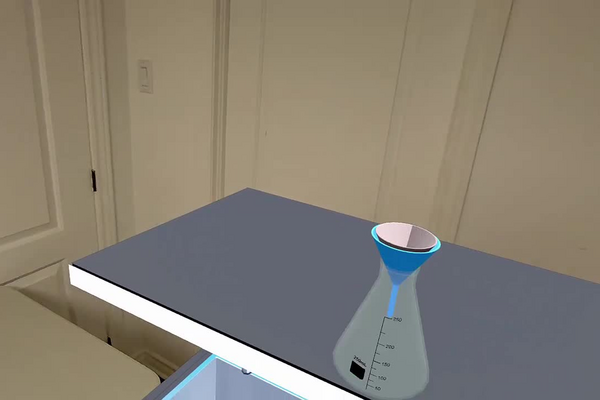
Separating a solid from a liquid is among the most common operations in all of applied chemistry. Water treatment plants let sediment settle out of raw water before filtering what remains; mining operations decant and filter enormous volumes to recover valuable minerals; and in the pharmaceutical industry, nearly every synthesis ends with a precipitate that must be cleanly separated from the solution that produced it. The two techniques used everywhere for this task are the ones in this laboratory: decantation and filtration.
Both exploit physical differences between the phases of a heterogeneous mixture, so neither changes the chemical identity of anything. Decantation uses density: a suspended solid denser than the liquid settles under gravity, and once it has collected at the bottom, the liquid above — the supernatant — can simply be poured off. Filtration uses particle size: liquid molecules pass freely through the microscopic pores of a paper filter, while solid particles, enormously larger, are held back.
In this laboratory you will separate a mixture of cobalt (II) hydroxide and water in two stages — first by decanting the settled mixture, then by filtering the remaining deposit — and see for yourself why the two methods are used in sequence rather than alone.
Educational Goals
Familiarization with the laboratory environment
- Identify the layout and equipment of the separation laboratory, including the beakers, the funnel and filter, and the 250 mL Erlenmeyer flask.
Careful manipulation of liquids and suspensions
- Pour a supernatant gently and continuously, without tilting the beaker so far that settled solid is carried over.
- Transfer a mixture onto a filter slowly enough that it does not overflow or bypass the paper.
Mastery of the vocabulary of separation
- Use the terms heterogeneous mixture, deposit, supernatant, filtrate and residue correctly, attaching each to the thing observed in the experiment.
Understanding the principle behind each technique
- Explain decantation in terms of density and settling, and filtration in terms of the difference between molecular and particle sizes.
- Explain why neither technique would work on a dissolved substance, and name the kind of technique that would.
Sequencing separation methods
- Justify why decantation is performed first and filtration second, and evaluate what each method alone would have left behind.
Protocol
The purpose of this laboratory is to separate the constituents of a mixture of cobalt (II) hydroxide and water.
PART 1: Decantation
This method makes it possible to carry out a first separation, because cobalt (II) hydroxide (Co(OH)2) is not soluble in water.
- An aqueous solution with a deposit of cobalt (II) hydroxide has been resting for at least 5 minutes (beaker Co(OH)2).
- Gently pour the liquid part (water) of the mixture into a second beaker (beaker 2).
Do not tilt the beaker too much to prevent solid particles from ending up in beaker 2.
- Leave the beaker Co(OH)2 containing the cobalt hydroxide to rest on the counter. The residual water can evaporate.
This is the first separation method (decantation).
PART 2: Filtration
- Fill the beaker Co(OH)2 which contains the deposit of cobalt (II) hydroxide up to 100 mL with distilled water.
- Attach the funnel to the top of the 250 mL Erlenmeyer flask.
- Insert the filter into the funnel.
- Slowly pour the mixture contained in the beaker Co(OH)2 onto the thick part of the filter.
- Let the mixture pass through the filter.
- The liquid obtained is called the filtrate
- The solid part remaining in the filter is the residue
- This is a second separation method (filtration)
Anticipated Outcomes
Expected results. The mixture separates cleanly into its two constituents: water, recovered first as decanted supernatant and then as filtrate, and solid cobalt (II) hydroxide, recovered as the pink residue on the filter paper.
| Technique | Physical property exploited | What you should observe | Limitation |
|---|---|---|---|
| Decantation | density — the solid settles below the liquid | most of the water pours off clear, leaving the pink deposit behind | some fine particles are carried over into beaker 2; some water stays with the solid |
| Filtration | particle size — the solid cannot pass the filter pores | a clear filtrate collects in the Erlenmeyer flask; the pink residue stays on the paper | slow for large volumes; the residue retains a little liquid until dried |
Why the mixture can be separated at all. Cobalt (II) hydroxide, Co(OH)2, is practically insoluble in water — its equilibrium solubility is of the order of a milligram per litre. Essentially all of it therefore remains as discrete solid particles suspended in, but not dissolved in, the water: a heterogeneous mixture. Because the two phases keep their own identities, physical differences between them — density, particle size — can be used to pull them apart. No chemical reaction is involved, and no new substance is formed at any point.
Why decantation works, and why it is imperfect. The solid particles are denser than water, so under gravity they settle to the bottom of the beaker — the five-minute rest in the protocol exists to give them time to do so. The clear liquid above can then be poured off. But settling is never perfect: the finest particles sink extremely slowly, because the drag a particle feels grows relative to its weight as it gets smaller. Tilting the beaker too far also remobilises the deposit. Decantation therefore removes the bulk of the liquid quickly and cheaply, at the cost of an imperfect cut between the phases.
Why filtration finishes the job. A paper filter is a mat of cellulose fibres whose pores are a few micrometres across. Water molecules, thousands of times smaller, pass through unhindered, while the solid particles are retained. The liquid that passes through is called the filtrate; the solid held on the paper is the residue. Filtration makes a far sharper separation than decantation, but it is slower — which is why the protocol decants first and filters only the concentrated remainder.
Summary of Assignment by Grade Range
Grade 9–10
- Focus: mixtures can be separated by their physical properties, and the vocabulary of separation.
- Activities: carry out the decantation and the filtration following the protocol; identify the deposit, supernatant, filtrate and residue by name as each appears; state which constituent of the mixture each recovered fraction represents; describe what was left behind by each method.
Grade 11
- Focus: the physical principles — density, settling and particle size — behind the techniques.
- Activities: explain why the mixture must rest before decanting and why fine particles settle slowly; explain filtration in terms of pore size versus particle size; justify the order of the two operations; predict what would happen if the mixture were filtered directly without decanting.
Grade 12 / College Level
- Focus: choosing and evaluating separation methods.
- Activities: classify the mixture and justify why physical separation applies, referring to the insolubility of Co(OH)2; evaluate the purity of each recovered fraction and identify where losses occur; propose how the recovered solid could be dried and the mass balance checked; determine which separation techniques would be required if the solid were soluble, and why.
Laboratory essentials
Instruments
- Beakers (100ml)
- Erlenmeyer (250 ml)
- Funnel
- Funnel filter
Products
- Cobalt hydroxide (II)
- Distilled water