

Precipitation is the simplest way to pull a dissolved ion out of solution: two clear liquids are combined, and a compound that will not dissolve appears as a solid suspended in the mixture. Water-treatment plants use it to strip phosphate and heavy metals from effluent, analytical laboratories use the very reaction studied here to determine calcium gravimetrically, and it is the same chemistry that builds kidney stones, which are largely calcium oxalate. A precipitate forms because every ionic compound has a solubility limit. When mixing two solutions pushes the product of the ion concentrations past that limit, the excess leaves the solution as a solid, while the ions that pair into a soluble compound stay dissolved and invisible.
What makes a precipitation reaction useful for teaching is that nothing is created or destroyed when it happens. The solid is new, but its atoms were already in the beaker; only their partners have changed. In this laboratory you will weigh an empty 50 mL beaker and an empty 10 mL graduated cylinder, measure 5 mL of 0.2 M calcium chloride and 5 mL of 0.2 M ammonium oxalate, weigh each solution in its own container, pour them together, stir for five seconds and watch a white solid appear, then weigh the beaker one last time. Comparing the total mass of the containers before mixing with the total afterwards is a direct test of the law of conservation of mass, and the amount of substance contained in each 5 mL portion lets you predict how much solid should have formed.
Educational Goals
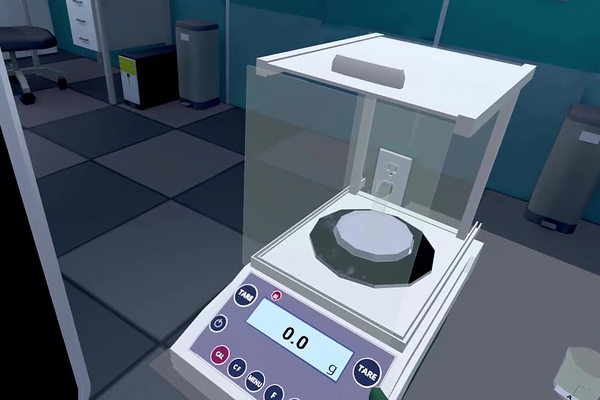
- Familiarization with the laboratory environment — locate the balance, the two reagent dispensers, the sink and the wash bottle before starting, and work through the numbered protocol on the tablet, confirming each step as it is completed.
- Use of the analytical balance — weigh an empty container and record its mass before anything is added to it, read the display to the hundredth of a gram, and recognise that every mass reported in this laboratory is the difference between two readings rather than a direct measurement.
- Measurement of liquid volumes — deliver 5 mL from a 10 mL graduated cylinder, reading the bottom of the meniscus at eye level, and rinse the cylinder with distilled water before reusing it for the second reagent so that no calcium chloride is carried into the oxalate.
- Preparation and combination of reagent solutions — transfer a measured solution into a beaker without loss, add the second solution gently, and mix with a glass rod rather than by swirling the beaker.
- Observation of a precipitation reaction — describe the change in appearance at the moment it occurs, and identify the white solid as a new substance rather than undissolved reagent.
- Quantitative interpretation of the results — build a mass balance from the recorded readings, calculate the amount of substance in each 5 mL portion and the mass of precipitate expected from it, then compare the prediction with what the balance shows and account for any difference.
- Laboratory safety and good practice — handle a soluble oxalate salt, which is toxic if ingested, with gloves and eye protection, and rinse glassware into the sink rather than leaving residues on the bench.
Protocol
- Initial Weighing of the beaker : Weigh an empty 50 mL beaker and record its mass.
- Initial Weighing of the graduated cylinder : Weigh an empty 10 mL graduated cylinder and record its mass.
- Calcium chloride measurement (CaCl2) : Using the graduated cylinder; accurately measure 5 mL of 0.2M calcium chloride solution.
- Transfer of calcium chloride : Pour the measured calcium chloride solution into the 50 mL beaker.
- Rinsing the graduated cylinder : Use a wash bottle to rinse the graduated cylinder with distilled water.
- Measurement of ammonium oxalate ((NH4)2C204) : Precisely measure 5 mL of 0.2M ammonium oxalate solution using the same graduated cylinder.
- Weighing the calcium chloride solution : Weigh the beaker containing the calcium chloride solution and record the mass.
- Weighing the ammonium oxalate solution : Weigh the graduated cylinder containing the ammonium oxalate solution and record the mass.
- Using the data collected in the previous steps, calculate the mass of the 2 liquids.
- Combination of solutions : Gently pour the ammonium oxalate solution into the beaker containing the calcium chloride solution.
- Mixing : Gently mix the solutions for 5 seconds with the glass rod. Note any changes in appearance.
- Final weighing : Weigh the beaker containing the mixture of the two reactive solutions.
- Using the data collected in steps 10 to 12, calculate the combined mass of the 2 mixed liquids.
- Compare the mass of the liquids before and after mixing them and note your observations.
Anticipated Outcomes
Five masses are recorded during the session. The table below gives the readings the simulation’s balance produces, exactly as they appear in the Results panel at the end of the run, together with the quantity each one is used to calculate.
| Protocol step | Object weighed | Balance reading (g) | Quantity obtained by difference |
|---|---|---|---|
| 1 | Empty 50 mL beaker | 75.0 | tare of the beaker |
| 2 | Empty 10 mL graduated cylinder | 50.0 | tare of the cylinder |
| 7 | Beaker + 5 mL CaCl2 0.2 M | 80.04 | 5.04 g of calcium chloride solution |
| 8 | Cylinder + 5 mL (NH4)2C2O4 0.2 M | 55.31 | 5.31 g of ammonium oxalate solution |
| 12 | Beaker + mixture, after reaction | 85.35 | 10.35 g of reacted mixture |
The comparison the laboratory is built around follows from the last three rows. Before mixing, the two liquids weigh (80.04 − 75.00) + (55.31 − 50.00) = 5.04 + 5.31 = 10.35 g. After mixing and reaction, the beaker holds 85.35 − 75.00 = 10.35 g. The difference is 0.00 g. Taking the containers into account gives the same conclusion for the system as a whole: 80.04 + 55.31 = 135.35 g before, and 85.35 + 50.00 = 135.35 g after, since the emptied cylinder still weighs its tare. Mass is conserved, and the Results panel records the visible change alongside it, as beaker 50 mL #A / calcium oxalate / white precipitate.
The reaction and the amounts involved
Calcium chloride and ammonium oxalate undergo a double displacement (metathesis) reaction: the cations and anions exchange partners, and one of the two possible products is insoluble.
CaCl2(aq) + (NH4)2C2O4(aq) → CaC2O4(s) + 2 NH4Cl(aq)
Only the calcium and the oxalate take part. Stripping out the ions that begin and end the reaction dissolved gives the net ionic equation, with Cl− and NH4+ as spectator ions:
Ca2+(aq) + C2O42−(aq) → CaC2O4(s)
The amount of substance in each portion comes from n = C × V. For the calcium chloride, n = 0.200 mol/L × 0.00500 L = 1.00 × 10⁻³ mol, and the identical concentration and volume give the same 1.00 × 10⁻³ mol of ammonium oxalate. The equation consumes the two reagents in a 1:1 ratio, so the portions are exactly stoichiometric and neither reagent is limiting — a deliberate choice, because it means the calculation has no wasted reagent to account for.
The precipitate expected is therefore m = n × M = 1.00 × 10−3 mol × 128.10 g/mol = 0.128 g of anhydrous calcium oxalate. Calcium oxalate in fact crystallises from cold aqueous solution as the monohydrate CaC2O4·H2O (M = 146.11 g/mol), which would weigh 0.146 g after filtration but not after drying at 200 °C. The 2.00 × 10⁻³ mol of ammonium chloride formed alongside it amounts to 0.107 g and stays in solution, invisible.
| Species in the beaker after reaction | Amount (mol) | Mass (g) | State |
|---|---|---|---|
| Water | 0.555 | 10.0 | liquid, solvent |
| CaC2O4 | 1.00 × 10⁻³ | 0.128 | white solid, suspended |
| NH4+ | 2.00 × 10⁻³ | 0.036 | dissolved, spectator |
| Cl− | 2.00 × 10⁻³ | 0.071 | dissolved, spectator |
| Ca2+ and C2O42− left in solution | 4.8 × 10⁻⁷ each | less than 0.0001 | dissolved, at equilibrium |
Why a solid appears, and why it appears completely
Whether a precipitate forms is decided by comparing the ion product Q = [Ca2+][C2O42−] with the solubility product of calcium oxalate, Ksp = 2.3 × 10⁻⁹ at 25 °C for the monohydrate. At the instant the two 5 mL portions meet, each solute has been diluted into 10 mL, so both ions are at 0.100 mol/L and Q = 0.100 × 0.100 = 1.0 × 10⁻². That is larger than Ksp by a factor of about 4 × 10⁶, which is why the cloudiness is immediate rather than gradual.
The same constant fixes how much calcium is left behind. For a 1:1 salt, the saturated concentration is s is the square root of Ksp, so s = (2.3 × 10⁻⁹)1/2 = 4.8 × 10⁻⁵ mol/L, so the 10 mL of supernatant retains 4.8 × 10⁻⁷ mol of calcium, or 0.06 mg. That is 0.05 % of the 1.00 × 10⁻³ mol added: the precipitation is quantitative to better than one part in a thousand, which is exactly why the reaction is used for gravimetric calcium determinations and why oxalate is a reliable way to remove calcium from a sample.
The other product does the opposite. Ammonium chloride dissolves to about 372 g/L at 20 °C, so 10 mL of water could hold 3.7 g of it; the 0.107 g formed here reaches only 3 % of saturation and never comes out of solution. The two solubility rules a student needs are visible side by side in a single beaker: oxalates of the alkaline earth metals are insoluble, and all common ammonium salts are soluble.
Why the total mass cannot change
A chemical reaction rearranges which atoms are bonded to which, and does nothing else. Counting the atoms on each side of the balanced equation makes the point without any appeal to authority: the reactants CaCl2 and (NH4)2C2O4 together contain 1 Ca, 2 Cl, 2 N, 8 H, 2 C and 4 O, and the products CaC2O4 and 2 NH4Cl contain 1 Ca, 2 C, 4 O, 2 N, 8 H and 2 Cl. The same atoms, in different company. Because each atom carries a fixed mass, the total mass of the contents is fixed as well, whatever happens to their appearance or their state.
The reason this particular reaction demonstrates the law so cleanly is that none of its products is a gas. Nothing can leave an open beaker, so no balloon, stopper or sealed flask is needed and the two totals can be compared directly. A reaction that releases carbon dioxide, such as the one used in the law of conservation of mass laboratory, appears to lose mass on an open bench and has to be run in a closed system before the same conclusion can be reached — a useful contrast to draw with students who assume the balance is simply telling them the truth.
Summary of Assignment by Grade Range
Grade 9–10
- Focus: reading a balance, keeping an orderly table of masses, and describing a chemical change in words.
- Activities: weigh the empty beaker and the empty cylinder; measure and transfer the two 5 mL portions; record all five readings; describe the appearance of each liquid before mixing and of the mixture afterwards; subtract the tares to find the mass of each liquid, and show that the two liquids together weigh the same before and after the reaction; state the conclusion in one sentence, using the words precipitate and conservation of mass correctly.
Grade 11
- Focus: the balanced equation, mole calculations and a complete mass balance.
- Activities: write the molecular and the net ionic equation and name the spectator ions; calculate n = C × V for each reagent and show that they are present in the 1:1 ratio the equation requires; predict the mass of calcium oxalate formed (0.128 g) and the mass of ammonium chloride left in solution (0.107 g); build the mass balance of the whole system and confirm 135.35 g before and after; explain, by counting atoms on each side of the equation, why the total was bound to be unchanged.
Grade 12 / College Level
- Focus: solubility equilibrium and the ion-product calculation.
- Activities: calculate the ion product at the moment of mixing and compare it with Ksp to argue that precipitation is quantitative; determine what fraction of the calcium remains dissolved and express it in mg/L; recalculate the expected mass of each 5 mL portion from its concentration; discuss how the yield would change in acidic solution, and how a gravimetric determination of calcium would have to be run to be trustworthy.
Laboratory essentials
Instruments
- Balance (digital, readable to 0.01 g)
- Beaker (50 mL)
- Graduated cylinder (10 mL)
- Glass rod
- Wash bottle
Products
- Calcium chloride CaCl2 0.2 M (solution, 5 mL)
- Ammonium oxalate (NH4)2C2O4 0.2 M (solution, 5 mL)
- Distilled water (for rinsing)