

Every living cell is enclosed by a membrane that lets some substances through and holds others back. That selectivity is what allows a cell to keep its proteins and sugars while still exchanging water, salts and nutrients with its surroundings. The same principle is used industrially in water purification and, most familiarly, in kidney dialysis, where a machine performs the filtration a failing kidney no longer can.
A membrane of this kind is described as selectively permeable: it is perforated by pores of a particular size, and whether a dissolved substance can cross depends chiefly on how large its molecules are. Small molecules and ions pass through readily and spread out by diffusion, moving from where they are concentrated to where they are dilute until they are evenly distributed. Large molecules are simply too big to fit and stay where they are. Water itself crosses freely in both directions, and its net movement toward the more concentrated side is what is properly called osmosis.
In this laboratory you will fill a dialysis bag with a mixture of three substances of very different molecular size — starch, sodium chloride and glucose — and suspend it in a beaker of distilled water. After the system has been left to exchange, you will test both the water surrounding the bag and the contents of the bag itself for all three substances, using a specific chemical test for each. By comparing which substances appear outside the bag and which do not, you will establish the size limit of the membrane without ever measuring a pore.
Educational Goals
Familiarization with the laboratory environment
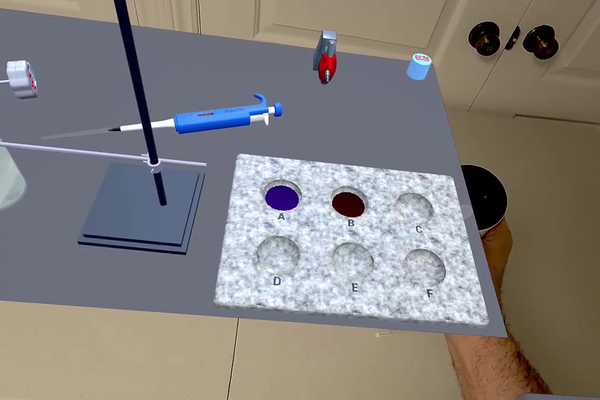
- Identify the layout and equipment of the Proteus osmosis laboratory, including the dialysis bag, the universal stand and clamp, the hot plate with its water bath, and the well plate used for the colour tests.
Use of protective equipment
- Wear gloves and eye protection throughout. Note in particular that silver nitrate stains skin and clothing and that the water bath operates above 70 °C.
Assembling and handling a dialysis membrane
- Close, fill and mount a dialysis bag without spilling its contents into the surrounding water — a contamination that would invalidate every subsequent test.
- Explain why the bag must be submerged but not immersed to the point where its opening is below the water line.
Accurate transfer of small volumes
- Use a pipette and a 10 mL graduated cylinder to combine three 3 mL portions, discarding excess between substances so that no carry-over occurs.
Performing three specific chemical tests
- Carry out the Lugol test for starch, the silver nitrate test for chloride, and the Fehling test for a reducing sugar, and state what a positive and a negative result looks like in each case before running it.
- Recognise that the Fehling test requires heating above 70 °C and that its result is read from the appearance of a precipitate, not from a colour change alone.
Distinguishing diffusion from osmosis
- Use the results to explain which substances crossed the membrane and why, and separate the movement of dissolved solutes from the movement of water.
Reasoning from an indirect measurement
- Deduce a property of the membrane — its approximate pore size — from the identity of the molecules that did and did not pass through it.
Protocol
The control solutions (positive)
NaCl and starch
- Using the dropper, put 5 to 10 drops of starch solution into the well labeled A.
- Empty the surplus from the dropper into the recovery container.
- Using the dropper, put 5 to 10 drops of sodium chloride solution into the well labeled D.
- Empty the excess from the dropper into the recovery container.
- Using the dropper, add 5 to 10 drops of Lugol into the well labeled A.
- Empty the excess from the dropper into the recovery container.
- Using the dropper, add 5 to 10 drops of silver nitrate into the well labeled D.
- Empty the surplus from the dropper into the recovery bin.
- Shake cups A and D well using the glass rod.
The observations of the control reactions are found in the results table.
Glucose
- Fill 400 mL of tap water into a 500 mL beaker.
- Insert the magnetic rod into the beaker.
- Place the beaker on the hot plate and set to 75°C. Wait until the temperature is reached.
- Turn on the magnetic motor (left button).
- Using the pipette, put 10 mL of glucose solution into the test tube labeled G.
- Using the pipette, add 10 mL of Fehling A to the test tube labeled G.
- Using the pipette, add 10 mL of Fehling B into the test tube labeled G.
- Mix the contents of the test tube by shaking it for a few seconds.
- Place a universal clamp on the left support, above the 500 mL beaker prepared in step 1.
- Attach the test tube labeled G to the universal clamp above the center of the beaker.
- Insert the thermometer into the test tube and wait for the temperature to reach above 70°C in the test tube.
- Take test tube G and put it back in its original position on the test tube rack.
- Mix the contents of the test tube by stirring it for a few seconds with the glass rod.
- Once the reaction in the test tube is completed (precipitation), lower the temperature of the heating plate to 15°C.
- Turn off the magnetic motor.
The observations of the control reaction are found in the results table.
Preparation of the osmosis bag and test of the initial solution
- Put 300 mL of warm tap water into the 600 mL beaker.
- Soak the dialysis bag in warm water to make it more flexible.
- Put a black cap at the bottom of the dialysis bag to close it.
- In the 10 mL graduated cylinder, successively pour using the pipette 3 mL of starch solution, 3 mL of sodium chloride and 3 mL of glucose solution. Between each substance, empty the surplus into the recovery container.
- Place the dialysis bag on the counter horizontally, the opening of the wide side facing upward. Pour the contents of the graduated cylinder into this opening.
- Place the empty 250 mL beaker next to the universal support on the right.
- Place a universal clamp on the right universal stand, above the center of the beaker.
- Attach the dialysis bag to the right universal support, using the universal clamp and place the whole assembly vertically in the 250 mL beaker. Be careful not to pour the contents of the dialysis bag into the beaker.
- Pour approximately 200 mL of distilled water into the 250 mL beaker so that the contents of the bag are immersed in the water. The water must not touch the end where the opening of the bag is located.
- Using the dropper, take the liquid from the beaker in which the dialysis bag is soaking. Put 5 to 10 drops of the solution into well B and 5 to 10 drops of the solution into well E.
- Empty the surplus from the dropper into the recovery container.
- Using the dropper, add 5 to 10 drops of Lugol’s solution into the well labeled B.
- Empty the surplus from the dropper into the recovery container.
- Using the dropper, add 5 to 10 drops of silver nitrate into the well labeled E.
- Empty the excess from the dropper into the recovery container.
- Shake well cups B and E using the glass rod.
- Set the hot plate on which there is always the beaker of water to 75°C. Wait for the temperature to be reached.
- Turn on the magnetic stirrer (left button).
- Using the pipette, put 10 mL into the test tube labeled H of the water from the beaker in which the bag is soaking.
- Using the pipette, add 10 mL of Fehling A into the test tube labeled H.
- Using the pipette, add 10 mL of Fehling B into the test tube labeled H.
- Mix the contents of the test tube by shaking it for a few seconds.
- Fix the test tube labeled (H) to the universal clamp above the center of the beaker.
- Insert the thermometer into the test tube and wait until a temperature above 70°C is reached in the test tube.
- Take the test tube (H) and put it back in its initial location on the test tube rack.
- Mix the contents of the test tube by shaking it for a few seconds with the glass rod.
- Lower the temperature of the heating plate to 15°C.
- Turn off the magnetic stirrer.
- Wait 24 h (use the clock button to advance time)
Test of the final solution
- Using the dropper, take the liquid from the beaker in which the dialysis bag is soaking and put 5 to 10 drops of the solution into well C and 5 to 10 drops of the solution into well F.
- Empty the surplus from the dropper into the recovery container.
- Using the dropper, add 5 to 10 drops of Lugol into the well labeled C.
- Empty the excess from the dropper into the recovery container.
- Using the dropper, add 5 to 10 drops of silver nitrate into the well labeled F.
- Empty the excess from the dropper into the recovery container.
- Shake cups C and F well using the glass rod.
- Set the hot plate on which there is always the beaker of water to 75°C. Wait for the temperature to be reached.
- Turn on the magnetic stirrer (left button).
- Using the pipette, put 10 mL into the test tube labeled I of the water from the beaker in which the bag is soaking.
- Using the pipette, add 10 mL of Fehling A into the test tube labeled I.
- Using the pipette, add 10 mL of Fehling B into the test tube labeled I.
- Mix the contents of the test tube by shaking it for a few seconds.
- Fix the test tube labeled (I) to the universal clamp above the center of the beaker.
- Insert the thermometer into the test tube and wait until the temperature in the test tube reaches above 70°C.
- Take the test tube (I) and put it back in its original location on the test tube rack.
- Mix the contents of the test tube by stirring it for a few seconds with the glass rod.
- Lower the temperature of the heating plate to 15°C.
- Turn off the magnetic stirrer.
The observations are found in the results table.
- A positive result for the presence of complex carbohydrates will result in a blue-black coloration (iodine-starch complex) in the well (Lugol’s test).
- A positive result for the presence of NaCl will result in a white precipitate (AgCl) in the well (silver nitrate reaction).
- A positive result for the presence of simple carbohydrates will result in a brick-red precipitate (Cu2O) in the test tube (Fehling’s reaction).
Anticipated Outcomes
The three substances and their sizes. The outcome of the experiment is decided almost entirely by molecular size, so it is worth setting the three side by side before looking at the results.
| Substance | Approximate molar mass | Size relative to the pores | Crosses the membrane? |
|---|---|---|---|
| Starch (amylose and amylopectin) | 105 – 106 g/mol | far larger | no |
| Glucose, C6H12O6 | 180 g/mol | smaller | yes |
| Sodium and chloride ions | 23 and 35.5 g/mol | much smaller | yes |
Expected results. Both the water surrounding the bag and the contents of the bag are tested for all three substances.
| Test | What it detects | Positive result looks like | Water around the bag | Inside the bag |
|---|---|---|---|---|
| Lugol | Starch | purple to blue-black | negative (well C) | positive (well A) |
| Silver nitrate | Chloride ion | white precipitate | positive (well F) | positive (well D) |
| Fehling, heated | Reducing sugar | brick-red precipitate | positive (tube I) | positive (tube G) |
Testing for solution in the beaker (wells B and E, and test tube H) will show negative results, since no substance had the time to cross the membrane.
The single negative result is the entire finding: chloride and glucose crossed the membrane, starch did not. Starch remains detectable inside the bag, which confirms it was present all along and simply could not leave.
The starch test. Lugol’s solution contains iodine together with potassium iodide, which combine to give triiodide, I2 + I− → I3−. It is the triiodide ion, not iodine or iodide alone, that produces the colour: it slots into the helical coil of the amylose chain, and the resulting host–guest complex absorbs strongly in the visible region to give the characteristic blue-black. Iodide by itself gives no colour with starch, which is why the reagent must contain both.
The chloride test. Silver ions and chloride ions combine to give a precipitate that is essentially insoluble in water:
Ag+(aq) + Cl−(aq) → AgCl(s) Ksp = 1.8 × 10⁻¹⁰
Because Ksp is so small, a cloudiness appears at chloride concentrations far below what the eye could otherwise detect, which makes this a sensitive test for a substance that has crossed the membrane in only modest quantity.
The glucose test. Fehling’s reagent is supplied as two solutions that are combined immediately before use. Fehling A is copper(II) sulfate; Fehling B is potassium sodium tartrate in approximately 2.5 M sodium hydroxide. Mixing them gives a deep blue solution in which tartrate holds the copper(II) in solution as a soluble complex — without that strongly alkaline tartrate, the copper would simply precipitate as copper(II) hydroxide and the reagent would be useless.
Glucose is a reducing sugar: it carries an aldehyde group that is oxidised on heating, and the copper(II) is reduced in exchange to copper(I), which leaves the solution as a brick-red precipitate of copper(I) oxide:
RCHO + 2 Cu2+ + 5 OH− → RCOO− + Cu2O(s) + 3 H2O
The reaction needs both heat and a strongly alkaline medium, which is why the test tube is brought above 70 °C in the water bath. The expected appearance of tube G is therefore deep blue before heating and a brick-red precipitate after heating. A frequent misreading is to expect the blue to deepen; it does not — the blue is the copper(II) complex being consumed, and its disappearance beneath the red precipitate is the positive result.
Diffusion, and why it stops. Glucose and the ions move because their concentrations differ on the two sides of the membrane. Net movement continues down that gradient until the concentrations equalise, at which point crossings in both directions balance and the system is at equilibrium. Nothing pumps the solutes; the process needs no energy input and cannot move a substance against its own gradient.
Osmosis, which is a separate effect. Water also crosses the membrane, and it moves preferentially toward the side where the total dissolved solute concentration is higher. At the start that is the inside of the bag, so water enters and the bag becomes noticeably firmer. The pressure that would have to be applied to stop that flow is the osmotic pressure, given for a dilute solution by the van’t Hoff relationship:
Π = i M R T where i is the number of particles each formula unit releases, M the molarity, R = 8.314 J·mol−1·K−1 and T the absolute temperature.
Sodium chloride contributes twice as much to this pressure as the same molarity of glucose, because it dissociates into two ions while glucose stays as one molecule. Starch contributes almost nothing despite its mass, since osmotic pressure counts particles rather than grams — a single starch molecule carrying thousands of glucose units exerts the osmotic effect of one particle. This is the clearest illustration in the laboratory that osmotic pressure is a colligative property.
A note on the name of this laboratory. Strictly, the movement of the dissolved solutes across the membrane is diffusion, or dialysis when a membrane separates the two sides; osmosis refers specifically to the movement of the solvent. Both are happening here at once, and a senior class can reasonably be asked to identify which observation demonstrates which.
Summary of Assignment by Grade Range
Grade 9–10
- Focus: selective permeability as an observable property, and reading a chemical test correctly.
- Activities: assemble and mount the dialysis bag; carry out the three tests on both samples and record each as positive or negative in a table; state which substance did not leave the bag; describe in plain terms why a large molecule cannot pass through a small opening; note that the bag feels firmer at the end than at the start.
Grade 11
- Focus: diffusion down a concentration gradient, and the chemistry of each test.
- Activities: relate the pass-or-fail outcome for each substance to its molar mass; write the ionic equation for the silver nitrate test and explain why a small Ksp makes it sensitive; explain why the Fehling test requires heat and alkali, and why the blue disappears rather than deepens; predict what would be observed if the bag had been filled with distilled water and suspended in the mixed solution instead.
Grade 12 / College Level
- Focus: osmosis as a colligative property, and the distinction between dialysis and osmosis.
- Activities: use Π = iMRT to compare the osmotic contributions of equal molarities of sodium chloride, glucose and starch, and explain why the starch contributes almost nothing despite its mass; identify which observations in the experiment demonstrate solute diffusion and which demonstrate solvent movement; estimate an upper bound on the pore size of the membrane from the identity of the largest molecule that crossed it; discuss what limits the sensitivity of each of the three tests and which of the three would be least reliable at detecting a small quantity that had crossed.
Laboratory essentials
Instruments
- Beakers (250 mL, 500 mL & 600 mL)
- Dialysis bag
- Black cap (to close the bag)
- Universal stand
- Universal clamp
- Well plate
- Test tubes and test tube rack
- Droppers
- Pipette
- Graduated cylinder (10 mL)
- Glass rod
- Hot plate with water bath
- Magnetic stir bar
- Thermometer
- Gloves and eye protection
Products
- Starch solution
- Sodium chloride solution
- Glucose solution
- Lugol 2 % solution
- Silver nitrate solution
- Fehling A solution (copper(II) sulfate)
- Fehling B solution (potassium sodium tartrate in approximately 2.5 M NaOH)
- Distilled water