

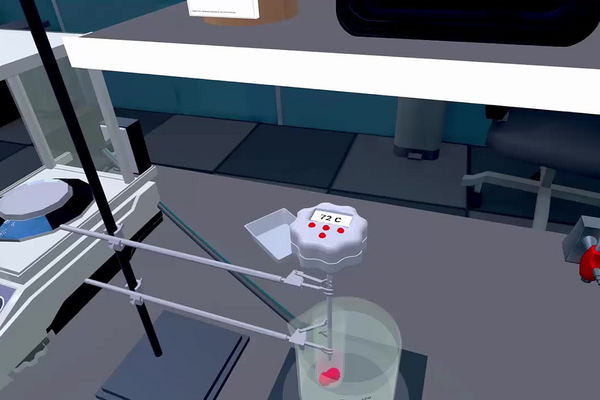
How do you tell one substance from another when both are white, odourless solids? Not by appearance — by measurement. Every pure substance carries a set of physical properties that do not depend on how much of it you have: its density, its melting point, its boiling point. These are called intensive properties, and they work like a fingerprint. Quality-control laboratories verify raw materials this way, forensic scientists identify unknown samples this way, and geologists classify minerals this way.
Density is the ratio of a sample’s mass to its volume — how much matter is packed into each millilitre. The melting point is the temperature at which the solid’s ordered structure collapses into liquid, and it stays fixed while melting is under way: the heat flowing in is consumed breaking the structure, not raising the temperature, which is why a melting substance shows a plateau on a temperature–time graph.
In this laboratory you will measure both properties for paraffin wax. First you will weigh a sample and determine its volume by water displacement, giving its density; then you will melt a weighed sample in a water bath, following the temperature on the tablet’s graph to catch the melting plateau. Together, the two numbers characterise the material.
Educational Goals
Familiarization with the laboratory environment
- Identify the layout and equipment of the laboratory, including the electronic balance, graduated cylinders, hot plate, lab stand and clamps, thermometer, timer and tweezers.
Correct use of the electronic balance
- Use the weighing boat and the tare function so that the balance reads the sample mass alone.
- Weigh a sample piece by piece up to a target mass, recording as you go.
Measuring the volume of an irregular solid
- Determine volume by water displacement: read the cylinder before and after adding the solid, and subtract.
- Read the meniscus at eye level.
Determining a density
- Compute density as mass divided by volume, with correct units (g/mL), and compare the result against a reference value.
Measuring a melting point
- Assemble the water-bath setup with the test tube and thermometer clamped clear of the bottom, and explain why the thermometer must not touch the glass.
- Follow the temperature–time graph, identify the melting plateau, and read the melting point from it.
- Explain why a water bath, rather than direct contact with the hot plate, is used to melt the sample.
Understanding intensive properties
- Explain why density and melting point do not depend on sample size, and how that makes them useful for identifying substances.
Protocol
Part 1 : Density
- Place the weighing boat on the pan of the balance.
- Press tare to set the balance to zero.
- Weigh 5 pieces of paraffin.
- Measure the volume of the paraffin sample by water displacement.
- a) Measure 20 mL of distilled water with the graduated cylinder.
- b) Take the boat containing the pieces of paraffin and pour the pieces into the graduated cylinder by letting them slide. Observe the increase in volume.
- c) The final volume, minus the initial volume (20 mL), is equal to the volume of the paraffin pieces.
- Verify that the mass and volume of paraffin are correctly entered in the results table on the tablet.
- The mass of paraffin divided by its volume is equal to the density of paraffin (in g/ mL).
Part 2 : The melting point
- Fill a 500 mL beaker with cold tap water (approximately 6 °C).
- Place the beaker of cold water on the hot plate.
- Knowing the density of paraffin, using tweezers, place pieces of paraffin on the balance using the weighing boat until a mass corresponding to a volume of 18 mL (21.25g) is reached.
- Pour the weighed paraffin into an empty test tube.
- Attach a universal clamp to the support (bottom position) above the center of the beaker.
- Attach the test tube to the universal clamp above the center of the beaker.
- Attach a second universal clamp to the support (top position) above the test tube.
- Insert the thermometer into the test tube by attaching it to the universal clamp. The thermometer must not touch the bottom of the test tube.
- Start the stopwatch (red button).
- Set the temperature of the hot plate to 85 °C, wait for the temperature to rise to 57 °C. The paraffin will begin to melt approximately 1 minute after the temperature of 57 °C has been reached (so a delay is to be expected).
The temperature in the test tube will rise, hold at a plateau while the paraffin melts, then continue to rise. Wait until the paraffin is completely melted. Follow the progress of the experiment on the graph in the results section of the tablet.
- Lower the temperature of the heating plate to 15°C.
Anticipated Outcomes
Expected results.
| Measurement | Expected result |
|---|---|
| Mass of 5 pieces of paraffin | between 21 and 22 g (about 4.25 g per piece) |
| Volume by water displacement | between 24.7 and 25.9 mL |
| Density (mass ÷ volume) | 0.85 g/mL |
| Melting point | around 57 °C, read from the plateau on the graph |
Why displacement gives the volume. An irregular solid has no formula for its volume, but it still occupies space: submerged in water, it pushes aside exactly its own volume of liquid, and the reading of the graduated cylinder rises by that amount. With the initial reading at 20 mL, the final reading gives the paraffin volume directly by subtraction. The density then follows: ρ = m/V = 21.25 g ÷ 25 mL = 0.85 g/mL. Note what this number immediately reveals — paraffin is less dense than water (1.00 g/mL), which is why candle wax floats.
Why the temperature holds at a plateau. A solid melts when its particles gain enough energy to break out of their ordered arrangement. While that is happening, every joule supplied by the water bath is spent dismantling the structure — the latent heat of fusion — and none is left over to raise the temperature. The graph therefore climbs, flattens at about 57 °C while the paraffin melts, and resumes climbing only once the last solid is gone. The plateau, not any single thermometer reading, is the measurement.
Why the setup is built the way it is. The water bath surrounds the test tube with a medium that heats evenly and cannot exceed 100 °C, protecting the sample from the scorching that direct contact with the plate would cause. The thermometer is clamped clear of the glass because the tube wall, heated from outside, runs hotter than the sample itself; touching it would bias the reading upward. And the delay the protocol warns about is real physics: heat takes time to work through water and wax to the thermometer bulb.
Summary of Assignment by Grade Range
Grade 9–10
- Focus: density and melting point as properties that identify a substance, and careful measurement technique.
- Activities: weigh the paraffin pieces using the tare function; measure their volume by displacement and compute the density; run the melting experiment and read the melting point from the graph; check both results against the expected values and suggest reasons for any difference.
Grade 11
- Focus: latent heat, and the interpretation of a temperature–time curve.
- Activities: explain the melting plateau in terms of latent heat of fusion; explain why the thermometer must not touch the tube and why a water bath is used; calculate the density; predict the shape of the curve if twice the mass of paraffin were used.
Grade 12 / College Level
- Focus: intensive versus extensive properties, and measurement design.
- Activities: classify each quantity measured as intensive or extensive and justify the classification; explain why a floating solid defeats naive displacement and how the measurement should be designed in a real laboratory; account for the width of paraffin’s melting range in terms of its mixed hydrocarbon composition; state the density with appropriate significant figures.
Laboratory essentials
Instruments
- Beakers (50 mL, 100 mL, 500 mL & 1000 mL)
- Electronic Scale
- Graduated Cylinders (70 mL & 100 mL)
- Hot plate
- Lab Stand & Clamps
- Magnetic stirrer
- Spatulas
- Test Tubes
- Thermometers
- Timer
- Tweezers
Products
- Paraffin (pieces)