

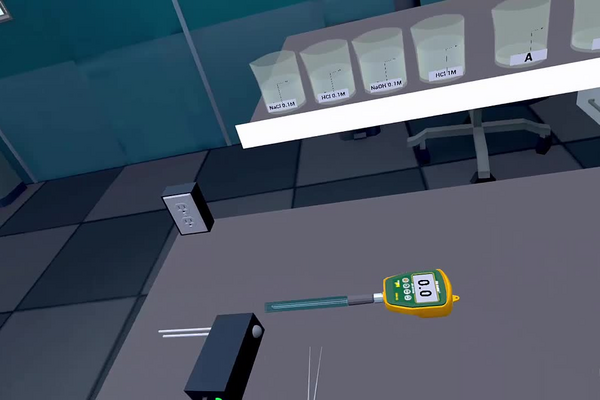
Sorting an unknown liquid into acid, base or salt is the first thing an analyst does with it, and the three tests used here are the oldest in the trade. A pair of litmus papers costs almost nothing and answers the question in seconds. A bulb wired in series with two electrodes dipped in the liquid shows whether the liquid carries ions at all. A strip of magnesium fizzes in acid and sits inert in everything else. Between them these tests separate a salt from an acid from a base without a single instrument reading, which is why they survive in water-quality field kits and in school laboratories alike.
What the three tests respond to is different in each case, and that is the point of running all three. Litmus is a dye whose colour depends on pH, so it reports the hydronium concentration. The bulb responds to mobile ions, and every soluble ionic compound supplies them whether it is acidic, basic or neutral — so conductivity separates ionic solutions from molecular ones, not acids from bases. Magnesium responds only to hydronium ion, being oxidised to Mg2+ while H3O+ is reduced to hydrogen gas. Three tests, three different questions; only their combination identifies a solution.
In this laboratory, you will run all three tests on 0.1 mol/L sodium chloride, hydrochloric acid and sodium hydroxide, recording the conductivity, both litmus colours, the pH-paper reading and the magnesium result for each. You will then prepare four dilutions of 1 mol/L hydrochloric acid — 10 mL made up to 30 mL, to 60 mL and to 100 mL, and 1 mL made up to 100 mL — and measure the pH of all five acid solutions with a pH meter. The second part turns the coarse pH scale of the first part into a quantitative one, and shows that the pH of a strong acid is nothing more than the logarithm of how far it has been diluted.
Educational Goals
Classifying a solution from evidence
- Assign an unknown solution to acid, base or neutral salt using the combined evidence of litmus, pH paper, conductivity and reaction with magnesium.
- Explain which of the four tests actually discriminates between the three classes and which does not, and why.
Handling the instruments
- Operate an electrical conductivity detector, and rinse and dry the electrodes between solutions so that a trace of the previous liquid cannot light the bulb.
- Read a pH paper against its colour scale and a pH meter from its display, and state which of the two is the more precise and by how much.
Litmus and pH paper as indicators
- Describe litmus as a dye with a transition range of roughly pH 4.5 to 8.3, and explain why two unchanged papers is a positive result rather than a failed test.
- Distinguish a single-dye paper, which gives a bracket, from a universal paper, which gives an approximate value.
Conductivity and dissolved ions
- Explain conduction in solution as the migration of ions, and account for the fact that all three 0.1 mol/L solutions light the bulb.
- Predict which of the three would conduct best if the detector reported a number rather than lighting a bulb, and justify the prediction from ionic mobilities.
Dilution and the logarithmic pH scale
- Calculate the concentration of a solution after dilution, in mol/L and in g/L, and prepare it correctly with a graduated cylinder.
- Show that for a strong monoprotic acid the rise in pH equals the base-ten logarithm of the dilution factor, and use that to predict a pH before measuring it.
Safety and disposal
- Handle 1 mol/L hydrochloric acid and 0.1 mol/L sodium hydroxide with gloves and eye protection, and know which of the two causes the more serious eye injury.
- Collect hydrogen evolved from magnesium away from any flame, and dispose of all solutions in the recovery bin.
Protocol
Part A: The properties of acids, bases and salts
- Turn on the electrical conductivity detector (ECD).
- Pour 10 mL of the 0.1M NaCl solution into beaker A.
- Clean the ECD electrodes with distilled water and wipe them with absorbent paper.
- Dip the electrodes into solution A. Observe whether the bulb lights up or not and record the result on the results table.
- Repeat steps 2 to 4 with the 0.1M HCl and 0.1M NaOH solutions, with beakers B and C.
- Dip a piece of blue litmus paper and a piece of red litmus paper into solution A. Record the colors obtained in the results table.
- Dip a piece of pH paper into solution A and evaluate the pH using the color scale. Record the pH in the results table.
- Repeat steps 6 and 7 with solutions B and C.
- Place a magnesium ribbon in solution A and record the observations in the results table.
- Repeat step 9 with solutions B and C
Part B: The concentration of an acidic solution and its pH
- Pour 10 mL of 1M HCl solution into the 100 mL graduated cylinder.
- Add distilled water up to the 30 mL mark.
- Pour the contents of the cylinder into the 100 mL beaker identified by the number 1.
- Pour 10 mL of 1M HCl solution into the 100 mL graduated cylinder.
- Add distilled water up to the 60 mL mark.
- Pour the contents of the cylinder into the 100 mL beaker identified by number 2.
- Pour 10 mL of 1M HCl solution into the 100 mL graduated cylinder.
- Add distilled water up to the 100 mL mark.
- Pour the contents of the cylinder into the 100 mL beaker identified by the number 3.
- Pour 1 mL of 1M HCl solution into the 10 mL graduated cylinder. Then pour the solution into the 100 mL graduated cylinder.
- Add distilled water up to the 100 mL mark.
- Pour the contents of the cylinder into the 100 mL beaker identified by the number 4.
- Measure the pH of the 1M HCl solution and that of solutions 1 to 4 using the pH meter. Record the results in the results table.
- Do not forget to rinse the pH meter with distilled water and dry it with paper, between measurements.
Anticipated Outcomes
Part A — the properties of acids, bases and salts. All three solutions are 0.1 mol/L and all three are strong electrolytes, so all three light the bulb. What separates them is litmus, the pH paper and the magnesium.
| Solution | Conducts | Blue litmus | Red litmus | pH paper | Magnesium | Class |
|---|---|---|---|---|---|---|
| A — NaCl 0.1 mol/L | Yes | stays blue | stays red | 7 | no reaction | neutral salt |
| B — HCl 0.1 mol/L | Yes | turns red | stays red | 1 | vigorous effervescence | strong acid |
| C — NaOH 0.1 mol/L | Yes | stays blue | turns blue | 13 | no reaction | strong base |
Why the salt leaves both papers unchanged. Litmus changes colour over roughly pH 4.5 to 8.3, so it can only report “below 4.5” or “above 8.3”. Sodium chloride dissolves to Na+ and Cl−, the conjugates of a strong base and a strong acid respectively, and neither takes a proton from water or gives one to it. The solution therefore stays at pH 7, both papers keep their original colour, and that pair of non-events is the positive identification of a neutral salt.
Why all three conduct. Conduction requires ions free to migrate, and each of the three compounds is fully dissociated at 0.1 mol/L, giving 0.2 mol/L of ions in every beaker. The bulb therefore lights in all three, and a student who expects the acid alone to conduct has confused “ionic” with “acidic”. The three are not equally good conductors, however, and this is the one place where the bulb hides something interesting.
| Solution (0.1 mol/L) | Ions supplied | Λm0 (S·cm2/mol) | Conductivity κ (mS/cm) | Relative |
|---|---|---|---|---|
| HCl | H3O+ + Cl− | 426 | ≈ 39 | 3.6 |
| NaOH | Na+ + OH− | 248 | ≈ 22 | 2.1 |
| NaCl | Na+ + Cl− | 126 | ≈ 11 | 1.0 |
Why only the acid attacks the magnesium. Magnesium is oxidised and hydronium reduced: Mg(s) + 2 H3O+ → Mg2+ + H2(g) + 2 H2O, or in the form usually written, Mg + 2 HCl → MgCl2 + H2. The driving force is large: E° for Mg2+/Mg is −2.37 V against 0.00 V for the hydrogen couple, so the cell potential is +2.37 V and the reaction is fast enough to see as a stream of bubbles. In the salt solution there is no oxidising agent stronger than water, and in the sodium hydroxide the metal is protected by an adherent film of insoluble Mg(OH)2; both are recorded as no reaction. The bubbles in beaker B are hydrogen, and they are the only gas produced anywhere in this laboratory.
Part B — concentration and pH. Four dilutions are made from the same 1 mol/L stock, whose mass concentration is 1.00 mol/L × 36.46 g/mol = 36.5 g/L. Each dilution obeys CdVd = CnVn, so Cn = CdVd/Vn. For solution 1, C1 = 36.5 g/L × 10 mL / 30 mL = 12.2 g/L, and the same substitution gives the rest.
| Solution | Prepared from | Dilution factor | Concentration | Concentration | Expected pH |
|---|---|---|---|---|---|
| reference | 1 mol/L HCl, undiluted | 1 | 1.00 mol/L | 36.5 g/L | 0.00 |
| 1 | 10 mL → 30 mL | 3 | 0.333 mol/L | 12.2 g/L | 0.48 |
| 2 | 10 mL → 60 mL | 6 | 0.167 mol/L | 6.1 g/L | 0.78 |
| 3 | 10 mL → 100 mL | 10 | 0.100 mol/L | 3.65 g/L | 1.00 |
| 4 | 1 mL → 100 mL | 100 | 0.0100 mol/L | 0.36 g/L | 2.00 |
The pH of a strong acid is the logarithm of its dilution. Hydrochloric acid ionizes completely, so [H3O+] equals the concentration prepared and pH = −log C. Dividing the concentration by a factor f therefore raises the pH by log f, and nothing else. That single statement accounts for every row of the table: log 3 = 0.48, log 6 = 0.78, log 10 = 1.00 and log 100 = 2.00, which are the four pH values without any further calculation. It also explains why the steps in this series are uneven while those in lab 048 are all equal — here the dilution factors are 3, 6, 10 and 100, not a constant ten.
Reading the scale backwards. Because the scale is logarithmic, one pH unit is a factor of ten in [H3O+]: solution 4 at pH 2.00 has one hundredth the hydronium concentration of the stock at pH 0.00, and one tenth that of solution 3. Going the other way, [H3O+] = 10−pH, so a reading of 0.78 corresponds to 10−0.78 = 0.166 mol/L, which recovers solution 2’s concentration to three figures. Being able to run the calculation in both directions is what makes the pH meter a concentration measurement rather than a colour comparison.
Summary of Assignment by Grade Range
Grade 9–10
Focus: running four tests carefully and describing what each one shows.
Activities: complete the Part A table for all three solutions from direct observation; state which solution is the acid, which the base and which the salt, and name the single test that settled each; explain why the bulb lit for all three; write the word equation for the reaction of magnesium with hydrochloric acid and name the gas; prepare the four dilutions and place the five pH readings in order, noting that the more dilute the acid, the higher the pH.
Grade 11
Focus: the arithmetic of dilution and of a logarithmic scale.
Activities: calculate the concentration of each of the four dilutions from CdVd = CnVn, in both mol/L and g/L, showing the substitution; predict each pH as −log C before measuring it and compare with the meter; convert each measured pH back to a hydronium concentration; show that the rise in pH equals the logarithm of the dilution factor for all four solutions; balance the magnesium reaction and calculate the volume of hydrogen a 0.10 g ribbon would give at room conditions.
Grade 12 / College Level
Focus: mechanism, precision and the limits of each method.
Activities: explain the anomalously high molar conductivity of H3O+ and OH− in terms of proton transfer between water molecules, and predict the ratio of conductivities of the three solutions; account quantitatively for the pH of the sodium chloride solution using Kw and the absence of hydrolysis; estimate the activity coefficient needed to reconcile a measured pH of 0.1 with a 1 mol/L stock and comment on the direction of the deviation; identify the two meter readings that disagree with −log C and quantify the discrepancy; propose a control that would make the conductivity test discriminating and predict its result; discuss why litmus, pH paper and a glass electrode disagree in precision by roughly an order of magnitude at each step.
Laboratory essentials
Instruments
- Electrical conductivity detector (ECD), with bulb and electrodes
- pH meter
- Tweezers
- Absorbent paper
- Graduated cylinder (100 mL)
- Graduated cylinder (10 mL)
- Beakers 50 mL (3, labelled A, B and C)
- Beakers 100 mL (4, numbered 1 to 4)
- Stock solution beakers (4, on the reagent bench)
- Blue and red litmus paper
- Universal pH strips with colour scale
- Recovery bin
Products
- NaCl 0.1 mol/L (solution)
- HCl 0.1 mol/L (solution)
- NaOH 0.1 mol/L (solution)
- HCl 1.0 mol/L (solution, 36.5 g/L)
- Magnesium ribbons
- Distilled water