

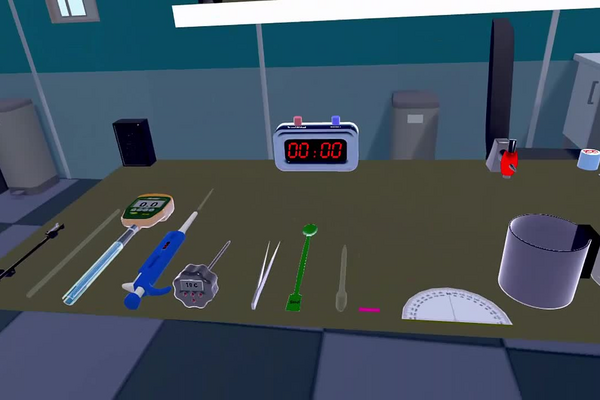
Every experimental result begins with a choice of instrument. A laboratory bench holds glassware that looks interchangeable but is not: a beaker and a volumetric flask may both hold 100 mL, yet one carries graduations for convenience while the other is calibrated to a single volume within a tenth of a millilitre. Knowing which is which, and handling each correctly, is the difference between a measurement and a guess. In a working laboratory it is also the difference between a routine session and a broken burette, a spilled reagent or a chemical burn, which is why professional practice puts equipment familiarity before any procedure.
The principle underneath the distinction is simple and quantitative: every instrument has a tolerance, and the tolerance of the least precise instrument used in a procedure sets the precision of the final result. Instruments also sort naturally by purpose rather than by appearance — some measure a quantity, some only contain a liquid, some transfer it, some hold other equipment steady, and some sense a physical property electronically. Learning them by function is far more useful than memorising a list of names, because it is function that decides which instrument a given experiment requires.
This laboratory has no reaction to run and no data to collect. You will work through the bench systematically, locating and picking up each item in turn: the wash bottle, the graduated cylinder, the beaker, the Erlenmeyer flask, the volumetric flask, the test tube, the dropper, the spatula, the tongs, the thermometer, the pH meter, the glass rod, the universal clamp, the ruler, the protractor, the acid container, the stopwatch, the pipette, the weighing boat, the burette and the funnel, finishing by placing a magnetic stir bar in the beaker and the lid on the calorimeter. The aim is recognition and correct handling, so that every laboratory that follows can be about the science rather than about the equipment.
Educational Goals
- Recognition of the standard bench inventory — name on sight each of the twenty-two instruments used in this session, and state its capacity or range where it has one.
- Classification by function — sort every item into one of five groups: instruments that measure, vessels that only contain, devices that transfer, supports that hold other equipment, and electronic sensors.
- Understanding precision and tolerance — explain why a 100 mL beaker and a 100 mL volumetric flask are not interchangeable, rank the volumetric instruments by relative tolerance, and identify which instrument sets the precision of a given procedure.
- Correct handling of fragile and precise equipment — pick up glassware by the body rather than the neck or the tip, keep a burette vertical in its clamp, avoid touching the bulb of a thermometer or the glass membrane of a pH electrode, and set instruments down where they cannot roll.
- Safe handling of a corrosive reagent — wear a laboratory coat, safety goggles and nitrile gloves throughout, carry an acid container with both hands and low to the bench, and know where the emergency equipment is before touching it.
- Organisation of the working space — lay out equipment in the order it will be used, keep the bench clear of anything the procedure does not require, and return each item to its place.
Protocol
- Locate the washing bottle, then take it in hand.
- Locate the 25 mL graduated cylinder , then take it in hand.
- Locate the 100 mL beaker, then take it in hand.
- Locate the 100 mL Erlenmeyer flask, then take it in hand.
- Locate the 100 mL volumetric flask, then take it in hand.
- Locate the test tube, then take it in hand.
- Locate the dropper, then take it in hand.
- Locate the 5 mL spatula, then take it in hand.
- Locate the tongs, then take them in hand.
- Locate the thermometer, then take it in hand.
- Locate the pH meter, then take it in hand.
- Locate the glass rod, then take it in hand.
- Locate the universal clamp, then take it in hand.
- Locate the 50 cm ruler, then take it in hand.
- Locate the protractor, then take it in hand.
- Locate the container of 1N hydrochloric acid, then take it in hand
- Locate the stopwatch and start it.
- Locate the pipette, then take it in hand.
- Locate the weighing boat, then take it in hand.
- Locate the burette, then take it in hand.
- Locate the funnel, then take it in hand.
- Locate the magnetic stir bar, take it in hand and insert it into the 100mL beaker
- Put the lid on the calorimeter.
Anticipated Outcomes
This laboratory produces no measurement. What it should produce is a student who can name every item on the bench, say what it is for, and say how far it can be trusted. The two tables below put that outcome in a form a teacher can mark.
| Instrument (protocol order) | Group | Function, and the handling point that matters |
|---|---|---|
| Wash bottle | Transfer | Delivers a directed jet of distilled water for rinsing glassware and washing residues down into a vessel. Squeeze the body, never the nozzle. |
| Graduated cylinder (25 mL) | Measure | Reads a range of volumes to about 1 %. Read the bottom of the meniscus at eye level, on a level bench. |
| Beaker (100 mL) | Contain | Holds, mixes and heats liquids. Its graduations are nominal and must not be used as a measurement. |
| Erlenmeyer flask (100 mL) | Contain | Conical body allows swirling without spillage, which is why titrations are run in one. Not a measuring vessel. |
| Volumetric flask (100 mL) | Measure | Calibrated to contain one volume to about 0.1 %. Fill to the mark, stopper, then mix by inversion; never heat it. |
| Test tube | Contain | Holds a few millilitres for a qualitative test or a colour comparison. Uncalibrated. |
| Dropper | Transfer | Delivers roughly 0.05 mL per drop, about twenty drops to the millilitre. Hold it vertical and never let the tip touch the liquid it is adding to. |
| Spatula | Transfer | Moves a solid from its container to a weighing boat. Keep it dry, and use one spatula per reagent. |
| Tongs | Transfer | Lifts hot or contaminated objects without contact. Grip near the base of the object and lift vertically. |
| Thermometer (digital) | Sense | Reads temperature, typically to 0.1 °C with an accuracy near 0.5 °C. Immerse the probe fully in the liquid, not against the wall of the vessel. |
| pH meter | Sense | Reads pH to about 0.01 unit after a two-point calibration. Rinse the electrode between samples and never let the glass membrane dry out. |
| Glass rod | Transfer | Stirs, and guides a liquid being poured so that it runs down the rod instead of over the lip. Not a thermometer and not a lever. |
| Universal clamp | Support | Holds a burette, thermometer or flask on a stand. Tighten until firm and no further; over-tightening breaks glass. |
| Ruler (50 cm) | Measure | Reads length to about 0.5 mm with millimetre divisions. Read square to the scale to avoid parallax. |
| Protractor | Measure | Reads an angle to about 0.5°. Align the baseline with one arm and the centre mark with the vertex. |
| Acid container (HCl 1 N) | Contain | Holds the corrosive reagent. Carry it with both hands, keep it below shoulder height, and open it only over the bench. |
| Stopwatch | Measure | Resolves 0.01 s, but human reaction limits a hand-timed interval to about 0.2 s. Start and stop it on a defined event. |
| Pipette | Measure | A volumetric pipette delivers one volume to about 0.2 %. Fill with a bulb or pipettor, never by mouth, and touch off the tip against the vessel wall. |
| Weighing boat | Contain | Holds a solid on the balance pan. Tare it before adding anything, and use a fresh one for each reagent. |
| Burette (50 mL) | Measure | Delivers a variable volume, readable to 0.05 mL. Keep it vertical, read the meniscus at eye level, and open the tap with the hand behind it. |
| Funnel | Transfer | Guides a solid or a liquid into a narrow neck without loss. Support it in the neck rather than holding it in mid-air. |
| Magnetic stir bar | Transfer | Sits in the vessel and is driven by the stirrer plate beneath it, giving hands-free mixing. Retrieve it with a magnet, not by pouring the liquid out. |
| Calorimeter and lid | Contain | An insulated vessel that limits heat exchange with the room so that a temperature change can be attributed to the process inside. The lid is part of the insulation, not a cover for tidiness. |
Which instrument measures a volume, and how well
| Instrument | Nominal volume | Typical tolerance | Relative tolerance | Calibration |
|---|---|---|---|---|
| Volumetric flask | 100 mL | ±0.10 mL | 0.1 % | to contain (TC) |
| Volumetric pipette | 10 mL | ±0.02 mL | 0.2 % | to deliver (TD) |
| Burette | 50 mL | ±0.05 mL per reading | 0.2 % of a full titre | to deliver (TD) |
| Graduated cylinder | 25 mL | ±0.25 mL | 1 % | to deliver, approximate |
| Beaker | 100 mL | about ±5 mL | 5 % | none — not a measuring vessel |
| Erlenmeyer flask | 100 mL | about ±5 mL | 5 % | none — not a measuring vessel |
| Dropper | about 0.05 mL per drop | uncalibrated | — | none |
Two distinctions follow from the table. The first is to contain against to deliver: a volumetric flask is certified for the volume it holds when filled to its mark, so a solution is made up in it, whereas a pipette and a burette are certified for the volume they release, with the film left behind on the glass already allowed for. Using one as the other introduces an error of roughly the same size as the tolerance being claimed. The second is that graduations do not imply calibration. A beaker’s marks exist so that a technician can see approximately how much is in it; treating them as a measurement wastes a factor of fifty in precision and is the most common single error in an introductory laboratory.
The electronic instruments have their own limits, and they are not the same as their display resolution. A digital thermometer showing 0.1 °C is typically accurate to about 0.5 °C, so the last digit is useful for following a change but not for reporting an absolute temperature. A pH meter reads to 0.01 pH but is only as good as its most recent two-point calibration, drifting by a few hundredths within a day. A stopwatch resolves 0.01 s, yet a hand-timed interval carries about 0.2 s of human reaction time, which is twenty times its resolution — the reason timing experiments use gates or long intervals rather than a faster stopwatch. In each case the honest report is limited by accuracy, not by the number of digits on the display.
Summary of Assignment by Grade Range
Grade 9–10
- Focus: recognition, vocabulary and safe handling.
- Activities: locate and pick up every instrument in the protocol, naming each one aloud; state the capacity of each piece of glassware; sort the whole bench into the five functional groups; identify the three items that are fragile and say how each should be held; point out the emergency equipment in the room before starting.
Grade 11
- Focus: justifying a choice of instrument, and comparing precision.
- Activities: explain why a volumetric flask rather than a beaker is used to prepare a solution of stated concentration, and why a titration is run in an Erlenmeyer flask rather than a beaker; rank the volumetric instruments from least to most precise and give the relative tolerance of each; select the equipment needed for two described experiments and defend each choice; explain the difference between an instrument calibrated to contain and one calibrated to deliver.
Grade 12 / College Level
- Focus: instrument tolerances and professional laboratory standards.
- Activities: for a given multi-step procedure, identify which instrument sets the precision of the final result; distinguish resolution from accuracy for the thermometer, the pH meter and the stopwatch, and explain why extra digits do not improve either; describe what Class A certification means and when it is required; specify the calibration each electronic instrument needs and how often; propose an equipment list, with tolerances, for an experiment of their own design and justify every entry.
Laboratory essentials
Instruments
- Wash bottle
- Graduated cylinder (25 mL)
- Beaker (100 mL)
- Erlenmeyer flask (100 mL)
- Volumetric flask (100 mL)
- Test tube (50 mL)
- Dropper (1 mL)
- Spatula (5 mL)
- Tongs
- Digital thermometer
- pH meter
- Glass rod
- Universal clamp
- Ruler (50 cm)
- Protractor
- Stopwatch
- Pipette
- Weighing boat
- Burette (50 mL)
- Funnel
- Magnetic stir bar
- Calorimeter with lid
- Laboratory coat, safety goggles and nitrile gloves
Products
- Hydrochloric acid HCl 1 N (equivalent to 1.0 mol/L), in its container
- Distilled water (in the wash bottle)