

The law of conservation of mass states that matter is neither created nor destroyed in a chemical reaction: the atoms present before the reaction are exactly the atoms present after it, only rearranged into different molecules. Antoine Laurent de Lavoisier established the principle in the 1780s by weighing sealed reaction vessels, and it is the reason every chemical equation must be balanced and the reason an industrial chemist can predict the mass of product a process will yield before running it.
Demonstrating the law is harder than it sounds, because a reaction that releases a gas appears to lose mass when it is run in an open vessel. The mass has not disappeared — it has simply left the balance pan. Conservation can therefore only be shown in a closed system, one in which every product, gases included, is retained and weighed with the rest. That single experimental requirement is the central idea of this laboratory.
You will test the law twice, using two reactions that behave very differently. In Part A, sodium bicarbonate reacts with acetic acid and releases carbon dioxide; the gas is captured in a rubber balloon fitted over the mouth of an Erlenmeyer flask, and a clamp on the neck of the balloon allows the trapped gas to be weighed on its own once the reaction is over. In Part B, solutions of calcium dichloride and sodium carbonate are mixed and a solid precipitate of calcium carbonate forms; nothing can leave the beaker, so the mass balance closes exactly. In each case you will weigh the system before and after the reaction, compare the totals, and account for any difference you find.
Educational Goals
Familiarization with the laboratory environment
- Locate and identify the electronic balance, the weighing boat, the graduated cylinder, the 250 mL Erlenmeyer flask, the two 50 mL beakers, the rubber balloon and the wooden clamp before beginning, and recognise which piece of apparatus makes the system closed.
Use of protective equipment
- Wear gloves and eye protection when handling 1 M acetic acid and the two salt solutions, and manage a reaction that builds pressure inside a sealed vessel without letting the balloon separate from the flask.
Building and testing a closed system
- Assemble a gas-tight reaction vessel from a flask, a balloon and a clamp, and explain why the same reaction run in an open flask would appear to violate the conservation of mass.
- Weigh the balloon and its trapped gas separately in order to measure the mass of a gaseous product directly.
Quantitative weighing technique
- Use the tare function correctly so that a weighing boat contributes nothing to the recorded mass of a powder, and record every mass to the full precision the balance reports (0.01 g).
- Weigh a complete system as a single object, understanding that clamp, flask, balloon, reactants and the air inside all form part of the total.
Stoichiometry and the limiting reagent
- Convert a volume and a concentration into a number of moles, identify which of two reactants runs out first, and predict the mass of gas or precipitate the reaction can produce.
Interpreting a mass balance
- Compare a measured mass difference against the precision of the instrument, and decide whether a discrepancy represents a genuine loss of matter or the ordinary scatter of a reading.
Protocol
Part A : The reaction between sodium bicarbonate and acetic acid
- Weigh the rubber balloon using the scale.
- Using the weighing boat, weigh about 2.2 g of sodium bicarbonate (NaHCO3).
- Introduce the weighed powder into the rubber balloon.
- Attach the wooden clamp to the base of the flask.
- Measure 25 mL of acetic acid (CH3COOH) 1M using the graduated cylinder and pour it into the Erlenmeyer flask.
- Attach the balloon to the opening of the Erlenmeyer flask, taking care not to drop the solid into the liquid.
- Weigh the system (balloon, clamp, Erlenmeyer flask and the two reactants) before the reaction. The mass is found in the results table.
- Detach the clip from the balloon.
- By pressing the glass rod on the balloon, let the solid fall into the Erlenmeyer flask.
- Gently shake the solution until completely dissolved by swinging the Erlenmeyer flask from left to right.
- Attach the clamp to the base of the balloon.
- Weigh the system again when the reaction is completed. The mass is found in the results table.
- Detach the balloon from the Erlenmeyer and keep the clamp attached to the base of the balloon.
- Weigh the balloon with the attached clamp.
Part B : The reaction between calcium dichloride and disodium carbonate
- Measure 15 mL of 1M calcium dichloride (CaCl2) solution with the graduated cylinder.
- Pour the solution into the 50 mL beaker 1.
- Weigh beaker 1 on the scale.
- Measure 15 mL of 1M sodium carbonate (Na2CO3) solution using the graduated cylinder.
- Pour the solution into the 50 mL beaker 2.
- Weigh beaker 2 on the scale.
- Pour the contents of beaker 1 into beaker 2.
- Stir the contents of beaker 2 with the glass rod.
- Weigh beaker 2 after the reaction and note the mass in the results table.
Anticipated Outcomes
Part A — sodium bicarbonate and acetic acid in a closed flask
| Protocol step | What is weighed | Mass (g) |
|---|---|---|
| 1 | Empty rubber balloon | 7.50 |
| 2 | Weighing boat alone, before taring | 0.50 |
| 2 | Weighing boat after taring | 0.00 |
| 2 | Sodium bicarbonate weighed out | 2.20 |
| 7 | Whole system before reaction (flask, clamp, balloon, both reactants) | 237.09 |
| 12 | Whole system after reaction | 237.12 |
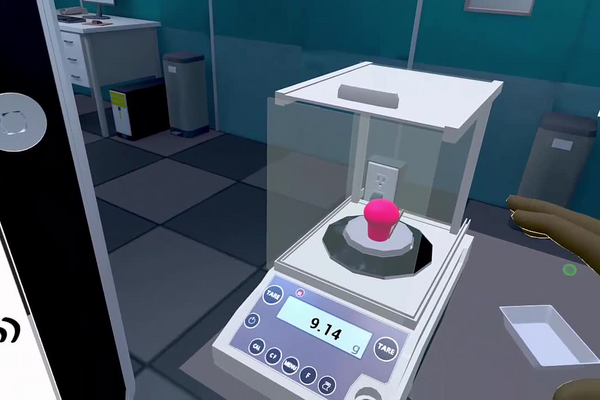
| 14 | Balloon + clamp + trapped carbon dioxide | 9.14 |
The reaction is an acid–carbonate reaction that produces carbon dioxide, water and sodium acetate:
NaHCO3(s) + CH3COOH(aq) → CH3COONa(aq) + H2O(l) + CO2(g)
Both reactants are present in comparable amounts, so the limiting reagent has to be identified before any mass of product can be predicted. For the acid, n = c × V = 1.00 mol/L × 0.0250 L = 0.0250 mol. For the bicarbonate, n = m / M = 2.20 g ÷ 84.01 g/mol = 0.0262 mol. The acetic acid runs out first, so it fixes the extent of the reaction: 0.0250 mol of CO2 is produced, with a mass of m = n × M = 0.0250 mol × 44.01 g/mol = 1.10 g. Roughly 0.0012 mol (0.10 g) of sodium bicarbonate is left unreacted at the bottom of the flask.
Step 14 isolates that gas. Subtracting the balloon and the clamp from the final weighing, 9.14 g − 7.50 g − 0.45 g = 1.19 g of gas is retained in the balloon, against the 1.10 g the stoichiometry allows. The two figures agree to within about 8 %. The important point is the comparison between 237.09 g and 237.12 g: had the same reaction been run in an open flask, about 1.10 g would have escaped and the balance would have shown a loss of roughly 0.47 % of the total — small, but far larger than the 0.03 g scatter of the sealed measurement, and easily mistaken for a violation of the law.
Part B — calcium dichloride and sodium carbonate in an open beaker
| Protocol step | What is weighed | Mass (g) | Contents alone (g) |
|---|---|---|---|
| 3 | Beaker 1 + 15 mL CaCl2 1 M | 91.25 | 16.25 |
| 6 | Beaker 2 + 15 mL Na2CO3 1 M | 91.59 | 16.59 |
| — | Sum of the two sets of contents before mixing | — | 32.84 |
| 9 | Beaker 2 after mixing, with the precipitate | 107.84 | 32.84 |
This is a double-displacement (precipitation) reaction, driven by the very low solubility of calcium carbonate:
CaCl2(aq) + Na2CO3(aq) → CaCO3(s) + 2 NaCl(aq)
Equal volumes of equal concentrations are used, so the two reactants are supplied in exactly the 1:1 ratio the equation requires: n = 1.00 mol/L × 0.0150 L = 0.0150 mol of each. Neither is in excess, and the reaction can in principle go to completion. The precipitate formed is m = n × M = 0.0150 mol × 100.09 g/mol = 1.50 g of CaCO3, leaving 0.0300 mol of NaCl (1.75 g) dissolved in the supernatant. A white cloudy suspension appears the moment the solutions meet, and settles into a fine white solid when stirring stops.
The visible change is dramatic — two clear liquids become a white slurry — and yet the balance does not move at all once the beaker is accounted for. That is exactly the point: a change of state and a change of chemical identity are not a change of mass. Dividing the contents by their volumes also gives the densities of the two stock solutions, 16.25 g ÷ 15.0 mL = 1.08 g/mL for the calcium dichloride and 16.59 g ÷ 15.0 mL = 1.11 g/mL for the sodium carbonate, both denser than pure water as expected for 1 M salt solutions.
Summary of Assignment by Grade Range
Grade 9–10
- Focus — observing that a chemical change alters appearance without altering mass, and learning the vocabulary that goes with it: reactant, product, precipitate, closed system, conservation.
- Activities — carry out both parts, record all seven Part A masses and all three Part B masses in the results table, describe what is seen at the moment of reaction (bubbling and an inflating balloon in Part A, a white cloud in Part B), and state in one sentence whether the mass changed. Answer the guided question: where would the carbon dioxide have gone without the balloon?
Grade 11
- Focus — treating the experiment quantitatively, with balanced equations and a mole-based prediction rather than a qualitative comparison.
- Activities — balance both equations; convert 25 mL of 1 M acetic acid and 2.20 g of NaHCO3 into moles and identify the limiting reagent; predict the mass of CO2 and compare it with the 1.19 g weighed in the balloon at step 14; predict the 1.50 g of CaCO3 formed in Part B; show arithmetically that 91.25 + 91.59 − 75.00 = 107.84 g and explain why one beaker mass must be subtracted.
Grade 12 / College Level
- Focus — error analysis, and interpreting a discrepancy instead of dismissing it.
- Activities — express both mass balances as percentage differences and compare them with the resolution of the balance; account for the 0.09 g by which the trapped gas exceeds its stoichiometric maximum, estimating how much water vapour a saturated gas volume at room temperature could carry; use the ideal gas law to predict the volume the balloon should reach at 101 kPa and 22 °C from n = 0.0250 mol; discuss the CO2/H2CO3/HCO3− equilibrium and how much carbon may remain in solution; and design a modification to Part A that would give a defensible gas-tight seal, explaining what it would improve.
Laboratory essentials
Instruments
- Electronic balance (readable to 0.01 g, with tare)
- Weighing boat (0.5 g)
- Spatula
- Rubber balloon (7.5 g)
- Wooden clamp (0.45 g)
- Glass rod
- 250 mL Erlenmeyer flask (200 g)
- 2 × 50 mL beakers (75 g each)
- 25 mL graduated cylinder
Products
- Sodium bicarbonate NaHCO3 (powder, 2.2 g)
- Acetic acid CH3COOH 1 M (25 mL of solution)
- Calcium dichloride CaCl2 1 M (15 mL of solution)
- Sodium carbonate Na2CO3 1 M (15 mL of solution)