

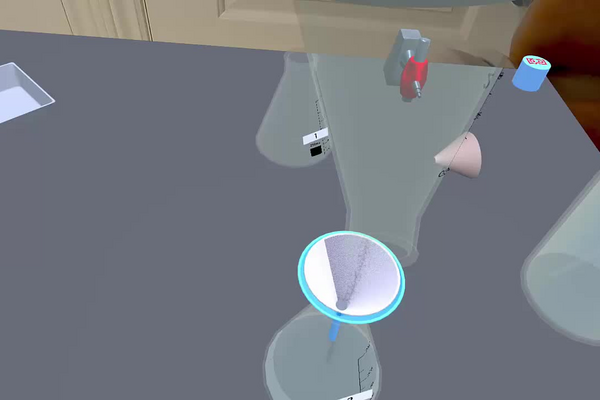
Lead and copper reach wastewater from corroding pipework, from spent plating and etching baths, and from the careless disposal of paints and solvents. Neither element is destroyed by dilution or by biological treatment, and both are toxic at low concentration — which is why municipal and industrial treatment plants remove dissolved metals chemically before water is discharged. The standard method is the one used here: add a counter-ion that forms an insoluble salt with the metal, then filter the solid out.
The chemistry rests on solubility. A salt precipitates when the product of its ion concentrations exceeds its solubility product Ksp; below that value it stays dissolved. Lead sulfate and copper carbonate are both very sparingly soluble, so adding sulfate removes lead as PbSO4 and adding carbonate removes copper as CuCO3. The order is not arbitrary. Carbonate would precipitate lead as well as copper, so if carbonate were added first the two metals would come out together and could not be separated. Sulfate, by contrast, leaves copper in solution — copper sulfate is freely soluble — so sulfate first, carbonate second, gives two clean fractions.
In this laboratory you will treat a 100 mL sample of wastewater containing both metals. You will weigh a filter paper, add sodium sulfate to the sample and watch the white lead sulfate form, filter it off and weigh the paper again to obtain the mass of the precipitate. You will then add potassium carbonate to the filtrate, precipitate the copper as blue-green copper carbonate, filter and weigh again. From the two masses you will work back to how much lead and how much copper the original sample contained, and judge how completely each was removed.
Educational Goals
Familiarization with the laboratory environment
- Locate and use the equipment of a gravimetric bench: the digital balance and weighing boat, the spatula, the graduated cylinder, the three Erlenmeyer flasks, the funnel and filter papers.
Use of protective equipment and safe handling of heavy metals
- Wear gloves and eye protection throughout, and treat every solution in this laboratory as contaminated.
- Explain why lead- and copper-bearing waste is collected for disposal rather than poured down a drain.
Selective precipitation
- Choose a precipitating agent on the basis of which metal it will and will not remove.
- Justify the order of the two additions, and predict what would go wrong if carbonate were added before sulfate.
Gravimetric filtration technique
- Assemble a funnel and filter paper, wetting the paper with distilled water so that it seals against the wall of the funnel.
- Weigh the filter paper before use and the paper-plus-precipitate afterwards, and obtain the mass of solid by difference.
Quantitative treatment of the results
- Convert a precipitate mass into moles using the molar mass of the salt.
- Use the 1:1 stoichiometry of each precipitation to obtain the moles, and then the mass, of metal that was dissolved in the original sample.
Assessing the effectiveness of a treatment
- Compare the mass of precipitate recovered against the maximum the quantity of reagent added could produce, and identify which species was limiting.
- State the sources of loss in a gravimetric determination and the direction in which each biases the result.
Protocol
Precipitation with sodium sulfate.
- Weigh a filter paper and find its mass in the results table.
- Measure 100 mL of wastewater with the graduated cylinder and pour the sample into Erlenmeyer flask 1.
- Weigh 79.8g (30 mL) of sodium sulfate.
- Deposit the sodium sulfate into the Erlenmeyer flask 1.
- Mix the contents of Erlenmeyer flask 1 and observe the precipitate that forms at the bottom of the container.
Sodium sulfate has the ability to form a precipitate with lead (PbSO4).
- Place a funnel on the Erlenmeyer flask 2.
- Place the filter paper in the funnel.
- Stick the filter paper to the wall of the funnel using a little distilled water.
- Pour the mixture from Erlenmeyer flask 1 through the filter paper placed on Erlenmeyer flask 2 to extract the precipitate.
- Let the filter paper dry for 10 seconds, then remove the filter paper + precipitate assembly and weigh it. The mass is found in the results table.
- Remove the funnel from the Erlenmeyer flask 2.
Precipitation with potassium carbonate
- Weigh 60.75g (25 mL) of potassium carbonate.
- Place the potassium carbonate in Erlenmeyer flask 2.
- Mix the contents of Erlenmeyer flask 2 and observe the precipitate that forms at the bottom of the container.
Potassium carbonate has the ability to form a precipitate with copper (CuCO3).
- Place a funnel on the Erlenmeyer flask 3.
- Place the other filter paper in the funnel.
- Stick the filter paper to the wall of the funnel using a little distilled water.
- Pour the mixture from Erlenmeyer flask 2 through the filter paper placed on Erlenmeyer flask 3 to extract the precipitate.
- Let the filter paper dry for 10 seconds, then remove the filter paper + precipitate assembly and weigh it. The mass is found in the results table.
These 2 reactions can be used to remove heavy metals from wastewater.
Anticipated Outcomes
The two precipitations. Each metal is removed by a single-step double-replacement reaction, and each has 1:1 stoichiometry between the metal ion and the salt that precipitates:
Pb2+(aq) + SO42−(aq) → PbSO4(s) — a dense white solid
Cu2+(aq) + CO32−(aq) → CuCO3(s) — a blue-green solid
Expected measurements. The figures below are those the simulation reports for a 100 mL sample.
| Step | Reagent added | Filter paper | Paper + precipitate | Mass of precipitate | Appearance |
|---|---|---|---|---|---|
| Lead, flask 1 → 2 | Na2SO4, 79.8 g (30 mL) | 0.5 g | 140.98 g | 140.48 g PbSO4 | white |
| Copper, flask 2 → 3 | K2CO3, 60.75 g (25 mL) | 0.0 g | 54.04 g | 54.04 g CuCO3 | blue-green |
From precipitate mass back to dissolved metal. The molar masses are M(PbSO4) = 303.26 g/mol and M(CuCO3) = 123.56 g/mol. For lead:
n(PbSO4) = 140.48 g ÷ 303.26 g/mol = 0.463 mol, and because one PbSO4 contains one Pb2+, n(Pb2+) = 0.463 mol as well. The mass of lead recovered is therefore 0.463 mol × 207.2 g/mol = 95.9 g, and its concentration in the 100 mL sample was 0.463 mol ÷ 0.100 L = 4.63 mol/L.
The same three steps for copper: n(CuCO3) = 54.04 g ÷ 123.56 g/mol = 0.437 mol, so n(Cu2+) = 0.437 mol, a mass of 0.437 mol × 63.55 g/mol = 27.8 g and a concentration of 4.37 mol/L. This is the whole logic of gravimetric analysis: a quantity that cannot be weighed — an ion in solution — is measured by capturing it in a solid of known composition and weighing that instead.
Which reagent was limiting. Worth checking, because it tells you whether the removal was complete. The sodium sulfate added amounts to 79.8 g ÷ 142.04 g/mol = 0.562 mol of sulfate, against 0.463 mol of lead: sulfate is in excess by about 20 %, so essentially all the lead is precipitated and the lead result is limited by the lead present, as intended. The potassium carbonate added amounts to 60.75 g ÷ 138.21 g/mol = 0.440 mol of carbonate, against 0.437 mol of copper recovered — almost exactly stoichiometric. The copper step therefore has no margin: a small shortfall in carbonate would leave copper behind, and any carbonate consumed by another reaction would show up directly as a low result.
What you should see along the way. The untreated sample is bluish, the colour of hydrated Cu2+; lead(II) in solution is colourless and contributes nothing. Precipitating the lead therefore leaves the filtrate still blue — the colour is not the lead. Only after the carbonate step, when the copper has been taken out as a solid, does the water run clear. That progression is itself the qualitative evidence that the second treatment did what the first could not.
Why the order matters, stated numerically. Lead carbonate is even less soluble than lead sulfate, so carbonate added to the original sample would drop both metals out together and the two masses could never be separated. Adding sulfate first exploits the one difference that matters here: PbSO4 is sparingly soluble while CuSO4 is very soluble, so the sulfate step is selective for lead. This is the principle behind every selective-precipitation scheme in analytical chemistry — find a reagent whose solubility products differ enough between the two ions to separate them.
Summary of Assignment by Grade Range
Grade 9–10
- Focus: precipitation as a way of removing a dissolved substance, and weighing by difference.
- Activities: weigh each filter paper before use; carry out both precipitations and describe the colour and appearance of each solid; filter and weigh, and obtain each precipitate mass by subtraction; describe how the colour of the water changes at each stage and say what it indicates.
Grade 11
- Focus: the quantitative link between a weighed solid and a dissolved ion.
- Activities: write and balance both precipitation equations, in molecular and net ionic form; convert each precipitate mass to moles and then to the mass and concentration of the metal in the original sample; determine which reagent was in excess in each step; explain why sodium sulfate must be added before potassium carbonate.
Grade 12 / College Level
- Focus: selective precipitation, solubility equilibria and error analysis.
- Activities: express each precipitation in terms of Ksp and calculate the residual metal concentration left in solution once precipitation is complete; explain quantitatively why carbonate cannot be used to separate lead from copper; discuss the consequence of the copper step being almost exactly stoichiometric, and specify how much carbonate you would add to guarantee complete removal; compare the concentrations obtained here with regulatory limits for lead and copper in discharged water and comment on the difference in scale.
Laboratory essentials
Instruments
- Digital balance
- Weighing boat
- Spatula
- Glass rod
- Funnel
- Filter papers ×2
- Erlenmeyer flasks 250 mL ×3
- Graduated cylinder (100 mL)
- Wash bottle of distilled water
- Gloves and eye protection
Products
- Wastewater containing Pb2+ and Cu2+ (100 mL sample)
- Sodium sulfate, Na2SO4 (powder, 79.8 g / 30 mL used)
- Potassium carbonate, K2CO3 (powder, 60.75 g / 25 mL used)
- Distilled water