
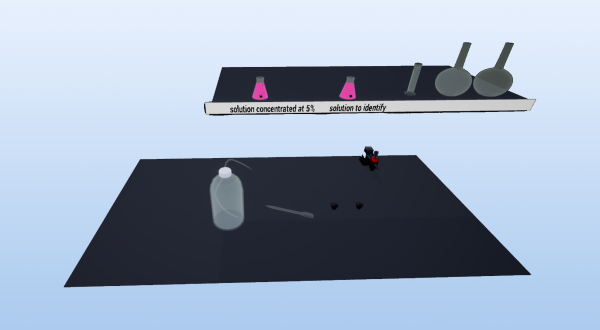
El laboratori "Dilucions" introdueix els estudiants als conceptes essencials de dilució, concentració i preparació de solucions. Els estudiants prepararan dues solucions estàndard (0,51 TP3T V/V i 0,11 TP3T V/V) a partir d'una solució mare 51 TP3T V/V, utilitzant mesures precises i tècniques de laboratori adequades. Aquesta activitat posa èmfasi en la precisió, el raonament lògic i les habilitats analítiques, ja que els estudiants comparen les solucions que han preparat amb una mostra desconeguda. Seguint les pràctiques de dilució estàndard de la indústria, els estudiants adquireixen una visió de les aplicacions reals del control de concentració en l'atenció sanitària, els productes de neteja i la ciència de laboratori. Aquesta experiència pràctica millora la seva comprensió de la química, la precisió de la mesura i els procediments de control de qualitat.
Objectius
- Prepareu solucions de concentracions conegudes mitjançant dilució: Els estudiants prepararan dues solucions de concentracions conegudes (0,51 TP3T V/V i 0,11 TP3T V/V) a partir d'una solució mare de 51 TP3T V/V, utilitzant les tècniques de dilució adequades.
- Aplica el concepte de dilució utilitzant la fórmula C1V1 = C2V2: Els estudiants calcularan el volum requerit de la solució mare per preparar les dues concentracions objectiu utilitzant la fórmula de dilució.
- Mesura i transfereix volums de líquid amb precisió: Els estudiants mesuraran volums precisos de líquid utilitzant un cilindre graduat de 10 ml i els transferiran a un matràs aforat de 100 ml.
- Manipular correctament el material i els instruments de laboratori: Els estudiants utilitzaran matrassos de volum, cilindres graduats i comptagotes per garantir la precisió i evitar la contaminació creuada durant la preparació de solucions.
- Observeu i compareu les diferències visuals en la intensitat del color: Els estudiants compararan l'aparença visual de la solució desconeguda amb les solucions preparades per identificar-ne la concentració.
- Seguiu els procediments estàndard de laboratori i els protocols de seguretat: Els estudiants portaran equipament de protecció (guants, ulleres de seguretat i davantals) i manipulareu tots els materials de manera segura i higiènica.
- Desenvolupar el pensament crític i el raonament analític: Els estudiants utilitzaran el raonament lògic per avaluar quina solució preparada s'assembla més a la solució desconeguda i trauran conclusions sobre la seva concentració.
- Registrar, analitzar i informar dades experimentals: Els estudiants documentaran els seus procediments, observacions i conclusions en un informe de laboratori formal, incloent taules de dades i anàlisi comparativa de colors.
- Reflexiona sobre les fonts d'error i proposa millores: Els estudiants identificaran possibles errors (p. ex., inexactituds en la mesura del volum) i suggeriran estratègies per millorar la precisió de futures proves.
- Comprendre l'aplicació real de la dilució a la indústria i la sanitat: Els estudiants comprendran com s'utilitza la dilució per preparar desinfectants, agents de neteja i solucions mèdiques a concentracions específiques per a aplicacions pràctiques en la salut i la indústria.
Objectius educatius
- Desenvolupar habilitats de laboratori i precisió: Els estudiants aprendran a mesurar amb precisió, diluir i transferir líquids utilitzant eines de laboratori com ara cilindres graduats i erlenmeyers.
- Promoure la comprensió conceptual de la dilució i la concentració: Els estudiants aprofundiran en la comprensió dels conceptes de volum, concentració i dilució. També aprendran com la concentració afecta el color i l'eficàcia dels agents de neteja.
- Aplicar raonament matemàtic en contextos científics: Els estudiants utilitzaran la fórmula de dilució C1V1 = C2V2 per calcular el volum de la solució mare necessari per preparar solucions de les concentracions desitjades.
- Enfortir les habilitats d'observació, anàlisi i comparació: Els estudiants milloraran la seva capacitat d'observar diferències subtils de color en solucions preparades i les compararan amb una solució desconeguda per identificar-ne la concentració.
- Potenciar la indagació científica i el pensament crític: Els estudiants faran prediccions sobre la concentració de la solució desconeguda, analitzaran els resultats experimentals i extreuran conclusions lògiques per donar suport o refutar les seves hipòtesis.
- Fomenta pràctiques de laboratori segures: Els estudiants seguiran els protocols estàndard de seguretat de laboratori, incloent-hi l'ús adequat de l'equip de protecció personal (EPP) i la manipulació de reactius químics.
- Reforçar la importància de l'exactitud i la precisió: Els estudiants reconeixeran l'impacte dels errors de mesura en els resultats experimentals i aprendran estratègies per millorar la precisió en les mesures de volum i les dilucions.
- Promoure el treball en equip i l'aprenentatge col·laboratiu: Els estudiants treballaran en equips per preparar solucions, mesurar volums de líquids i comparar observacions visuals, fomentant les habilitats de col·laboració i comunicació.
- Prepara els estudiants per a aplicacions del món real: Mitjançant la simulació de tasques utilitzades a les indústries industrial, sanitària i de neteja, els estudiants veuran la importància pràctica de la dilució en aplicacions quotidianes com la preparació de desinfectants i solucions mèdiques.
- Donar suport a les habilitats de comunicació i redacció científica: Els estudiants aprendran a crear informes de laboratori ben estructurats que incloguin la seva metodologia, observacions i conclusions, preparant-los per a futurs estudis en ciències i recerca.
Aquests objectius i fites educatives s'alineen amb els resultats d'aprenentatge pràctics, analítics i conceptuals associats a la dilució i la concentració, assegurant que els estudiants adquireixin habilitats de laboratori essencials i capacitats de pensament crític que puguin aplicar-se en entorns acadèmics, industrials i sanitaris.
Protocol
Preparació de la solució A
Volem identificar la concentració de la solució desconeguda.
Per tant, prepararem 2 solucions de diferents concentracions i les compararem amb la solució desconeguda.
- Mesura 10 mL de la solució concentrada 5% V/V amb el cilindre graduat de 10 mL.
- Aboca la solució en un matràs aforat de 100 mL.
- Afegiu aigua destil·lada al matràs aforat fins que arribi exactament a 100 ml. Si cal, utilitzeu el compte-gotes.
- Poseu el tap al matràs aforat.
- Barreja suaument.
- Compareu la solució preparada amb la solució desconeguda.
- Esbandiu el cilindre graduat.
Preparació de la solució B
- Mesura 2 mL de la solució concentrada 5% V/V amb el cilindre graduat de 10 mL.
- Aboca la dissolució a l'altre matràs aforat de 100 mL.
- Afegiu aigua destil·lada al matràs aforat fins a arribar exactament als 100 mL. Si cal, utilitzeu el comptagotes.
- Poseu el tap al matràs aforat.
- Barreja suaument.
- Compareu la solució preparada amb la solució desconeguda.
Determineu la concentració de la solució desconeguda després de la comparació amb les solucions A i B.
Resultats previstos
El laboratori “Dilucions” proporciona als estudiants habilitats essencials en dilucions, anàlisi de concentracions i l'ús d'equips volumètrics. Aquesta activitat emfatitza les tècniques pràctiques de laboratori, el pensament crític i l'aplicació real de la química en la indústria sanitària, de neteja i de control de qualitat. Els resultats esperats per a aquesta activitat de laboratori són els següents:
- Dominar les Tècniques de Preparació de Solucions
- RESULTAT ESPERATEls estudiants prepararan amb precisió dues solucions de concentracions específiques (0,51 TP3T V/V i 0,11 TP3T V/V) a partir d'una solució mare de 51 TP3T V/V de concentrat de suc.
- Detalls:
- Els estudiants mesuraran 10 ml de la solució 5% V/V per preparar 100 ml de 0.5% V/V (Solució A), que correspon a 0,00344 mol o 0,6198 g de concentrat de suc (ja que 5 ml de concentrat pesen 6,2 g, i 10 ml equivalen a 0.5 ml de suc pur).
- Per a la Solució B, els estudiants mesuraran 2 ml de la solució 5% V/V per preparar 100 ml de 0.1% V/V, que correspon a 0,000688 mol o 0,124 g de suc concentrat, equivalent a 0,1 ml de suc pur.
- Els estudiants utilitzaran equips volumètrics, com ara cilindres graduats, matrassos aforats i comptagotes, per garantir ajustos de volum precisos.
- Aplicació de la fórmula de dilució C1V1 = C2V2
- RESULTAT ESPERATEls estudiants calcularan correctament la quantitat de solució mare necessari per preparar dues concentracions conegudes utilitzant la fórmula de dilució.
- Detalls:
- Els estudiants aplicaran la fórmula de dilució (C1V1 = C2V2) per determinar el volum (V1) de la solució mare 5% V/V necessari per preparar 100 mL de solucions 0.5% i 0.1%.
- Per Solució A (0,51 TP3T V/V): V1=(0.5% V/V)×(100 mL)5% V/V=10 mL
- Per Solució B (0,11 TP3T V/V): V1=(0.1% V/V)×(100 mL)5% V/V=2 mL
- Aquests càlculs ajuden els estudiants a connectar el raonament matemàtic amb la resolució de problemes del món real, especialment en entorns industrials i sanitaris on la dilució és essencial.
- Càlcul Precís de Concentracions Molars
- RESULTAT ESPERATEls estudiants calcularan i comprendran les concentracions molars de les solucions preparades.
- Detalls:
- Per a la solució 5% V/V: 6,2 g/5 mL = 1,24 g/mL
- Utilitzant la massa molar del concentrat de suc (sucre) com a 180.16 g/mol, the molarity is: Molarity=6.2 g180.16 g/mol=0.0344 mol/100 mL
- Per Solució A (0,51 TP3T V/V), with 0.5 mL of pure juice in 100 mL: Molarity=0.6198 g180.16 g/mol=0.00344 mol
- Per Solució B (0,11 TP3T V/V), with 0.1 mL of pure juice in 100 mL: Molarity=0.124 g180.16 g/mol=0.000688 mol Molarity=0.000688 mol100 mL=0.00688 M
- Critical Thinking and Analytical Reasoning
- RESULTAT ESPERAT: Students will analyze their observations, draw logical conclusions, and determine which reference solution (A or B) best matches the unknown sample.
- Detalls:
- Students will identify the concentration of the unknown solution based on its color similarity to Solution A (0.5% V/V) or Solution B (0.1% V/V).
- Using their prior knowledge of concentration effects on color intensity, students will correctly identify that the mystery solution is 0.5% V/V since it most closely matches the color of Solution A.
- Mastery of Volumetric Equipment Use
- RESULTAT ESPERAT: Students will demonstrate the correct use of laboratory equipment, such as graduated cylinders, volumetric flasks, and droppers, to ensure precise measurements.
- Detalls:
- Students will practice measuring precise volumes using graduated cylinders and transferring them into volumetric flasks.
- They will use droppers to ensure the final volume in the flask reaches exactly 100 mL, a crucial step for ensuring the accuracy of the solution’s concentration.
- Proper cleaning and rinsing of instruments, such as the graduated cylinder, will prevent cross-contamination between solutions.
- Accurate Data Collection and Reporting
- RESULTAT ESPERAT: Students will record their observations, measurements, and conclusions in a laboratory report.
- Detalls:
- Students will document the measurements used to prepare the two solutions and include step-by-step details of the dilution process.
- They will create a table comparing the color of Solution A, Solution B, and the unknown solution.
- Students will analyze the color differences, state their conclusions, and explain the logic behind their identification of the unknown solution’s concentration.
- Identification of Potential Sources of Error
- RESULTAT ESPERAT: Students will reflect on potential sources of error and suggest improvements to their methods.
- Detalls:
- Students will identify sources of error such as improper volume measurement, incorrect use of droppers, or difficulty seeing the meniscus when filling the volumetric flask.
- They will recognize the human error involved in visually comparing the colors of the solutions and suggest methods for reducing these errors, such as using a colorimeter for more precise measurements.
- Understanding of Real-World Applications
- RESULTAT ESPERAT: Students will connect their laboratory experience to real-world applications, such as the preparation of disinfectants, cleaning agents, and medical solutions.
- Detalls:
- Students will understand how accurate dilutions are essential in healthcare, cleaning, and food processing industries.
- By preparing cleaning solutions in the lab, students will appreciate how dilution is used to create solutions for practical applications in industry, healthcare, and food safety.
- Adherence to Laboratory Safety Protocols
- RESULTAT ESPERAT: Students will follow proper laboratory safety procedures and avoid common hazards during solution preparation.
- Detalls:
- Students will wear gloves, safety goggles, and protective aprons to prevent exposure to cleaning solutions and concentrated liquids.
- They will follow standard safety protocols for handling laboratory glassware, such as volumetric flasks and graduated cylinders, to prevent spills and glass breakage.
The “Dilutions” laboratory provides a well-rounded learning experience that builds on students’ understanding of dilution, concentration, and quantitative reasoning. Students will master laboratory skills such as handling volumetric equipment, applying the dilution formula, and preparing solutions with precision. They will engage in scientific inquiry, critical thinking, and data analysis while making real-world connections to the preparation of cleaning agents and disinfectants. This experience lays the foundation for advanced study in chemistry, biology, healthcare, and industrial applications of chemical solutions. Students will successfully identify the unknown solution as a 0.5% V/V concentration, reinforcing the principles of dilution and solution preparation.
Resum de tasques per rang de qualificació
Cursos 3-5 (Edats 8-10)
Enfocament
- Introduction to basic scientific principles through simple observations and guided hands-on activities.
- Exposure to safety practices, laboratory tools, and simple experimental procedures.
Activitats:
- Simple Measurements: Students will be introduced to the use of basic measurement tools such as beakers, droppers, and graduated cylinders to observe and measure liquids and solids.
- Observation Skills: Students will engage in activities that promote careful observation of simple phenomena, such as the change of state (solid to liquid) and color changes resulting from chemical reactions.
- Basic Microscopy: Students will learn how to view simple plant and animal cells under the microscope, with guidance on how to recognize large, visible structures like the cell wall and chloroplasts.
- Safety Practices: Students will learn to recognize essential safety equipment, like goggles and gloves, and follow simple rules for handling instruments and chemicals safely.
- Hands-on Exploration: Activities include seed germination, water displacement to understand volume, and simple solution preparation (e.g., sugar and water solutions).
Resultats esperats:
- Development of fundamental observation skills and early exposure to scientific inquiry.
- Ability to recognize laboratory tools and understand their basic functions.
- Recognition of the importance of safety in scientific activities.
- Curiosity and enthusiasm for exploring natural phenomena.
Cursos 6è-8è (Edats 11-13 anys)
Enfocament
- Introduction to intermediate concepts of scientific inquiry, experimentation, and analysis.
- Building familiarity with laboratory equipment, scientific method, and data collection.
Activitats:
- Intermediate Measurements: Students will work with instruments like balances, thermometers, and pH meters to measure mass, temperature, and acidity. They will record measurements and analyze the data.
- Solution Preparation: Students will prepare solutions of known concentrations (e.g., 25 g/L sugar solution) and learn techniques for accurate measurement and dissolution of solids in liquids.
- Microscopy Practice: Students will observe stained plant and animal cells under the microscope, focusing on cell components such as the nucleus, cell membrane, and chloroplasts.
- Scientific Method: Students will follow protocols to test hypotheses, make observations, collect data, and draw conclusions. Activities may include water displacement to determine density and identification of unknown substances through boiling points and solubility tests.
- Chemical Reactions: Students will participate in hands-on experiments demonstrating key concepts such as solubility, phase changes, and the impact of temperature on reaction rates.
- Lab Safety and Procedures: Emphasis on safe handling of glassware, chemicals, and other laboratory equipment. Students are trained in proper cleaning, equipment maintenance, and waste disposal.
Resultats esperats:
- Mastery of essential laboratory techniques, such as measurement, solution preparation, and microscopy.
- Ability to use scientific reasoning to analyze experimental outcomes and draw evidence-based conclusions.
- Deeper understanding of concepts like solubility, density, and phase changes.
- Awareness of the importance of accurate data collection and meticulous observation.
Cursos 9-12 (Edats 14-18)
Enfocament
- Advanced mastery of scientific inquiry, complex laboratory techniques, and critical thinking.
- Emphasis on independence in planning and conducting experiments, as well as technical proficiency in laboratory skills.
Activitats:
- Advanced Measurements and Data Analysis: Students will learn to use precision instruments such as burettes, analytical balances, and electronic thermometers to measure volume, mass, and temperature with accuracy. They will use statistical analysis to evaluate results.
- Solution Preparation and Titration: Students will prepare solutions with specific molarities (e.g., 0.1M HCl) and perform titrations to analyze the concentration of unknown solutions. They will calculate molar masses and stoichiometric ratios.
- Microscopic Analysis: Students will use compound microscopes to study plant and animal cells in greater detail. They will identify specific cell organelles, such as mitochondria and the nucleus, and analyze cellular structures in stained and unstained samples.
- Investigation of Reaction Rates and Chemical Kinetics: Students will measure the rate of reaction of various solutions under different conditions, such as changes in temperature, concentration, and catalysts.
- Chemical Synthesis and Identification: Advanced activities involve synthesis of new compounds, analysis of unknown samples, and identification of gases using tests like the flame test, limewater test, and splint test.
- Independent Research Projects: Students will be encouraged to conduct independent experiments on topics of interest, following the scientific method from hypothesis formation to result analysis.
- Use of Advanced Equipment: Use of advanced scientific tools, such as spectrophotometers, magnetic stirrers, and hot plates for precise temperature control. Students will also master the use of data loggers for real-time data collection.
- Scientific Writing and Reporting: Students will prepare formal lab reports, including abstract, hypothesis, materials, procedure, results, and conclusion. Emphasis will be placed on clear communication of scientific findings and the ability to defend conclusions using evidence.
Resultats esperats:
- Mastery of advanced laboratory techniques and independent problem-solving skills.
- Deep understanding of chemistry, biology, and physics concepts, such as reaction rates, equilibrium, and energy changes.
- Ability to design, conduct, and analyze independent investigations.
- Ability to critically evaluate experimental procedures, identify errors, and suggest improvements.
- Proficiency in creating formal scientific reports with proper data analysis, conclusions, and use of scientific terminology.
Summary This summary outlines how the laboratory assignments and experiences are adapted to different grade ranges. Younger students (Grades 3-5) engage in exploratory activities that focus on basic observation and curiosity-driven discovery. Middle school students (Grades 6-8) are introduced to more structured activities that emphasize measurement, experimentation, and the use of the scientific method. By high school (Grades 9-12), students master advanced scientific concepts, develop technical proficiency with laboratory tools, and conduct independent investigations. Through this progression, students develop critical thinking, technical skills, and an appreciation for the role of science in understanding the natural world.
Equipament de laboratori
Instruments
- Gotejador
- 2x Gaugeated flasks 100mL
- Cilindre graduat 100mL
Productes
- Concentrated solution 5%
- Unknown solution