

Two substances, one acid, one calorimeter, and a question a single experiment cannot answer: how much energy is released when magnesium burns in oxygen? Magnesium burns far too fiercely, and far too brightly, to be measured directly in a school calorimeter, and the reaction cannot be persuaded to happen slowly in a beaker of water. The way round the problem is the standard trick of thermochemistry — measure two reactions that can be done safely, then combine them arithmetically to reach the one that cannot. That is Hess’s law: because enthalpy is a state function, the energy change between two states does not depend on the route taken between them, so a reaction that is impossible to measure can be assembled out of reactions that are easy.
The two easy reactions are the ones done here. Magnesium metal dissolves in hydrochloric acid, giving hydrogen and a magnesium chloride solution; magnesium oxide dissolves in the same acid, giving the same solution and water instead of hydrogen. Both are exothermic, both go to completion in a few minutes, and both are safe in a closed vessel with dilute acid. Subtracting one from the other, and adding the known enthalpy of formation of liquid water, leaves exactly the combustion of magnesium. In this laboratory you will run both reactions in turn in the same calorimeter with 100 mL of 1 mol/L hydrochloric acid, record the temperature before and after each, and follow both on the same temperature-against-time graph — which also makes the second point of the laboratory visible, that two reactions between the same elements can release very different amounts of energy at very different rates.
Educational Goals
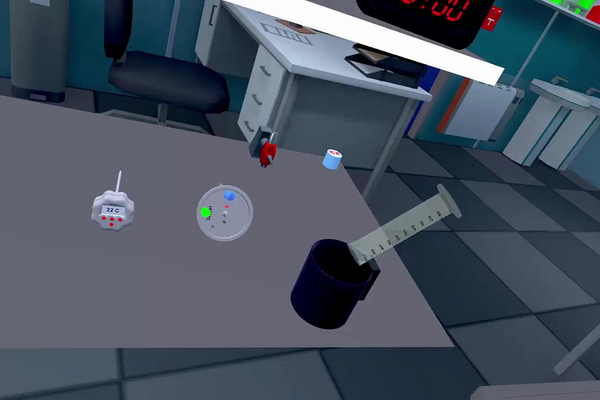
Familiarization with the calorimetry bench
- Identify the calorimeter, its lid with the stirrer and thermometer ports, the balance, the graduated cylinder and the tablet, and state what each contributes to one determination.
- Recognise that the same apparatus is used twice, so that any imperfection of the vessel affects both runs equally and largely cancels when the two are subtracted.
Running a repeated measurement cleanly
- Empty, rinse and cool the calorimeter between runs, and explain why each of those three steps is necessary before the second reaction can be started.
- Confirm that the second run begins from the same starting temperature as the first, rather than assuming it.
Two reactions of the same metal
- Write and balance both equations, Mg(s) + 2 HCl(aq) → MgCl2(aq) + H2(g) and MgO(s) + 2 HCl(aq) → MgCl2(aq) + H2O(l), and identify what is the same and what is different about the products.
- Explain why only the first produces a gas, and what that means for handling a closed calorimeter.
Calorimetric measurement
- Apply q = mcΔT to each run and divide by the amount of the limiting reagent to obtain two molar enthalpies.
- Show by calculation that the acid is in excess in both runs, so that the metal and the oxide are what limit each reaction.
Hess’s law
- State Hess’s law and set out the cycle that links the two measured reactions and the formation of water to the formation of magnesium oxide.
- Combine the three enthalpies with the correct signs to obtain a value for a reaction that was never carried out.
Comparing rates as well as energies
- Read two curves on one set of axes and compare both the height reached and the steepness of the climb.
- Explain why the more exothermic reaction is also the faster one here, and identify the factors — particle size, solubility, mechanism — that make that so.
Critical evaluation of the result
- Compare the value obtained with the published enthalpy of formation of magnesium oxide and express the difference as a percentage.
- Identify which of the two runs contributes most of the error, and say what would have to change to reduce it.
Protocol
- Measure 100 mL of hydrochloric acid (HCl) 1 M using the graduated cylinder.
- Pour the contents of the graduated cylinder into the calorimeter.
- Put the lid on the calorimeter.
- Insert the thermometer into the lid hole.
- Weigh a small piece of magnesium (Mg) ribbon (approximately 0.5 g) using the balance.
- Open the lid and place the piece of magnesium in the calorimeter and close it again as quickly as possible.
- Activate the timer.
- Activate the calorimeter stirrer by pressing the green button on the lid.
- Observe attentively the evolution of the temperature in the results table.
- Wait about 3 minutes or until the temperature no longer increases.
- Stop the stopwatch.
- Reset the timer by pressing the Reset button.
- Stop the agitator by pressing the red button. Remove the thermometer then remove the calorimeter lid.
- Pour the liquid contents of the calorimeter into the black waste container. Remove the piece of magnesium ribbon using the tongs.
- Rinse the calorimeter, the thermometer, and the stirrer with distilled water.
- Let the calorimeter cool for about 30 seconds.
- Repeat steps 1 to 11 with approximately 1 g of magnesium oxide in pieces.
The reaction is accelerated 10 times faster, to more easily observe the complete reaction.
Anticipated Outcomes
Both runs warm the acid, and both level off within about three minutes, but they are not alike: the magnesium ribbon fizzes vigorously as hydrogen comes off and drives the temperature up sharply, while the magnesium oxide dissolves quietly with no gas at all and produces a smaller, gentler rise. On the tablet’s graph the two appear together, the metal as the upper curve and the oxide as the lower one. These are the readings taken from the simulation’s own thermometer during the reference run:
| Run | Solid added | Initial T | Final T | ΔT | Gas evolved |
|---|---|---|---|---|---|
| Part 1 | Magnesium ribbon, about 0.5 g | 22 °C | 37 °C | 15 °C | Hydrogen, vigorous |
| Part 2 | Magnesium oxide, about 1 g | 22 °C | 27 °C | 5 °C | None |
Both reactions have the acid in excess, so the solid is what limits them. 100 mL of 1 mol/L acid is 0.100 mol of HCl. Part 1 uses 0.5 / 24.305 = 2.06 × 10⁻² mol of magnesium, which consumes 4.1 × 10⁻² mol of acid; Part 2 uses 1.00 / 40.30 = 2.48 × 10⁻² mol of magnesium oxide, which consumes 5.0 × 10⁻² mol. Both leave more than half the acid unreacted, which is the right way to design the experiment: it guarantees that every particle of solid dissolves and that the heat measured corresponds to a known amount of substance.
Turning each temperature rise into a molar enthalpy. Taking 100 mL of dilute acid as 100 g of liquid with the specific heat capacity of water, 4.18 J g−1 °C−1:
| Step | Part 1 — magnesium | Part 2 — magnesium oxide |
|---|---|---|
| Amount of solid, n = m/M | 0.5 / 24.305 = 2.06 × 10⁻² mol | 1.00 / 40.30 = 2.48 × 10⁻² mol |
| Heat released, q = mcΔT | 100 × 4.18 × 15 = 6.27 kJ | 100 × 4.18 × 5 = 2.09 kJ |
| Molar enthalpy, ΔH = −q/n | −305 kJ/mol | −84 kJ/mol |
| Value the page was written around | −440 kJ/mol | −150 kJ/mol |
| Published value | −466.9 kJ/mol | −151.1 kJ/mol |
Hess’s law, which is what the two runs are for. Write the two measured reactions and the formation of water: (1) Mg(s) + 2 H+(aq) → Mg2+(aq) + H2(g), ΔH1; (2) MgO(s) + 2 H+(aq) → Mg2+(aq) + H2O(l), ΔH2; (3) H2(g) + ½ O2(g) → H2O(l), ΔH3 = −285.8 kJ/mol. Reversing (2) and adding it to (1) and (3) cancels the magnesium ion, the protons, the water and the hydrogen, and leaves Mg(s) + ½ O2(g) → MgO(s). Therefore ΔHf(MgO) = ΔH1 − ΔH2 + ΔH3. With the published enthalpies that is −466.9 − (−151.1) + (−285.8) = −601.6 kJ/mol, which is precisely the tabulated enthalpy of formation of magnesium oxide — the cycle closes exactly, and that is the result the laboratory exists to reproduce.
Why the metal beats the oxide by so much. Both reactions end with the same aqueous magnesium ion, so the difference between them is entirely a difference in the starting materials. In magnesium oxide the magnesium has already been oxidised: its electrons are already given up, the lattice energy of MgO (about −3795 kJ/mol) has already been paid out, and dissolving it in acid does little more than exchange the oxide ion for two water molecules. In magnesium metal the two valence electrons are still there to be lost, and losing them to the protons of the acid is where the energy comes from. The oxide reaction is an acid–base neutralisation; the metal reaction is a redox reaction. That is the single sentence a student should take away, and it is why the difference is a factor of three rather than a few per cent.
The rates differ too, and for separate reasons. The metal curve climbs more steeply and reaches its plateau sooner. Three things contribute: the metal reaction is more exothermic per mole, so it heats its own surroundings faster and the Arrhenius factor works in its favour; hydrogen bubbles form on the ribbon and stir the liquid at the surface where it matters, continually exposing fresh metal; and the oxide is added “in pieces”, so it presents less surface per gram than a thin ribbon does. Note that the last of these is an experimental choice, not a property of the substances — ground magnesium oxide would react faster than lumps, exactly as laboratories 061 and 062 demonstrate for other solids — so a student should not conclude that the oxide is intrinsically the slower reagent.
Summary of Assignment by Grade Range
Grade 9–10
Focus: Comparing two exothermic reactions of the same element.
Activities: Record the initial and final temperature for each run and state the two rises. Describe the two reactions in words, noting that one produces a gas and the other does not, and say how you could tell them apart with your eyes closed. Write both balanced equations. Read the two curves on the tablet’s graph and say which reaction released more energy and which one finished sooner. Explain why the calorimeter has to be emptied, rinsed and cooled before the second run, and what would go wrong if it were not.
Grade 11
Focus: Quantitative calorimetry of two reactions and the reason they differ.
Activities: Calculate the amount of magnesium and of magnesium oxide, and show by comparison with the 0.100 mol of acid available that the solid is limiting in both runs. Apply q = mcΔT to each run with the substitution written out, then obtain both molar enthalpies. Explain in terms of oxidation states why the metal releases about three times as much energy per mole as the oxide, and identify one reaction as redox and the other as neutralisation. Calculate the volume of hydrogen produced in Part 1 and comment on doing that inside a closed calorimeter.
Grade 12 / College Level
Focus: Hess’s law, error propagation and the credibility of a derived result.
Activities: Set out the three-step cycle explicitly, with each equation reversed or retained as required, and show which species cancel. Combine the enthalpies to obtain the enthalpy of formation of magnesium oxide, first from the measured values and then from the published ones, and compare both with the tabulated −601.6 kJ/mol. Design the calibration that would give the calorimeter’s heat capacity. Finally, explain why this cycle is the standard way of obtaining an enthalpy of combustion that cannot be measured directly, and name one other quantity obtained the same way.
Laboratory essentials
Instruments
- Calorimeter with insulating lid, thermometer port and built-in stirrer (green button to start, red to stop)
- Thermometer, inserted through the lid (displays whole degrees Celsius)
- Electronic balance
- Graduated cylinder, 100 mL, for measuring the acid
- Timer, with a Reset button, used once for each run
- Tongs, for lifting the unreacted ribbon out of the calorimeter
- Spatula
- Beaker (1000 mL) and black recovery bin, for the spent acid and the rinsings
- Wash bottle of distilled water, for rinsing the calorimeter, thermometer and stirrer between runs
- Tablet, for the protocol, the results table and the temperature-against-time graph
Products
- HCl 1 mol/L (solution), 100 mL for each of the two runs
- Magnesium (ribbon), about 0.5 g
- Magnesium oxide (in pieces), about 1 g
- Distilled water, for rinsing