

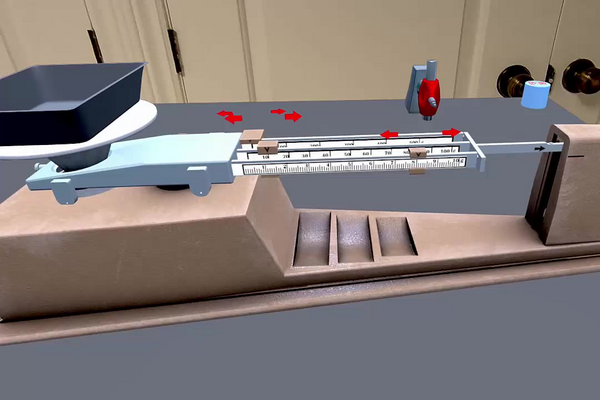
The triple beam balance is one of the oldest instruments still in everyday laboratory use, and one of the most reliable: it compares the unknown mass on its pan against sliding standard masses on three graduated beams, using nothing but the lever principle. Because it compares masses rather than measuring a force, its reading does not depend on the strength of gravity and it needs no batteries and no calibration curve — only a clean pan and a properly zeroed pointer. Weighing is the single most common operation in experimental science, and nearly every quantitative laboratory in this catalogue begins with it. In this tutorial, you will learn the complete weighing routine on a triple beam balance: zeroing and calibrating the instrument, weighing a solid in whole pieces (magnesium ribbons) and a solid in powder form (magnesium oxide), and obtaining the mass of each substance by subtraction — weighing the empty boat first, so that the container’s mass drops out of the result.
Educational Goals
Operation of the triple beam balance
- Zero and calibrate the balance before use, and work the three riders in the correct order — largest beam first, smallest last — to bring the pointer to the zero mark.
- Read the mass as the sum of the three beam positions.
Weighing technique
- Weigh solids in whole pieces and in powder form using a weighing boat, handling samples with tweezers and a spatula rather than fingers.
- Obtain the mass of a substance by subtraction: (boat + substance) − (empty boat), so the container’s mass cancels out of the result.
Understanding precision
- Recognise why a mass measured precisely and reproducibly is the foundation of every quantitative result built on it.
Laboratory habits
- Leave the station ready for the next user: samples discarded in the waste bin, the boat returned, and all riders back at zero.
Protocol
Basic Principles
1. Before weighing, make sure all the balance riders are at zero and the pan is clean.
2. Check that the black pointer on the right of the balance rests on the zero mark (the small horizontal black line). If it does not, calibrate the balance with the small adjustment screw on the left, underneath the pan.
3. Place the object to be weighed on the balance pan.
4. Move the rider on the largest beam (using the small red arrows) forward until the black pointer drops below the zero mark, then step it back one notch so the pointer rises above zero. Repeat with the middle beam, then slide the rider on the smallest beam until the pointer is perfectly aligned with the zero mark.
5. Add the masses shown on the three beams to obtain the mass of the object.
Measure the mass of a whole solid
1. Adjust the balance level using the adjustment screw.
2. Weigh the empty weighing boat on the balance.
3. Using the tweezers, place all the magnesium ribbons in the weighing boat on the pan.
4. Weigh the boat and the ribbons.
5. Calculate the mass of the substance as follows: (mass of the boat and ribbons) – (mass of the empty boat).
6. Discard the magnesium ribbons in the black waste bin and return the empty boat to the counter.
Measure the mass of a powdered solid
1. Take 5 mL of magnesium oxide powder with the large spatula and place it in the weighing boat.
2. Weigh the boat and the magnesium oxide powder.
3. Calculate the mass of the substance as follows: (mass of the boat and powder) – (mass of the empty boat).
4. Discard the magnesium oxide powder in the black waste bin and return the empty boat to the counter.
5. Return all the balance riders to zero.
Anticipated Outcomes
This tutorial demonstrates skills rather than testing a hypothesis: at the end of it the student can zero a balance, work the riders in the correct order, and weigh by subtraction so that the boat’s mass cancels. The two exercises have definite expected readings. The substances are Mg(s) in ribbons and MgO(s) in powder. One magnesium ribbon weighs 0.55 g, and there are five ribbons in the container, so the weighed set should come to 2.75 g after the empty boat’s mass is subtracted. The magnesium oxide powder is stated at a density of 3.58 g/mL, so the 5 mL portion taken with the large spatula should weigh 17.9 g by the same subtraction. Getting these two numbers, and being able to say why the boat’s own mass appears nowhere in them, is the whole point of the exercise.
Summary of Assignment by Grade Range
Grade 9–10
Focus: correct technique. Students zero and calibrate the balance, weigh the ribbons and the powder following the protocol, and obtain both masses by subtraction. Success is procedural: the riders worked in the right order, the pointer settled on zero, the reading recorded as the sum of the three beams, and the station left clean with the riders returned to zero.
Grade 11
Focus: reading and recording with precision. Students record each mass to the finest graduation the smallest beam supports, carry the correct number of significant figures through the subtraction, and verify the ribbon result against the stated 0.55 g per ribbon. They can explain why the subtraction method requires two readings.
Grade 12 / College Level
Focus: the instrument itself. Students explain why a beam balance measures mass rather than weight — both sides of the comparison feel the same gravity, so g cancels — and why its reading would be identical on the Moon where a spring scale’s would not. They argue why weighing by subtraction is standard practice for anything that cannot sit directly on the pan.
Laboratory essentials
Instruments
- Triple beam balance
- Weighing boat
- Large spatula
- Tweezers
- Waste bin
Products
- Magnesium (ribbons)
- Magnesium oxide (powder)