

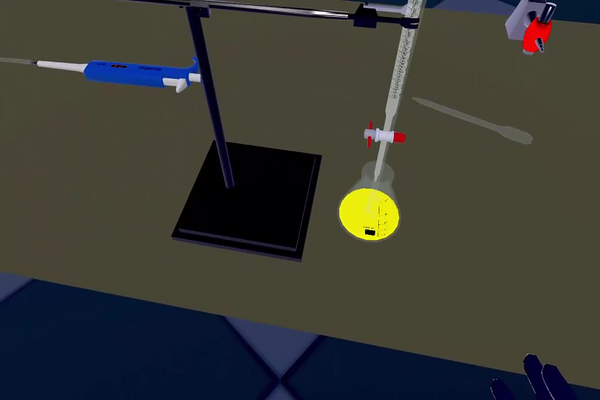
Titration is the standard way of answering a question that cannot be answered by looking: how much of a dissolved substance is present. A solution of known concentration is added to a measured volume of the unknown, in small controlled amounts, until exactly enough has been added to consume it. The volume needed is read off a burette, and because the balanced equation fixes the ratio in which the two substances react, that volume gives the unknown concentration directly. Water treatment plants, dairies, wineries, swimming-pool operators and clinical laboratories all run titrations daily, and the technique remains the reference method against which faster instrumental analyses are calibrated.
The chemistry underneath is neutralization. Hydrochloric acid and sodium hydroxide react one mole to one mole, HCl(aq) + NaOH(aq) → NaCl(aq) + H2O(l), so at the moment the acid is exactly consumed the amount of base added equals the amount of acid that was there. That moment is the equivalence point, and because sodium chloride is the salt of a strong acid and a strong base, neither of its ions reacts with water and the solution at equivalence is exactly neutral, pH 7.00. The problem is seeing it. An indicator is added — here bromothymol blue, which is yellow below pH 6.0 and blue above pH 7.6 — so that the solution changes colour as the equivalence point is crossed.
In this laboratory you will clamp a 50 mL burette to a stand, fill it with 2.0 mol/L sodium hydroxide with the meniscus set to zero and no bubble in the stopcock, pipette 10 mL of hydrochloric acid of unknown concentration into an Erlenmeyer flask, and add three drops of bromothymol blue. You will then release the base one drop at a time, mixing after each, until the yellow solution turns. Counting the drops gives the volume of base delivered, and from that volume the concentration of the acid follows in two lines of arithmetic. This is the first true titration in the collection: laboratory 047, despite its title, is a colorimetric pH determination with no burette and no equivalence point.
Educational Goals
The principle of volumetric analysis
- State what a titration measures and why a volume can stand in for an amount of substance.
- Distinguish the equivalence point, which is fixed by the chemistry, from the endpoint, which is what the indicator shows.
Stoichiometry of neutralization
- Write and balance HCl + NaOH → NaCl + H2O and recognise the 1:1 mole ratio it imposes.
- Apply CaVa = CbVb to obtain an unknown concentration, and explain why the relation holds only for a 1:1 reaction.
- Appreciate that neutrality means equal amounts of H3O+ and OH−, not equal volumes of the two solutions.
Choosing and reading an indicator
- Justify bromothymol blue for a strong acid titrated with a strong base, given that its transition interval of pH 6.0 to 7.6 straddles the equivalence pH of 7.00.
- Recognise the first persistent green as the endpoint, and a settled blue or turquoise as evidence that the endpoint was passed.
Volumetric glassware technique
- Set up a burette: clamp it vertically, expel the air bubble from the stopcock, and bring the meniscus to zero, reading a burette scale that runs downwards.
- Deliver a defined aliquot with a volumetric pipette and mix the flask after every addition.
- Approach the endpoint one drop at a time, and know why the last drop is the one that matters.
Data handling and precision
- Convert a drop count into a volume and then into an amount of substance, keeping track of units at every step.
- Quote the result to a number of significant figures the measurement can actually support.
- Explain why replicate trials are averaged.
Safety with concentrated corrosives
- Handle 2 mol/L sodium hydroxide, which is more damaging to the eye than the acid it neutralises, with the correct protective equipment.
- Dispose of neutralised waste in the recovery tray and rinse glassware with distilled water.
Protocol
We want to determine the concentration of a hydrochloric acid solution (HCl).
Setup
- Attach a universal clamp to the stand.
- Attach the 50 mL volumetric burette to the clamp.
- Measure 10 mL of hydrochloric acid solution of unknown concentration using the pipette.
- Empty the pipette containing hydrochloric acid into the Erlenmeyer flask.
- Add 3 drops of bromothymol blue into the Erlenmeyer flask, using the dropper.
- Mix the solution using the glass rod. Note the color and estimate the pH using the colorimetric scale.
- Rinse the glass rod with distilled water.
- Fill the burette halfway with neutralizing solution NaOH 2M.
- Place a 50 mL beaker under the burette stopcock.
- Caution, there must be no bubbles in the stopcock. To remove them, let a little NaOH 2M flow from the burette into the 50 mL beaker by touching the small red valve of the stopcock.
- Empty the 50 mL beaker into the recovery tray and put it back under the burette.
- Complete filling the burette with the neutralizing solution NaOH 2M until the meniscus of the volumetric burette is at zero. Caution, the burette is graduated in the opposite direction to that of a graduated cylinder.
- Replace the 50 mL beaker placed under the volumetric burette with the 100 mL Erlenmeyer flask containing hydrochloric acid.
Titration of the solution
- Let 1 drop (about 0.05 mL) of neutralizing solution (NaOH 2M) flow by touching the small red valve of the burette stopcock (the valve opens briefly and closes automatically after the drop has flowed).
- After each drop, mix the solution using the glass rod.
- Repeat steps 1 and 2 until the color of the solution changes from yellow to the first persistent green, which corresponds to a neutral pH (7) for bromothymol blue. A distinctly blue or turquoise solution means the endpoint has been passed.
- When the solution has reached a neutral pH, rinse the glass rod with distilled water.
- The volume of neutralizing solution (NaOH 2M) added is recorded in the results table.
- It is recommended to repeat the experiment 2 times to average the results obtained.
- Calculate the amount of NaOH 2M that was needed to neutralize an equal amount of HCl. The amount obtained, calculated for 1 L of solution, will be the molarity of the HCl solution.
Note: 1 drop = 0.05 mL, NaOH 2 moles/1000 mL = NaOH 0.0001 mole / 0.05 mL, and 1 mole of NaOH neutralizes 1 mole of HCl. The number of moles of NaOH used to neutralize 10 mL of hydrochloric acid will indicate the number of moles of HCl found in 10 mL of solution. To extrapolate the molarity of the HCl solution, you must multiply by 100 (therefore 10 mL * 100 = 1000 mL).
Anticipated Outcomes
The reaction and what the endpoint means. The titration reaction is HCl(aq) + NaOH(aq) → NaCl(aq) + H2O(l), or in ionic terms simply H3O+ + OH− → 2 H2O, since sodium and chloride are spectators throughout. The ratio is one to one, so at equivalence n(NaOH added) = n(HCl present). Sodium chloride does not hydrolyse — chloride is the conjugate base of a strong acid and sodium is not acidic — so the solution at equivalence is exactly neutral and the equivalence pH is 7.00. That is unusual and convenient: for a weak acid it would be above 7, and bromothymol blue would then be the wrong indicator.
The measurement. The drop is the unit of volume in this laboratory. One drop is 0.05 mL, so each drop of 2.0 mol/L sodium hydroxide delivers
n = C × V = 2.0 mol/L × 0.05 × 10⁻³ L = 1.0 × 10⁻⁴ mol of NaOH per drop
The endpoint is reached after 15 drops. That is 15 × 0.05 = 0.75 mL, carrying 15 × 1.0 × 10−4 = 1.5 × 10⁻³ mol of base, which by the 1:1 ratio must have neutralised 1.5 × 10⁻³ mol of acid. The acid occupied 10.00 mL, so
C(HCl) = n / V = 1.5 × 10⁻³ mol / 0.0100 L = 0.15 mol/L
The same answer follows in one line from CaVa = CbVb: Ca = (2.0 mol/L × 0.75 mL) / 10.0 mL = 0.15 mol/L. The protocol’s route — multiply the amount found in 10 mL by 100 to reach one litre — is the same arithmetic written differently.
| Quantity | Value | Where it comes from |
|---|---|---|
| Volume of acid taken | 10.00 mL | volumetric pipette |
| Titrant | NaOH 2.0 mol/L | bench reagent |
| Volume of one drop | 0.05 mL | stated in the protocol |
| Amount of base per drop | 1.0 × 10⁻⁴ mol | 2.0 × 0.05 / 1000 |
| Drops to the endpoint | 15 | observed |
| Volume of base delivered | 0.75 mL | 15 × 0.05 |
| Amount of base delivered | 1.5 × 10⁻³ mol | 15 × 1.0 × 10−4 |
| Amount of acid neutralised | 1.5 × 10⁻³ mol | 1:1 mole ratio |
| Concentration of the acid | 0.15 mol/L | 1.5 × 10⁻³ / 0.0100 |
| pH of that acid | 0.82 | −log(0.15) |
| pH of the 2.0 mol/L titrant | ≈ 14.3 | 14 + log(2.0) |
What the flask does, drop by drop. The colour of the solution is governed by its pH, and the pH is governed by whichever of the two reagents is in excess. Before the endpoint there is leftover acid; after it there is leftover base; the crossing is abrupt because a strong acid and a strong base leave nothing to buffer the solution. The table below works out the whole approach, using excess amount divided by total volume at each stage.
| Drops | NaOH added (mol) | Excess | Total volume (mL) | Concentration (mol/L) | pH | Colour |
|---|---|---|---|---|---|---|
| 0 | 0 | 1.5 × 10⁻³ H3O+ | 10.00 | 0.150 | 0.82 | yellow |
| 10 | 1.0 × 10⁻³ | 5.0 × 10⁻⁴ H3O+ | 10.50 | 0.0476 | 1.32 | yellow |
| 14 | 1.4 × 10⁻³ | 1.0 × 10⁻⁴ H3O+ | 10.70 | 9.35 × 10⁻³ | 2.03 | yellow |
| 15 | 1.5 × 10⁻³ | none | 10.75 | 1.0 × 10⁻⁷ | 7.00 | cyan |
Reading the burette. A burette is graduated downwards, with zero at the top, because the quantity of interest is what has left it rather than what remains. The titre is therefore the final reading minus the initial reading, and setting the meniscus to zero before starting is a convenience rather than a requirement. The bubble in the stopcock matters for the same reason: a bubble expelled during the titration is counted as delivered volume when it never reached the flask, and it biases the titre high and the calculated concentration with it.
Why bromothymol blue and not another indicator. An indicator is itself a weak acid whose two forms differ in colour, and it changes over roughly two pH units centred on its pKIn. Bromothymol blue has pKIn ≈ 7.1, which is why its band brackets neutrality; laboratory 049 works through the arithmetic behind that two-unit width. For this particular titration the choice is generous rather than critical: because the pH sweeps from about 4 to about 10 within a fraction of a drop in a normally designed strong–strong titration, methyl red or phenolphthalein would give the same titre. The choice becomes critical as soon as the acid is weak. Titrating ethanoic acid, the subject of laboratory 048, leaves ethanoate in solution at equivalence, the pH there is about 8.7, and bromothymol blue would signal the endpoint early while phenolphthalein would be right.
Where this sits among the other pH laboratories. Laboratory 046 establishes what pH is and how it is measured. 048 separates concentration from strength by comparing ethanoic acid with hydrochloric acid at the same concentration. 049 covers indicator equilibria and the width of a transition band. 050 shows that for a strong acid the pH is simply the logarithm of the dilution factor. This laboratory is where those ideas become an analytical method: for the first time the pH is not the answer but the signal, and the answer is a concentration read off a burette.
Summary of Assignment by Grade Range
Grade 9–10
Focus. Observation, vocabulary and careful procedure. The calculation is supplied and the student fills in the numbers.
- Set up the apparatus correctly: burette vertical and clamped, no bubble in the stopcock, meniscus at zero.
- Count the drops to the colour change and convert the count to a volume using 1 drop = 0.05 mL.
- Describe the colour sequence and name the indicator; state what yellow, green and blue each mean.
- Complete a supplied calculation to reach 0.15 mol/L.
- Vocabulary to be used correctly by the end: titration, titrant, burette, aliquot, indicator, endpoint, neutralization.
Grade 11
Focus. The full calculation unaided, and the meaning of the equivalence point.
- Derive the concentration from first principles: amount per drop, amount delivered, amount of acid, concentration — without being given the route.
- Obtain the same answer a second way using CaVa = CbVb, and say why that shortcut is valid only for a 1:1 reaction.
- Calculate the pH of the acid before titration and confirm 0.82, and the pH of the titrant and confirm 14.3.
- Explain why the equivalence pH is exactly 7.00 for this pair of reagents, and justify bromothymol blue on that basis.
- Calculate the pH after 14 and after 16 drops and explain why the transition is so abrupt.
- Round the answer to the precision that one drop represents.
Grade 12 / College Level
Focus. Method design, error analysis and the limits of the technique. Students are expected to criticise the procedure rather than execute it.
- Construct the full titration curve, pH against volume of titrant, and identify the inflection; compare its steepness with the width of the indicator band.
- Show quantitatively that a 2.0 mol/L titrant limits the result to two significant figures, and calculate the improvement that a 0.10 mol/L titrant would give.
- Redesign the titration to reach an endpoint between 20 and 40 mL, and specify the titrant concentration and aliquot volume that achieve it.
- Predict how the curve and the equivalence pH would change if the analyte were ethanoic acid rather than hydrochloric acid, and select the appropriate indicator for that case.
- Discuss the difference between the equivalence point and the endpoint as a source of systematic rather than random error, and estimate its size here.
- Relate the method to its industrial and clinical uses — alkalinity of treated water, titratable acidity in wine and milk, gastric acid analysis — and say what makes titration a reference method for calibrating faster instrumental techniques.
Laboratory essentials
Instruments
- Burette (50 mL) with stopcock
- Universal clamp and stand
- Volumetric pipette (10 mL)
- Erlenmeyer flask (100 mL)
- Beaker (50 mL), used to purge the stopcock
- Dropper
- Glass rod
- pH colour scale (bench chart)
- Recovery tray
Products
- Hydrochloric acid HCl, concentration unknown (10 mL aliquot; found to be 0.15 mol/L)
- Sodium hydroxide NaOH 2.0 mol/L (titrant)
- Bromothymol blue indicator (3 drops)
- Distilled water (rinsing)