

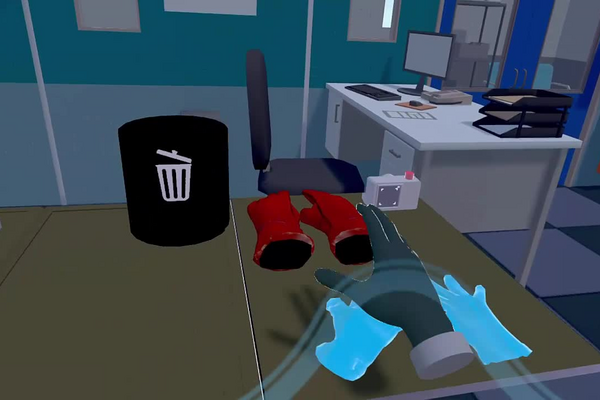
Laboratory safety is the set of practices that makes experimental work possible at all. In a research, industrial or teaching laboratory, every procedure is preceded by an assessment of what could go wrong, and by the choice of equipment and behaviour that keeps a foreseeable incident from becoming an injury. A school laboratory contains open flames, hot surfaces, mains-powered instruments, corrosive and flammable substances and fragile glassware, and each of those hazards is managed by a specific combination of three things: protective equipment worn on the body, a procedure followed in a fixed order, and an emergency device whose location is known before it is needed.
Two of those hazards are made explicit here, and they behave very differently. A Bunsen burner flame releases the chemical energy of a hydrocarbon at a temperature near 1500 °C and announces itself: it is luminous, it is noisy and it is unambiguous. A hot plate at 100 °C is fully capable of causing a burn and announces nothing at all, because a surface does not begin to glow in the visible range until roughly 500 °C. The energy still leaves the plate — as a rising column of hot air and as infrared radiation whose peak wavelength lies far outside the range the eye can detect — so the hazard has to be inferred from the instrument’s own readout and from the procedure rather than seen. Learning to treat an unmarked surface as dangerous is the single most transferable habit in this activity.
In this laboratory you will put on the protective equipment appropriate to the task, use a laser pointer to locate and name the emergency equipment of the room, and then observe the two heat sources in turn: the flame of a Bunsen burner, and the surface of a hot plate brought to 100 °C and then turned back down. No measurement is collected and no substance is consumed. The product of the exercise is a set of behaviours, a vocabulary and a mental map of the room, all of which every later laboratory assumes the student already has.
Educational Goals
By the end of this laboratory, students will be able to:
Selection and use of personal protective equipment
- Locate and put on the lab coat, the safety goggles and the nitrile gloves required for a given task.
- Explain what each item protects against, and why nitrile gloves must be exchanged for thermal protective gloves before a heat source is approached.
Location and purpose of emergency equipment
- Locate the first aid kit, the fire extinguisher, the emergency shower, the eyewash station, the fire alarm, and the smoke and carbon monoxide detector.
- State, for each device, the situation that would call for it and the situation that would not.
Safe handling of heat sources
- Light and extinguish a Bunsen burner, and set, read and lower the temperature of a hot plate.
- Approach a heat source with the hands protected, briefly, and from the side rather than through the rising plume of hot air.
Recognition of a hazard that gives no visual signal
- Explain why a surface at 100 °C looks exactly like a surface at 20 °C, and why the plate stays dangerous for more than a minute after the setpoint has been lowered.
- Use an instrument readout, rather than appearance, as the evidence that a surface is safe to touch.
Laboratory rules and personal conduct
- Apply the general rules of the room: hair tied back, jewellery removed, closed shoes, benches and aisles clear, hands washed on entering and leaving, nothing eaten, drunk, tasted or smelled.
- Report any breakage, spill or injury immediately, and leave the equipment and the workspace clean.
Transfer to other laboratory settings
- Apply the same risk-assessment reflex in a laboratory of a different discipline, where the specific hazards differ but the method of managing them does not.
Protocol
Wear the protective equipment appropriate to the task
- Locate and put on the lab coat.
- Locate and put on the safety goggles.
- Locate and put on the nitrile gloves.
Using the laser pointer, point to the location of the following safety equipment
- Locate the first aid kit.
- Locate the fire extinguisher.
- Locate the emergency shower and the eyewash station.
- Locate the fire alarm.
- Locate the smoke and carbon monoxide detector.
Effect of a heat source: Bunsen burner
- Remove the nitrile gloves.
- Locate and put on the thermal protective gloves.
- Light the Bunsen burner using the red button at the base of the tube.
- Quickly pass one hand above the flame (make sure to wear the thermal gloves!).
- Turn off the burner.
Effect of a heat Source: Hot plate
- Set the hot plate temperature to 100°C. Wait until the temperature is reached.
- Quickly pass one hand above the hot plate (make sure to wear the thermal gloves!).
- Lower the hot plate temperature to 15°C.
Additional information
- It is also important to tie back your hair, remove your jewelry (rings, bracelets, etc.) and wear closed toe shoes.
- Clear the lab benches and aisles of any obstruction (a backpack, for example).
- Wash your hands when entering and leaving the laboratory.
- Read and follow the labeling of the products used.
- Ask for clarification if you are uncertain about a procedure to perform or a product to use.
- Do not eat, drink or chew gum in the laboratory.
- Behave calmly, handle equipment carefully and pay attention to your work.
- Avoid handling a flammable product next to a hot spot.
- Perform only the procedures prescribed by the teacher, the teacher, the technician or the laboratory technician.
- Do not taste or smell any substance.
- Do not pour toxic chemical or biological products into the sinks.
- Never take equipment or substances out of the laboratory.
- Immediately report any breakage, spill or injury to the person responsible for the laboratory.
- Clean the equipment and the workspace after the experiments.
Anticipated Outcomes
This laboratory produces no measurement to be marked. What it produces is a set of correct actions, and the expected outcome is that every one of them is performed without prompting: the three items of protective equipment are put on before anything else is touched, the six emergency devices are found and named, the nitrile gloves are exchanged for thermal gloves before either heat source is approached, and the burner is turned off and the plate turned down before the session ends. A student who reaches the end of the protocol having skipped the glove exchange has not completed the laboratory, even though the simulation will let them continue.
Protective equipment, and why each item is specified. The lab coat covers the forearms and the clothing beneath it and is the item removed and left behind when leaving the room, so that anything spilled on it is not carried out. Safety goggles seal against the face and protect from a splash arriving from the side or from above; safety glasses do not, which is why the protocol names goggles. Nitrile gloves are a chemical-splash barrier roughly 0.1 mm thick and offer effectively no thermal protection — which is precisely why the protocol has the student take them off before the heat sources. Treating the glove layer as one-dimensional steady conduction, the heat flux reaching the skin through a glove in contact with a surface is q = k ΔT / d. For nitrile (k ≈ 0.2 W/m·K, d = 0.1 mm) against a 100 °C plate with skin at 33 °C, q = 0.2 × 67 / 1.0 × 10⁻⁴ ≈ 1.3 × 10⁵ W/m2; for a thermal glove (k ≈ 0.04 W/m·K, d = 3 mm), q = 0.04 × 67 / 3.0 × 10⁻³ ≈ 9 × 10² W/m2. The thermal glove reduces the flux by a factor of about 150, and does so by combining a lower conductivity with thirty times the thickness.
| Emergency device | What it is for | What it is not for |
|---|---|---|
| First aid kit | Minor cuts and small burns, after the hazard has been removed | Any injury that has been reported but not yet seen by the person responsible |
| Fire extinguisher | A small, contained fire on a bench, used by a trained person from the doorway side | A fire on a person, or a fire already spreading — sound the alarm and evacuate |
| Emergency shower | Chemical spilled over the body or clothing, and clothing on fire | Splashes to the eyes alone |
| Eyewash station | Any substance in the eye, flushed for a sustained period with the eyelids held open | A brief rinse, which is the most common error |
| Fire alarm | Alerting the building and triggering evacuation | A spill or an injury with no fire |
| Smoke and carbon monoxide detector | Detecting combustion products, including a gas that has no colour, smell or taste | Detecting a chemical vapour or a leak of unburned gas |
Why the flame is obvious and the plate is not. A hot body radiates over a continuous spectrum whose peak wavelength is fixed by its temperature alone, through Wien’s displacement law, λmax = 2898 µm·K / T. At the 373 K of a plate held at 100 °C this gives λmax = 2898 / 373 = 7.8 µm, roughly fourteen times the longest wavelength the eye responds to; no part of the emission falls in the visible band in any detectable quantity. Visible incandescence does not begin until about 800 K (525 °C, the Draper point), and a Bunsen flame at 1773 K is far above it. The total emission grows as the fourth power of temperature, so the net flux leaving a surface at temperature T into a room at T0 = 298 K is q = σ(T4 − T04) with σ = 5.67 × 10⁻⁸ W/m2·K4. For the plate at 100 °C, q = 5.67 × 10−8 × (1.94 × 1010 − 7.89 × 10⁹) = 6.5 × 10² W/m2 — about two thirds of the solar flux reaching the ground at noon, from a surface that looks like any other. This is the quantitative answer to the question the laboratory is built around: the plate is not less dangerous than the flame, it is only less visible.
| Source | Temperature | λmax (Wien) | Net radiant flux into a 25 °C room | Visible? |
|---|---|---|---|---|
| Hot plate, lowered setpoint | 60 °C (333 K) | 8.7 µm | 2.5 × 10² W/m2 | No |
| Hot plate, protocol setpoint | 100 °C (373 K) | 7.8 µm | 6.5 × 10² W/m2 | No |
| Onset of incandescence (Draper point) | 525 °C (798 K) | 3.6 µm | 2.3 × 10⁴ W/m2 | Faint red |
| Bunsen burner flame | ≈ 1500 °C (1773 K) | 1.6 µm | 5.6 × 10⁵ W/m2 | Yes |
What counts as a dangerous temperature. Skin damage depends on temperature and duration together, not on temperature alone, and the dependence is steep: every additional few degrees cuts the tolerable exposure by roughly a factor of three. The classic scald data (Moritz and Henriques) give the times below for a full-thickness burn from contact with hot water. They explain why 60 °C is treated as a hazardous surface temperature in laboratory guidance, and why the plate must be treated as dangerous long after it has stopped being at its setpoint.
| Contact temperature | Approximate exposure for a full-thickness burn |
|---|---|
| 48 °C | 5 minutes |
| 51 °C | 2 minutes |
| 55 °C | 17 seconds |
| 60 °C | 5 seconds |
| 65 °C | 2 seconds |
| 70 °C | under 1 second |
What the hot plate readout does, and what it tells the student. The plate carries two displays, T° plate (the current surface temperature) and T° target (the setpoint dialled in). The plate rises from 56 °C to 95 °C in roughly twenty seconds and then crept the last few degrees far more slowly, which is the signature of an exponential approach to the setpoint rather than a linear ramp: the temperature difference remaining decays with a time constant of about fifteen seconds, so the first thirty degrees take less time than the last six. Once the dial was turned back down, the reading fell from 95 °C to 79 °C in under ten seconds. The teaching point is in the last row of the table: at the moment the protocol ends, the plate is still at 79 °C, which the previous table places at well under one second of tolerable contact.
| Point in the procedure | T° plate | T° target | Phase |
|---|---|---|---|
| Shortly after the setpoint is entered | 56 °C | 101 °C | Heating |
| About 14 s later | 82 °C | 101 °C | Heating |
| About 20 s after the setpoint | 94 °C | 101 °C | Heating, slowing |
| Hand passed above the plate | 95 °C | 101 °C | Near setpoint |
| Dial being turned down | 93 °C | 62 °C | Setpoint falling |
| A few seconds after | 89 °C | Lowered | Cooling |
| End of the protocol | 79 °C | Lowered | Cooling, still hazardous |
Summary of Assignment by Grade Range
Grade 9–10
Focus. Recognising hazards and building the routine. Students learn the names of the protective equipment and the emergency devices, and the order in which things are done.
- Put on the lab coat, goggles and nitrile gloves, then list what each one protects against.
- Point out the six emergency devices and say, in one sentence each, when they would be used.
- Observe both heat sources and state which one gives a warning and which one does not.
- Rewrite the general laboratory rules as a short checklist in their own words, and identify which rule each of three described accidents would have prevented.
Grade 11
Focus. Quantitative treatment of the hazard, and justification of each precaution rather than recitation of it.
- Record the T° plate readings during heating and cooling, plot them against time and describe the shape of each curve.
- Use the burn-threshold table to state how long after the final protocol step the plate remains capable of causing an injury, given the cooling behaviour they recorded.
- Calculate λmax from Wien’s law for the plate and for the flame, and explain in terms of the result why only one of them is visible.
- Explain why nitrile gloves are removed rather than kept on, using the conduction estimate q = k ΔT / d.
Grade 12 / College Level
Focus. Safety as risk management: derivation and quantitative analysis.
- Compute the net radiant flux σ(T4 − T04) for both heat sources, compare it with an estimate of the convective flux above the plate, and state which mechanism dominates for a hand held 5 cm above it.
- Fit the recorded cooling data to Newton’s law of cooling, extract a time constant, and compare it with the heating time constant; account for the difference in physical terms.
- Carry out a written risk assessment of the procedure: identify each hazard, the control applied to it, and the residual risk that remains after the control.
- Identify at least two points at which the simulation abbreviates reality in a way that could produce a false sense of safety, and propose how a teacher should compensate.
Laboratory essentials
Instruments
- Lab coat
- Safety goggles
- Nitrile gloves
- Thermal protective gloves
- Laser pointer
- Bunsen burner (lit with the red button at the base of the tube)
- Hot plate with a temperature dial and a T° plate / T° target readout
- Emergency equipment of the room, located but not handled: first aid kit, fire extinguisher, emergency shower, eyewash station, fire alarm, smoke and carbon monoxide detector
Products
- None. No chemical or biological product is used or consumed in this laboratory; the only consumable is the gas burned by the Bunsen burner.